Brands that desire distinctive online experiences need design flexibility now more than ever. Across the web, WordPress controls nearly 43% of all websites globally. Nevertheless, the use of conventional WordPress themes and addons tends to reduce creativity.
Being a headless solution, Strapi CMS opens the front-end freedom and scalability that WordPress setups cannot compete with. As 73% of businesses switch to the headless CMS architecture (14% more compared to 2021), it is evident that the move towards flexible content management is underway. Developers and designers who offer creative control are selecting headless solutions.
A common objection that needs to be resolved before going into the benefits is to ensure that your CMS is capable of supporting your developing business requirements. Wonder how Strapi changes the definition of design flexibility in WordPress-based websites? Let us see.
Understanding the WordPress Design Ecosystem

The Pros of WordPress for Designers
WordPress is uniquely endowed with a number of features that have made it the favorite of millions of websites. The platform offers thousands of themes that allow you to launch fast. It is a large community, so you are likely to find solutions to nearly every problem. Elementor and Divi, drag-and-drop web builders, provide an opportunity to create websites without knowledge of code.
The market share of WordPress among websites based on content management systems is 60.4% which is a sign that it is reliable and popular. On the platform, it is extremely easy to create and publish content. Minimal technical talent is needed for placing pictures, charts, or additional layout pieces.
WordPress has tens of thousands of themes and many ways to customize your site through the use of over 65,000 plugins. This extensive ecosystem implies that you will be able to locate tools to support nearly all the functionality that you require. WordPress is also very good in SEO, and with proper configuration, your content can rank well in search engines.
The Limitations of WordPress Design Flexibility
Although it is a popular platform, WordPress has significant limitations that influence the flexibility of designs. The vast majority of WordPress theme detectors restrain you with pre-defined layouts and designs. Although you are able to tweak colors and fonts, structural modifications may need serious technical expertise or contracting a developer.
Another complexity can be observed in plugin dependency. The excessive use of plugins may make your site much slower. The code of each of the plugins has to be processed by your server, which affects the loading time and the experience of the user.
Many WordPress sites will suffer performance problems because of bloated front-ends. The platform is an amalgamation of presentation and data layers, which may cause heavy and slow pages. The mean loading time of a WordPress site is 2.5 seconds on a desktop and 13.25 seconds on a mobile device. This lag may be damaging to user interactions and search engine ranking.
In the case of traditional WordPress, it is hard to come up with unique, API-driven layouts or multi-channel experiences. The platform was built specifically to serve websites, but not to drive mobile applications and kiosks, among other digital touchpoints, at the same time. Besides this, WordPress has many complicated features as well. It may not be easy to comprehend, and it is only natural that a newcomer gets confused.
Every 22 minutes, a WordPress site is attacked, and 13,000 WordPress sites are hacked each day. Most of these security attacks are due to old plugins and themes. Beyond the free platform, customization may also prove to be an expensive affair. Premium themes, additional plugins, and developer services are quick to add up when you require higher functionality.
What Makes Strapi CMS Different?
A Quick Overview of Strapi
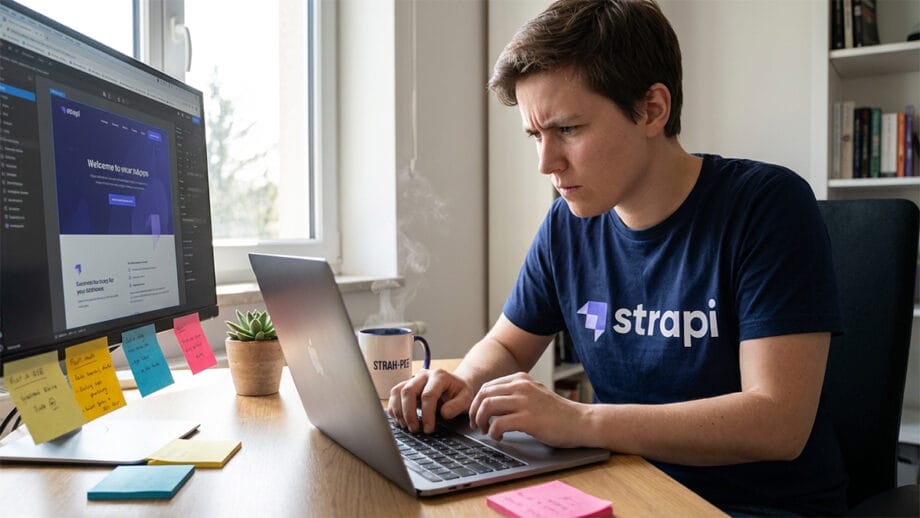
Strapi is a new type of content management system, constructed on TypeScript and Node.js. In contrast to traditional platforms, which package content management with presentation, Strapi is API-first, which completely decouples content and design.
Strapi is in use in approximately 795 live websites, and this figure keeps increasing as more developers begin to see its benefits. Currently, Strapi is used by more than 2,589 companies around the globe as an API-first CMS tool.
In what way can this platform achieve adaptability while being productive? Its secret lies within its interface-driven approach. Following that design, building a Strapi corporate site will prove simple.
Strapi works by organizing the content via APIs and is very flexible across digital platforms. This API solution will enable you to control and release content across various outlets easily, such as a website, mobile app, or any other digital interface.
The platform also has an API over REST and GraphQL to ensure smooth integration on the front end, allowing developers to adopt the most appropriate API format to suit their project needs. Strapi automatically generates RESTful APIs when you define any content type, and it will also generate GraphQL APIs when the GraphQL plug is installed.
Strapi as a Design Enabler
Strapi allows designers and developers to use their favorite front-end framework. Want to build with React? Go ahead. Prefer Vue or Next.js? No problem. Angular? That works too. This also gives the teams the freedom to choose the most appropriate tools to fit their project requirements as opposed to being limited by what the CMS can support.
The infrastructure makes it possible to use sectional blueprint frameworks, plus repeatable user interface elements. You are able to build component libraries that are consistent throughout your digital ecosystem. This modularity ensures that updates, as well as redesigns, occur much more quickly since any alterations in a component could be reflected in all its uses.
Strapi is also NodeJS-based, which is compatible with the most frequently used front-end frameworks such as React, Vue, and Angular. It is compatible with other existing NodeJS services and microservices. Strapi is interrelated with third-party tools and APIs with an easy-to-connect architecture. This compatibility allows a headless CMS with Strapi to develop more smoothly and serves to build connected applications.
How Strapi Enhances Design Flexibility in WordPress Sites?
Freedom from Themes and Page Builders
WordPress themes, in the traditional way, limit your design options. Each theme has its structure, layout patterns, and restrictions. You are also still working within a set of boundaries, even with page builders.
Strapi is capable of creating custom interfaces without thematic limits. No need to wrestle with a theme and its inbuilt CSS or attempt to override default styles. Add the structured content of Strapi with a lightweight front-end platform and have a hundred percent control over each pixel.
The design team can design and test ideas at a faster rate with this approach. Developers can implement cutting-edge visual fashions, unique motion graphics, and bespoke engagement without concerns of theme compatibility. Strapi can assist you in designing a website that best represents what your brand is about, and not what WordPress allows you to show.
Dynamic Content Modelling for Creative Layouts
Strapi is good at flexible content modeling. You are able to create your own content types and relationships in the exact way that you need. Require an elaborate product listing with different variants? Create it. Wish to have a top-down menu with an unlimited depth? Build it.
Dynamic sections can be easily redesigned without changing the backend. Using Strapi, the content structure is fixed, but the presentation layer can be changed. This separation results in fewer and quicker design iterations.
One such example would be to build a page builder content type that consists of dynamic zones. These areas allow the editors to combine and interchange the types of components: hero sections, an image gallery, testimonials, and so forth, in any sequence. Designers do not have to wait until backend updates are done to create new components.
Headless Architecture for Multi-Channel Experiences
A single CMS serves a variety of platforms at the same time: websites, mobile applications, digital kiosks, smartwatches, and even Internet of Things devices. The content is in one place, but is accessed by the user wherever they are.
Headless CMS allows the delivery of content across an omnichannel, where you can create a piece of content and deliver it anywhere. Whether your users are calling you online on a desktop or mobile device, using Alexa, or at a brick-and-mortar store, Strapi assists in giving your users consistent content.
Performance and SEO Advantages
The faster and lighter front-end configurations contribute to better Core Web Vitals. Google favors websites that load very fast. You can specifically optimize your front-end in case you decouple your front-end from WordPress and Strapi. JavaScript frameworks such as Next.js are made to offer server-side rendering and source site generation, which generate blazing-fast pages.
The AP-based delivery helps to reduce page loads, maintain the visually-intensive content, and does not negatively impact the performance. Your front-end will only fetch the content it needs specifically through the API, as opposed to loading a complete WordPress installation with all of your requests. Such selective loading will provide leaner and faster pages.
The majority of front-end developers choose a headless CMS to perform better. Studies suggest a typical focus span for a person is about eight seconds. In this brief period, you must capture the attention of users who come to your site. You cannot hold their attention if the site is slow or sluggish to load, since the bounce rate increases.
Teams and developers working with headless CMSs can work faster because of a single focus on the front-end user experience and the accomplishment of business goals.
Hybrid Approach: Using Strapi Alongside WordPress
Why Use Both CMS Platforms Together?
The thing is that you do not have to leave WordPress and go full Strapi to reap the benefits. The hybrid approach works well in many organizations.
Use WordPress in blogs and editorials. The user-friendly editing environment and built-in capabilities of WordPress make it ideal for content teams. In the meantime, you can use Strapi with dynamic or application-like front-ends, which need greater flexibility and performance.
As an illustration, your marketing blog can stick to WordPress since content writers are already familiar with the platform. Nonetheless, your product catalog, customer portal, or interactive tools can be deployed on the headless architecture of Strapi.
How Integration Works?
An average configuration may resemble the following: Strapi will act as the content management tool and the API layer. Legacy pages and blog materials are still supported by WordPress. Another contemporary framework, such as Next.js, serves as the front-end layer, which requests content in both systems as required.
Design teams receive a cohesive workflow where content is fed in by various sources into a regular presentation layer. Front-end changes do not need backend changes; hence, prototyping is expedited. The teams may test out new designs and features without having to disturb existing content.
Key Advantages of Integrating Strapi with WordPress

Unified Content and Design Workflows
Strapi enables teams to put centralized structured content and leave WordPress as a friendly editorial platform. This hybrid model can guarantee that design and marketing teams can work together without duplication of duty.
The content creators operate in the comfort of their used WordPress, and the developers create state-of-the-art interfaces using Strapi-driven APIs. An editor does not require knowledge of technical implementation. Developers don’t need to compromise their technical choices based on CMS limitations.
Faster Prototyping and Deployment
By decoupling the front-end, designers can iterate on layouts or update UX elements without backend dependency. Need to test a new homepage design? Just update your front-end components. Want to try a different navigation structure? Make the change without touching the CMS.
Developers can deploy new components faster using modern JavaScript frameworks. Continuous merging and nonstop delivery automation tracks grow easier once your client-side code remains separate. You can push updates multiple times per day without worrying about breaking the content management system.
Enhanced Performance and Security
A headless setup powered by Strapi reduces WordPress plugin load, leading to better speed, uptime, and security. The separation also protects content endpoints by isolating the front-end from the CMS layer.
You don’t need a database connection on every front-end request. Confidential data can be secured by employing verification tools and guaranteed communication rules. Such distance provides an added shield of defense plus a safeguard against the many thousands of unknown breaches occurring every four weeks.
Scalable Future-Ready Architecture
The integration allows support for various locations, multi-language, and every-channel distribution perfectly. As your business grows, adding new touchpoints like apps or portals becomes effortless without redesigning the core website.
Composable architecture allows you to build systems from modular components. Those pieces can be separately built, verified, and maintained. This modularity eases upkeep and improves the readability of your source scripts, making it more manageable over time.
When to Choose Strapi for WordPress Design Flexibility

If you need custom UI and unique design systems that don’t fit standard WordPress themes, Strapi provides the freedom you need. If templates and page builders limit your creativity, an API-first method eliminates these barriers.
For brands serving multiple digital platforms simultaneously, Strapi becomes essential. If you need to power a website, mobile app, and digital signage from the same content source, Strapi’s multi-channel delivery excels.
When page-builder plugins limit creativity or performance, it’s time to consider alternatives. Moving to a Strapi-powered front-end eliminates these bottlenecks. Determine whether a full migration, a hybrid approach, or strategic integration makes the most sense for your situation.
Regarding agencies managing many jobs, its decoupled framework streamlines refreshes. One may keep the identical server side at the time of refreshing your client side, enhancing maintainability. Additionally, Strapi offers complete adaptability regarding release choices, from Strapi Cloud to any foundation like Google Cloud.
Best Practices for Implementing Strapi + WordPress
Start with clear design goals and content structure. Before migrating or integrating systems, map out your content types, relationships, and design requirements.
Use component-based front-end libraries for reusable design elements like React or Vue. Develop a component library that designers and coders will consult across the entire endeavor.
Improve application programming interfaces for speed and search engine results. Format those interface messages so they contain the required information. Implement caching strategies to reduce server load.
Guarantee tight collaboration among designers and programmers. Design handoff is done with tools such as Figma, while version control systems such as Git are used to track code changes.
Future of Design Flexibility with Headless CMS
The trends in the industry are towards composable architectures and JAMstack development. Modern applications are a combination of best-of-breed services instead of a monolith that does it all. Strapi fits well in this ecosystem as the content management layer.
The open-source character of the platform implies its community-driven development. The ability to host anywhere offers clients authority regarding their architecture and expenses. 80% of businesses that lack headless architecture are planning to build it in the next two years.
By 2025, hybrid CMS will be adopted by 35% of organizations worldwide as they start to realize the advantages of integrating traditional and headless strategies.
The reason developers keep the legacy software is due to the trouble and expense involved in refreshing their programs. Businesses end up not innovating and lagging in the market. Your future-proofed application is one in which you decouple your presentation layer from the data and logic layer.
Ready to Transform Your WordPress Site with Strapi CMS?
Unleash the power of headless innovation now. Blend Strapi’s scalability with the architecture of enterprises to build high-performing, scalable, and visually stunning WordPress websites of tomorrow.
Working with a reputable Strapi website development company will provide you with strategic partners who understand both the technology and your business goals. They assist you in sailing through the transition process and getting the maximum returns on your CMS investment.
Start your transformation toward a smarter, design-first web experience. The future of web development prefers malleable, modular structures that adjust per user requirements.
Strapi website development services offer the adaptability, speed, and growth capacity that contemporary pages require. Combined with WordPress’s content management strengths, this mixed method offers maximum advantage from two systems.