Apple’s Pursuit of the Foldable Frontier
Apple is advancing towards the dawn of its inaugural foldable smartphone, with recent revelations indicating that the tech giant has been engaged in a clandestine development phase for several years.
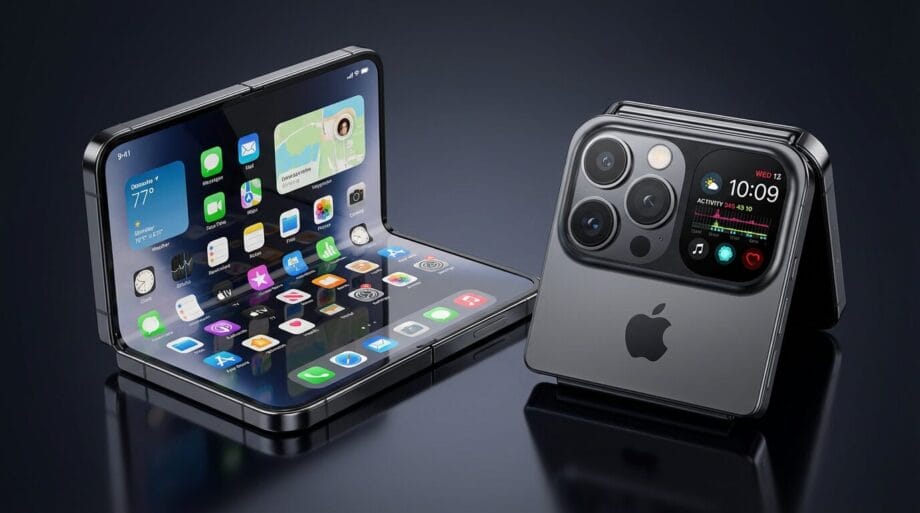
The device, currently referred to as the iPhone Ultra Fold, merges a petite external display with an expansive tablet-format screen internally. The latest disclosures emphasize a launch prioritizing resilience over mere novelty.
When closed, the phone features a 5.3-inch cover display, adept at managing notifications, calls, and quick interactions without necessitating user engagement with the primary interface.
When unfurled, the inner display expands to a substantial 7.8 inches, approximating the size of an iPad Mini. It is this expansive second screen that Apple appears to be banking on, transforming the device’s essence the instant it is opened.
Notable modifications in hardware will be immediately apparent to long-time iPhone aficionados. Touch ID makes its reappearance, now ingeniously integrated into the power button, a departure from its previous incarnation on the home button.
Meanwhile, Face ID has yielded its place in this iteration. The volume controls have relocated to the top-right edge, evoking design parallels with the iPad Mini rather than the recent iPhone models.
On the rear, Apple has maintained a dual-camera configuration—wide and ultra-wide—eschewing the elaborate arrangements found in the Pro lineup. Notably, MagSafe is omitted, as is the Action Button.
Addressing the Challenges of Foldable Technology
Foldable smartphones have consistently faced challenges related to hinges, screen creases, and the deterioration that ensues from repeated opening and closing.
Apple’s strategy focuses on a liquid metal hinge engineered to distribute tension uniformly along the fold, suggesting that this innovation could be pivotal in prolonging the device’s lifespan.
The display itself is constructed with an OLED panel encased in ultra-thin glass, with an optically clear adhesive installed between the layers to prevent a pronounced crease that might detract from visual quality.
These intricate engineering details, although subtle, are often the determinants that distinguish a premium foldable device from a flimsy one after prolonged usage.
On the software front, the device operates on a tailored version of iOS 27, optimized specifically for this form factor.
Applications have undergone redesign with new sidebars; side-by-side multitasking has been incorporated, and video playback has been adjusted to a 4:3 ratio to prevent cinematic content from being marred by black bars on the wide inner screen.
Notably, it does not support iPadOS, nor does it accommodate the more intensive professional applications found on the iPad—Apple has clearly delineated this as a smartphone, not a hybrid.
The anticipated pricing positions the device firmly in the luxury sector. The base model with 256GB of storage is projected to debut at approximately $2,300, while the 1TB variant could soar to around $2,900.
The scheduled launch is set for September 2026, coinciding with the release of the iPhone 18 Pro series. At this price point, the Fold will surpass many of Apple’s own laptops, positioning it uniquely within the company’s product lineup.
This release coincides with a pivotal leadership transition at Apple, as John Ternus ascends as the new chief executive following Tim Cook’s tenure.
The Fold will stand as one of the initial groundbreaking products influenced by Ternus’s direction. As such, its success could determine whether it appeals to a broad audience or remains a niche offering for avant-garde enthusiasts, signaling a significant shift as Apple steps into the foldable market.
For the moment, the Fold appears more as an exploratory indication of Apple’s future vision for the iPhone rather than a mass-market product.
Its exclusive pricing strategy ensures it will not appeal to everyone; however, after years of observing competitors innovate in foldable display technology, Apple is poised to unveil its distinctive version of the answer.
Source link: Inews.zoombangla.com.