Unwrapping the iPhone Experience
Opening a sealed iPhone retail box is an exercise in patience. As you peel back the seals and gingerly lift the lid, anticipation mounts.
Yet, the lid resists, its precision fit creating an almost Sisyphean struggle. While one might be tempted to force it open, most users likely adhere to Apple’s directive to recycle their empty boxes, many choosing instead to retain them as artifacts of ownership.
This meticulous unboxing ritual is no accident; it has been meticulously crafted by Apple to enhance user anticipation and impart a sense of luxury.
Although the tech giant rarely discusses its retail packaging philosophy, insights from luminaries like Steve Jobs and Jony Ive elucidate its strategic intent. In fact, various patents filed by Apple also reveal the company’s thoughtful approach to packaging design.
“When you open the box of an iPhone or iPad, we want that tactile experience to set the tone for how you perceive the product,” Steve Jobs remarked, reflecting on the marketing philosophies instilled in him by Apple’s first investor and chairman, Mike Markkula. These sentiments were chronicled in Walter Isaacson’s biography of Jobs.
As noted by RetailBrew, Jony Ive has dedicated considerable thought to packaging design. His discussions with Isaacson revealed a profound appreciation for the unboxing process.
“You design a ritual of unpacking to make the product feel special,” he stated. “Packaging can be theater; it can create a story.”
The iPhone Unboxing Experience
A person removing the protective covering from an iPhone 14 post-unboxing. – Valiantsin Suprunovich/Getty Images
Though Ive did not explicitly mention the iPhone, it is the centerpiece of Apple’s product line for the past decade.
The packaging has evolved since the inception of the original model, yet it consistently provides users with the same exhilarating experience.
In a conversation with design expert Greta Dirsel from Landor & Fitch, she articulated that the packaging’s design intentionally elicits a sense of suspense as one awaits the unveiling of the product.
“Time is the most precious commodity,” she stated. “We’re accustomed to hastily tearing into things. This design urges you to slow down; you’re about to embark on something astonishing.”
Since the debut of the original iPhone in 2007, Apple has maintained a coherent packaging ethos, though significant changes were implemented with the iPhone 12.
The packaging now boasts a minimalist design, slightly larger than the device itself, constructed from sturdy cardboard to ensure adequate protection.
Visually, it is either black or white, prominently showcasing an image of the phone on top with the product name adorning the sides and regulatory details featured on the back.
The first sight that greets you upon finally lifting the lid is the iPhone, shielded by a paper covering. Following this moment of revelation, buyers gain immediate access to their sought-after device. Beneath the iPhone lies a separate compartment designated for accessories.
The Evolution of the iPhone Retail Box
In a dialogue with Stripe in 2025, Jony Ive elaborated on his meticulous efforts to curate the iPhone unboxing experience.
He described the experience surrounding the charging cable’s packaging as possessing a spiritual essence, citing a profound connection to the user.
“When someone unwraps that box and retrieves that cable, they think, ‘Somebody cared about me,’” he articulated. By 2020, the charger and EarPods had been removed, leaving only the cable in the box.
The decision to exclude the power adapter and EarPods stemmed from Apple’s commitment to environmental sustainability, allowing the company to downscale the box size and increase shipping efficiency.
This adjustment reportedly reduced annual carbon emissions by 2 million metric tons—an equivalent of taking 450,000 vehicles off the road.
Although this practical modification expedited the unboxing process, the ceremonial experience largely remained intact, with users still compelled to wait for their prize.
Apple has continued to refine its retail box design while retaining its fundamental aesthetic. The iPhone 13 series eliminated plastic wrapping, and in 2024, the iPhone 16 packaging was crafted from 100% fiber, comprising 64% recycled content.
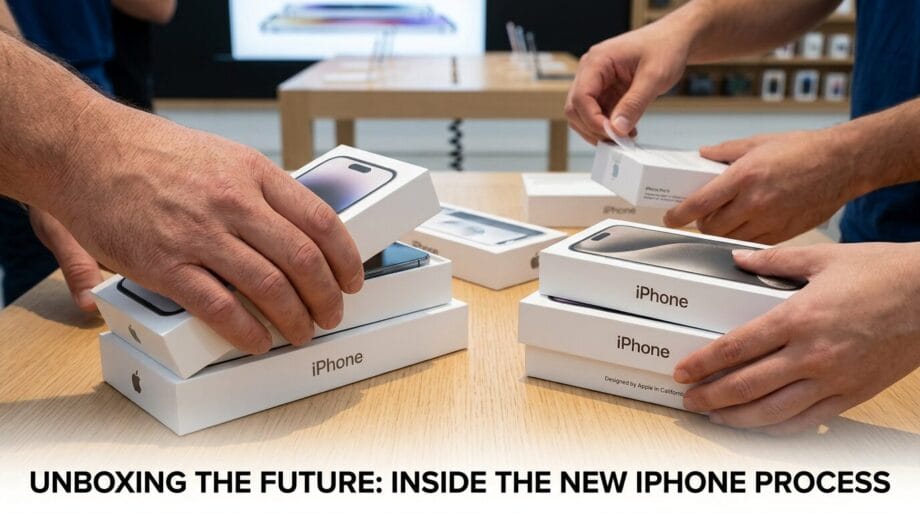
Despite these advancements, which reduced packaging volume by 8% from the iPhone 15 box, Apple has preserved the iconic unboxing ritual, characterized by its challenging lid-opening experience.
Source link: Aol.com.