Apple is poised to embark on one of its most significant product unveilings in recent history. In a mere two months, the tech giant is anticipated to reveal two remarkable devices: its inaugural foldable iPhone, rumored to bear the name iPhone Ultra, alongside the iPhone 18 Pro, the flagship model within the forthcoming iPhone 18 series.
Both devices are reportedly infused with Apple’s latest technological advancements. The foldable variant, in particular, could eclipse the $2,000 threshold, a notable milestone for the company.
This steep valuation coincides with Apple’s alerts that future products may see price escalations due to a global shortage of memory components.
The pressing question that lingers among consumers is whether these devices justify such an exorbitant price, particularly amid rising tech layoffs and an uncertain economic landscape.
The iPhone Fold Is Finally Coming
At this juncture, the debut of Apple’s first foldable iPhone appears to be a foregone conclusion. With competitors like Samsung and Huawei leading the foldable phone market since 2019, Apple is somewhat tardy to the innovation showcase.
While foldable devices currently represent a modest fraction of global smartphone sales, the industry’s dynamics could shift dramatically upon Apple’s entry.
Officially, Apple remains mute on the subject, having yet to confirm the existence of the anticipated device. Nonetheless, numerous reports indicate that the phone is ready for unveiling, likely scheduled for this September, although its retail release timeline remains ambiguous.
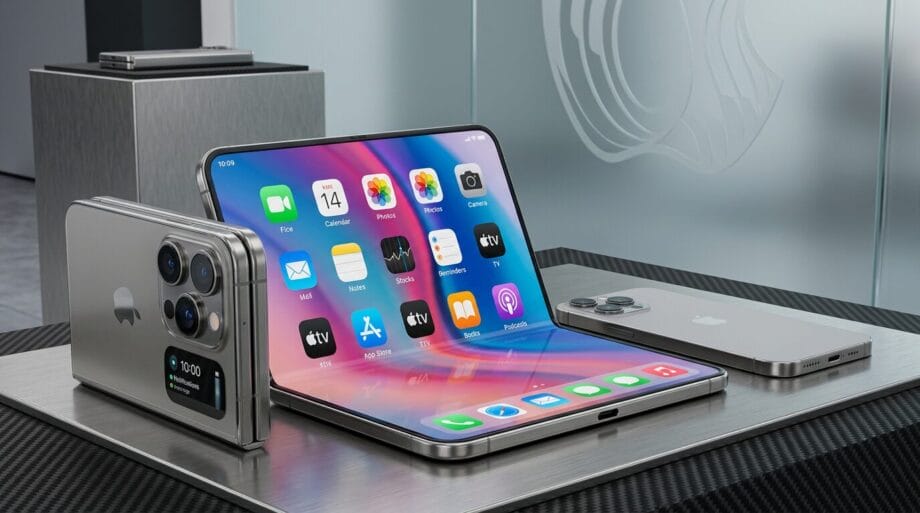
Predictions suggest the phone will adopt a book-style fold, resembling a diminutive tablet when opened. Speculation points toward a compact, wider design, drawing comparisons to the original Google Pixel Fold, rather than a slender, elongated model akin to Huawei’s Pura X.
In March, analyst Ming-Chi Kuo provided preliminary forecasts: he posits that the foldable iPhone’s exterior could sport a 5.5-inch display, while its interior could reveal a substantial 7.8-inch screen.
When folded, its thickness may range between 9mm and 9.5 mm, tapering to approximately 4.5mm to 4.8mm when fully opened.
Under the hood, anticipate the most advanced A-series chip to date, complemented by additional RAM to facilitate seamless multitasking across its dual displays.
The device is also rumored to feature two rear cameras, as well as front-facing cameras for both the inner and outer screens.
An intriguing development: Touch ID may return as a side-mounted button, as the spatial constraints might preclude the use of Face ID.
Additionally, the oft-criticized crease that typically plagues other foldable devices may be virtually imperceptible or entirely absent in this iteration.
Software Could Be the Real Game-Changer
While hardware specifications are noteworthy, the software experience might ultimately distinguish Apple’s foldable from its contemporaries.
Many Android foldables still resemble traditional smartphones elongated across dual screens, lacking innovative approaches to app utilization in this expanded format. Apple seems poised to address these shortcomings thoughtfully.
We may have caught a glimpse of these developments during WWDC 2026. In his keynote address, Apple’s software chief Craig Federighi introduced a new Device Hub feature, allowing users to resize applications dynamically and experiment with various screen configurations.
This suggests that Apple is meticulously preparing its development tools for more than a mere flat-screen interface.
Apple’s showcase of widgets—such as those for Music, News, and Weather—that can expand into full-page layouts illustrates the potential for enriched user experiences.
While such features may appear inconsequential on standard iPhones, they gain considerable relevance on a foldable device with ample screen real estate.
The Price Tag Will Stun
None of these advancements comes inexpensively. According to analyst Ming-Chi Kuo, the pricing for Apple’s foldable could range from $2,000 to $2,500, thus establishing it as the costliest iPhone to date.
What about the iPhone 18 Pro?
While the foldable phone garners much of the attention, the iPhone 18 Pro and Pro Max will also undergo a series of enhancements. However, major design alterations are not expected.
The dimensions, overall aesthetic, and triple-camera configuration are anticipated to remain largely intact from previous models. Nonetheless, several noteworthy upgrades are reportedly forthcoming.
The display is set to implement new LTPO+ technology, which should enhance both battery life and operational efficiency. Internally, a new A20 chip is likely to facilitate improved speed and power management.
The Dynamic Island may experience a reduction in size, while Apple might introduce its inaugural variable aperture camera, a feature that mechanically adjusts the lens opening to modulate light intake.
Rumored color selections are said to encompass light blue, dark cherry, dark gray, and silver. Furthermore, the construct is expected to maintain the aluminum frame and frosted Ceramic Shield back panel debuted with the iPhone 17 Pro.
Why Everything Apple Sells Might Cost More
This issue has broader implications for consumers beyond just prospective foldable buyers. The global memory shortage is projected to persist for at least another year, prompting various smartphone manufacturers to implement price increases—that trend appears to be influencing Apple as well.
CEO Tim Cook affirmed this sentiment in a recent interview with the Wall Street Journal, indicating that price hikes on select products will materialize due to the ongoing memory crisis.
While he refrained from delineating a precise timeline or identifying which models would be most affected, indications suggest that Apple is likely to target its premium offerings first, as Pro-series customers are typically more amenable to higher price points.
Market analysts predict that the current $999 iPhone Pro could see an increase of approximately $100, with the $1,199 iPhone Pro Max poised for a similar adjustment.
What to Watch For Next
As the launch window approaches, anticipate a surge of leaks and insights as September draws nearer. Pricing, precise release dates, and comprehensive specifications for both the iPhone Fold and iPhone 18 Pro are expected to crystallize in the forthcoming weeks, especially following Apple’s dispatch of invitations for its autumn event.
Source link: Bizzbuzz.news.


