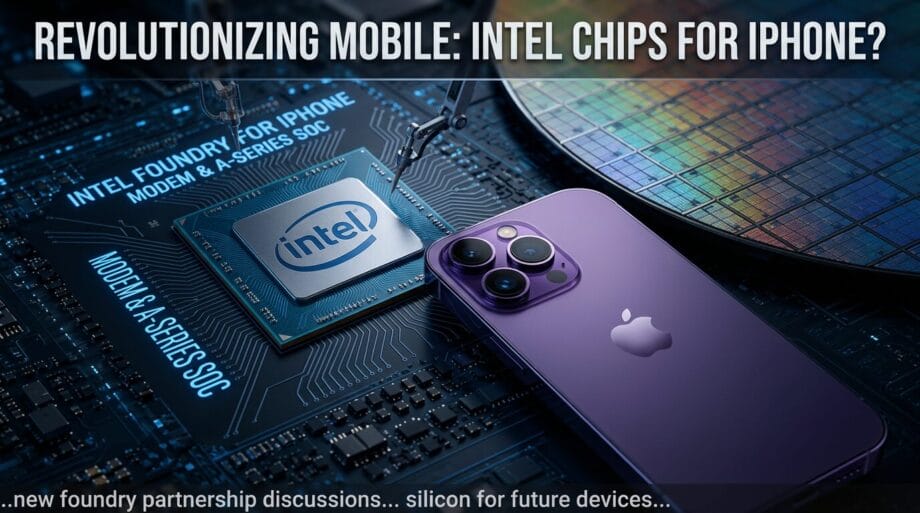
Apple has officially embarked on the production of low-end and legacy processors for its iPhones, iPads, and Mac computers at Intel’s foundries, according to a recent report by esteemed analyst Ming-Chi Kuo.
Historically, the tech giant has depended on TSMC for the fabrication of its custom silicon. However, a report from The Wall Street Journal last week disclosed that Apple has entered into a preliminary agreement with Intel for the manufacturing of select chips that power its myriad devices.
Apple Commences Production of Intel-Powered Chips for iPhones:
Kuo indicates that Apple has begun designating low-end or legacy processors across its iPhone, iPad, and Mac product lineups to Intel’s innovative 18A-P manufacturing process.
Approximately 80% of this order allocation pertains to iPhone chips, mirroring Apple’s broader distribution in product sales.
Kuo outlines Apple’s production trajectory with Intel, encompassing a phase of ‘small-scale testing’ slated for 2026, followed by an escalation in production in 2027, continued growth through 2028, and a projected decline by 2029.
Reports suggest that Apple is actively scrutinizing Intel’s other advanced-node technologies. Nevertheless, details regarding Intel’s mass production timeline and specific shipment scales remain elusive, with assembly partners yet to receive definitive shipment schedules.
Kuo asserts that Intel’s chief yield objective for 2027 is to achieve stability in production rates of 50% to 60% or higher.
Concurrently, the company recognizes that TSMC’s manufacturing resources are progressively shifting focus toward artificial intelligence and high-performance computing.
“Apple is simulating and validating Intel’s potential as a comprehensive product-line supplier, intentionally utilizing the full 18A-P generation to optimize yield and collaboration processes, rather than simply placing a low-risk trial order,” Kuo highlights.
Despite this new collaboration, TSMC is forecasted to retain over 90% of Apple’s supply chain share in the foreseeable future. However, Kuo observes that this agreement enables Apple to “nurture a new supplier while still maintaining its bargaining power.”
Tim Cook Addresses Chip Constraints:
Apple’s CEO, Tim Cook, recently addressed the constraints surrounding chip availability during the company’s Q2 2026 earnings call, revealing that such shortages were complicating Apple’s ability to fulfill customer demand for products like iPhones and Macs.
“We possess less flexibility in our supply chain than we typically would,” Cook remarked earlier this month.
“We anticipate that memory costs will exert an increasing influence on our business,” Cook elaborated during the call.
Notably, the escalating prices of memory chips have precipitated increased costs across the entire smartphone industry.
Although Apple has, thus far, mitigated these cost hikes from affecting its products, the outlook remains uncertain.
The company is poised to conduct its next significant product launch, likely in September, where it is expected to unveil the iPhone 18 Pro series alongside the iPhone Ultra/Fold.
Source link: Livemint.com.