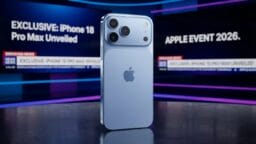
On September 18, Apple unveiled its latest iPhone 18 Pro series in South Korea, with the flagship model carrying a formidable price tag of nearly 4 million won.
This unprecedented price escalation has sparked considerable discourse surrounding “premium pricing” and Apple’s perceived shortcomings in the realm of artificial intelligence (AI), prompting many to label the tech giant an “AI laggard.”
As reported by industry insiders on September 21, the launch price for the iPhone 18 Pro Max is poised at 2.19 million won (approximately $1,600) for the entry-level 256GB model, and a staggering 3.99 million won (around $2,900) for the high-end 2TB variant.
Comparatively, the previous year’s iPhone 17 Pro Max 2TB was the first to breach the 3 million won threshold, priced at 3.19 million won ($2,300).
This year, with an 800,000 won ($580) increase in just one cycle, Apple has unmistakably ushered in the 4 million won era.
The iPhone 18 Pro, with its smaller display, also experienced a price surge, rising from 1.99 million won (approximately $1,400) to 3.79 million won (about $2,700).
This marks a price increase ranging between 200,000 won ($360) and 500,000 won ($360) compared to its predecessor for similar configurations.
In the United States, prices have similarly escalated, with the iPhone 18 Pro Max retailing from $1,299 to $2,499 and the iPhone 18 Pro from $1,199 to $2,399—up to $500 more than the previous generation.
A central contention revolves around the perceived enhancements not aligning with the stark price spikes.
Although the device is equipped with the A20 Pro application processor (AP), renowned for its top-tier performance, critiques indicate that the AI functionalities expected from this chip still lag behind those extended by competitors.
On September 15, The Wall Street Journal (WSJ) opined that while Apple has made strides in augmenting Siri’s capabilities, the company remains hesitant in the AI landscape.
While Siri now boasts chatbot functionalities, it finds itself overshadowed by advanced AI agents such as ‘Instinct’ and ‘Muse.’
Apple’s introduction of improved Siri AI features under the “Apple Intelligence” moniker alongside the iPhone 18 Pro is noteworthy, yet competitors have already transitioned to autonomous AI agents capable of managing smartphones independently, positioning Apple in a reactive stance.
AI Delays and Escalating Prices: A “Double Burden”
Apple’s characterization as an “AI laggard” in comparison to other Big Tech entities stems from its distinctive philosophy of valuing internal technical development rather than pursuing external collaborations.
The unveiling of Apple Intelligence at the 2024 Worldwide Developers Conference (WWDC) was intended to occur alongside the prior iPhone 16 series; however, development setbacks resulted in consumer lawsuits due to delays. The iPhone 18 Pro represents the inaugural formal launch of Apple Intelligence.
Currently, only the English version of the software is available, with Korean language support anticipated through an update later in the year.
In Europe, the launch timeline remains ambiguous, ensnared by outstanding regulatory issues stemming from the European Union’s Digital Markets Act (DMA).
This act categorizes dominant digital platforms, including Apple, as “gatekeepers,” restricting them from prioritizing their own services to bolster market control.
The EU insists that Apple must permit rival AI services like GPT to equate its functionality with Siri on the iPhone, although Apple has yet to fully comply.
Furthermore, tech analysts have observed that the new devices are marginally heavier than their predecessors, weighing in at 211g for the Pro and 249g for the Pro Max, featuring only slight enhancements in design and specifications.
Staggered Release Strategy Proves “Profitable”: Optimism Beyond Wall Street Projections
In a separate vein from the pricing discourse, analysts propose that Apple’s inaugural “staggered release” strategy is yielding favorable early indications.
This autumn, Apple debuted the iPhone 18 Pro series and its inaugural foldable device, the iPhone Duo, while postponing the standard iPhone 18, budget iPhone 18e, and iPhone Air 2 until the upcoming spring.
Gene Munster, managing partner at Deepwater Asset Management and a former analyst at Piper Jaffray, observed that initial pre-order shipping estimates for the iPhone 18 Pro series were roughly 15% longer than the corresponding period last year, implying that consumers are possibly reallocating their budgets from standard models to the pricier Pro tier.
He contended that Wall Street’s revenue projections for Apple’s fiscal 2027 (ending September 25, 2027) are underrepresented by approximately 10%. While the consensus anticipates around $274.4 billion, Munster posits that actual revenue may ascend to $301.84 billion.
Concerning the demand for the foldable iPhone Duo, Munster argues that Wall Street’s estimates for market share may be overly cautious.
The street anticipates that Apple’s inaugural foldable will capture approximately 35% of the global foldable phone market in its inaugural year, but Munster anticipates outcomes could surpass this prediction.
The last four quarters in the global foldable phone market registered around 13 million units, with Huawei commanding a 50% share while competitors Samsung Electronics, Motorola, and Honor each held about 10-15%.
Samsung previously enjoyed a 60% share but has recently seen a reduction due to intensified competition from Motorola in the U.S. and Honor in Europe and Asia.
Munster postulated two potential reasons for the robust pre-order demand for the iPhone 18 Pro series. One explanation posits that actual demand for the foldable iPhone Duo was less than anticipated, prompting users to remain within the Pro tier.
Alternatively, it’s plausible that traditional Pro users shifted towards the foldable, while standard-model buyers opted for Pro models.
He finds the latter scenario more believable, suggesting that the staggered release strategy is effectively elevating the average purchase price for consumers.
Meanwhile, in Japan, the 256GB model of the iPhone Duo is priced at 364,800 yen (approximately $2,300), inciting discussions about an iPhone surpassing “360,000 yen.”
Some media outlets speculate that this price point may deter users from the iPhone; however, counterarguments maintain that foldables are premium products, not targeted at the mass market.
A pressing concern remains the constant price hikes of existing models during this cycle, leaving consumers who intended to purchase older versions after witnessing the new lineup at risk of missing their opportunity due to inflated prices.
While initial interest in the iPhone 18 Pro series appears substantial, the confluence of regionally delayed AI functionalities and unprecedented pricing raises critical questions regarding Apple’s ability to justify its premium pricing strategy in this product cycle.

The true effectiveness of the staggered release strategy and evolving consumer preferences will be highlighted once pre-orders for the foldable iPhone Duo commence.
Source link: Finance.biggo.com.