Consumers purchasing the iPhone 18 Pro Max in Germany will enjoy a mobile technology advantage that remains inaccessible to their U.S. counterparts for the time being: Apple’s proprietary C2 modem rather than a Qualcomm chipset.
This development is particularly surprising; many industry analysts had anticipated that the smaller flagship variant would be the first to feature Apple’s own technology, allowing the more substantial Pro Max model to rely on Qualcomm for at least another iteration.
This difference is likely attributable to an existing supply agreement that Apple appears bound to in the United States.
The Modem Surprise on the iPhone 18 Pro Max
Apple initiated a gradual transition away from Qualcomm, embedding its own cellular modems beginning with the iPhone 16e and the iPhone Air.
This progression continues with the latest release: both the iPhone 18 Pro and the iPhone 18 Pro Max integrate Apple’s in-house C2 modem in Germany and other European markets.
Conversely, the larger Pro Max variant in the United States will, perplexingly, utilize a Qualcomm chip—most likely the Snapdragon X80.
Numerous U.S. technology publications, including MacRumors and Android Headlines, have independently reported on this anomaly in market offerings.
The most credible explanation revolves around a contractual obligation between Apple and Qualcomm, established in 2023, stipulating that Qualcomm would supply modems through 2026.
It seems Apple is minimally adhering to this commitment for its largest model sold in the U.S., while the rest of the globe transitions to its innovative in-house technology.
What Does the C2 Modem Do Better than Qualcomm’s Technology?
The C2 represents Apple’s second-generation in-house cellular modem, succeeding the C1 found in the iPhone 16e and the C1X featured in the iPhone Air.
Both Apple and various testing reports project the C2 to exhibit significant enhancements relative to its predecessor, the C1X:
| Feature | Apple C2 (iPhone 18 Pro/Pro Max, EU) | Qualcomm Modem (iPhone 18 Pro Max, U.S.) |
|---|---|---|
| 5G Support | Sub-6 GHz and mmWave | Sub-6 GHz and mmWave |
| Upload Speed | Up to 50% faster than C1X | No information on the increase |
| Power Consumption | About 15% lower than C1X | No official comparison figures |
| Origin | Developed in-house by Apple | Purchased from a third party, presumably the Snapdragon X80 |
The C2 modem is further enhanced by Apple’s proprietary N2 chip, which supports Wi-Fi 7 and Bluetooth 6.
Reports suggest that both components are designed to pave the way for future satellite capabilities: anticipated functionalities could include emergency satellite-based communication as well as data access beyond conventional cellular networks. As of yet, Apple has not disclosed any official details regarding these features.
Confusion Surrounding Apple’s Own Specifications Page
Adding to the confusion, Apple itself inadvertently contributed to the uncertainty: shortly following the launch, European specification pages failed to mention the C2 modem for the iPhone 18 Pro Max, although it was indicated for the smaller iPhone 18 Pro.
This oversight briefly raised doubts that European consumers might receive a technologically inferior configuration in the larger model.
Apple has since clarified that this discrepancy was merely a display error on its website. The German and international specifications pages now correctly identify the C2 modem for both Pro variants.
What Does This Mean for Buyers in Germany?
In practical terms, the distinctions are expected to be particularly pronounced in scenarios involving the upload of sizable files and overall battery efficiency on cellular networks—specifically in routine situations such as transmitting videos or working in mobile settings devoid of Wi-Fi.
German consumers will likely benefit from the more advanced technological iteration, while U.S. users will continue to rely on established Qualcomm technology for the foreseeable future.
Whether these differences will manifest as measurable advantages in real-world tests remains to be seen in forthcoming independent speed evaluations.
An Overview of the Other New Features
The modem is not the only facet of the iPhone 18 Pro Max undergoing transformation. According to Apple’s official specifications, additional features include:
- The new A20 Pro chip, fabricated utilizing TSMC’s 2-nanometer process, featuring a 6-core CPU and 7-core GPU, equipped with neural accelerators.
- A mechanically adjustable aperture on the main camera, providing enhanced control over light intake and depth of field.
- A reengineered vapor chamber cooling system to mitigate performance degradation during sustained use.
- A 6.9-inch OLED display with a resolution of 2868 x 1320 pixels, 460 ppi, and ProMotion technology supporting up to 120 Hz.
- Extended battery life of up to 43 hours during video playback.
The iPhone 18 Pro Max exemplifies Apple’s differentiated market approach: while U.S. consumers remain tethered to a legacy supplier contract for the larger variant, Germany is already leveraging the technological advancements of the C2 modem.
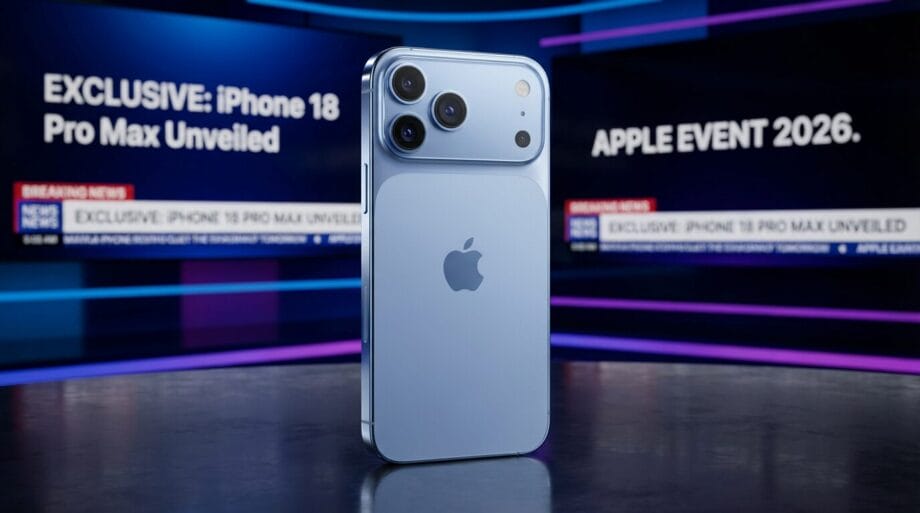
While this feature alone may not serve as a pivotal element in consumer choices, it starkly illustrates the rapid evolution of Apple’s modem strategy.
For those intrigued by potential future iterations, preliminary rumors regarding the iPhone 20 Pro Max can be found on Basic Tutorials.
Source link: Basic-tutorials.com.