iPhone 18 Pro Delivery Times Show Decline Amid Solid Launch Validation
Since its initial release, the delivery timelines for Apple’s iPhone 18 Pro have experienced a significant reduction, plummeting to 31% below the levels seen a year prior.
Gene Munster, managing partner at Deepwater Asset Management, posits that despite these early indicators, a healthy product cycle for the tech titan remains evident.
Munster, who meticulously monitors lead times across eight nations, conveyed via a post on X that both the Pro and Pro Max models have seen a decrease in wait times three weeks after their launch.
He described the rollout as “commencing on a positive note,” with investor focus now gravitating towards the imminent preorders for the iPhone Duo.
In the stock market, shares of Apple Inc. (AAPL) dipped by over 1% during Friday’s trading session, followed by a further decrease of 0.2% in after-hours trading, reflecting some trepidation regarding demand trends for the premium segment.
Cooling Demand for Pro Models After Strong Debut
On the day of launch, lead times for the iPhone 18 Pro extended 15% longer than those for the iPhone 17 Pro from the previous year, signaling a robust consumer interest in the latest flagship iteration.
This premium persisted throughout the first week, only to diminish to 5% below last year’s metrics by the second week. Recent figures reveal that the gap has since widened to 31% below comparable statistics from 2025.
While Munster acknowledged the downturn as alarming, he also indicated that a degree of reduction was anticipated due to the allure of the new iPhone Duo, potentially diverting consumers from the Pro series.
“As we entered this cycle, I forecasted that we would witness lead times 20% lower than last year, as the attractive Duo would entice former Pro purchasers,” he noted.
Pro Max Demonstrates Robustness
The larger Pro Max model has fared significantly better in retention. On launch day, lead times were recorded at 18% longer than those of the iPhone 17 Pro Max from the previous year, maintaining a 6% elevation after two weeks.
Presently, these lead times align closely with last year’s figures, an outcome Munster deems a fortunate development for Apple, especially considering his prediction that the Duo would siphon off a notable fraction of previous Pro Max buyers.
“I surmise that a substantial portion, possibly 20%, of the early Pro Max buyers from last year are deferring their purchases for the Duo,” he stated.
If such a transition is indeed occurring, stable lead times for the Pro Max could indicate that other iPhone customers are opting for higher-tier models.
A possible scenario suggests that consumers typically inclined to purchase the standard iPhone 18 might now be gravitating towards the Pro or Pro Max, given that the base model is not scheduled for delivery until next spring. “In this context, it represents a victory for FY27 iPhone revenue,” Munster articulated.
Complex Signals Emanating From China and Supply Chains
The demand landscape presents a complex picture. Counterpoint Research noted last month that sales of the iPhone 18 Pro series in China surged by 12% year over year within the first three days, resulting in Apple capturing a 33% market share within the nation’s smartphone sector during week 38. This early momentum is a promising harbinger for the world’s largest smartphone market.
However, reported reductions in component orders, estimated at 15% for the iPhone 18 Pro and Pro Max, have injected an additional layer of uncertainty into the demand forecast.
The combined lead times for both premium models currently average around three weeks, approximately mirroring last year’s figures for the same period.
Munster cautioned that recent directional trends take precedence over averages. “The pronounced decrease observed in recent weeks is more indicative,” he asserted, emphasizing that this downturn could temper expectations for positive developments in the upcoming December quarter.
Upcoming Duo Preorders Present Critical Test
The next pivotal moment on the horizon occurs on October 16, when Apple will initiate preorders for the iPhone Duo, with shipments anticipated to commence on October 23. Munster remains optimistic regarding this new design.
“The Duo represents a wildcard; I firmly believe it will outperform expectations,” he stated, projecting sales approaching 20 million units during its inaugural year, in stark contrast to current estimates which anticipate approximately 10 million units.
Nonetheless, he acknowledged the possibility of initial supply limitations that could extend delivery wait times up to five weeks in the first month, complicating the assessment of early demand.
Market Dynamics Surrounding Apple’s Position
Apple’s stock has surged by 24% year-to-date and achieved a remarkable 33% increase over the past 12 months, surpassing broader market movements.
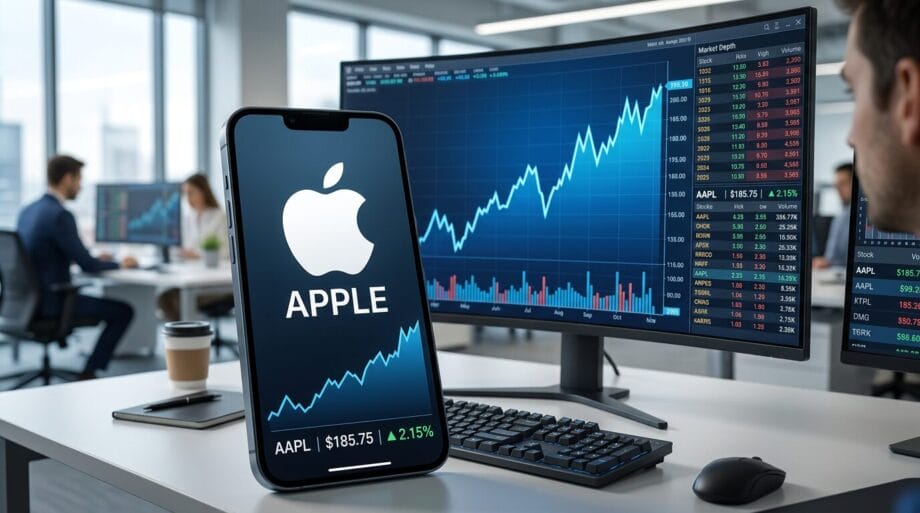
The SPDR S&P 500 ETF Trust (SPY) has seen a gain of 16% during the same 12-month timeframe, while the Invesco QQQ Trust (QQQ) has risen by 23%.
Retail sentiment surrounding Apple on Stocktwits has lingered in neutral territory, reflecting the ambiguity regarding whether the bifurcated product cycle will ultimately enhance or dilute the company’s economic standing within the premium tier segment.
Source link: Finance.biggo.com.