Quick Summary
HubSpot Marketing Hub and ActiveCampaign solve different problems for small businesses. HubSpot stands out as an all-in-one platform that unifies marketing, sales, and CRM, with a shorter learning curve, stronger analytics, and better long-term scalability. ActiveCampaign excels at advanced email automation and top-tier deliverability, making it ideal for eCommerce, newsletters, and automation-first teams.
If email automation is your core growth engine, choose ActiveCampaign. If you need a single system to align marketing and sales and scale your business, HubSpot is the better investment.
Introduction
You know how frustrating it is when your marketing tools feel like they’re fighting against you rather than working for you? Many small business owners I talk to are stuck in this exact spot.
You have data in one place, email templates in another, and a sales team that has no idea what marketing is doing.
Choosing between HubSpot Marketing Hub and ActiveCampaign usually comes down to solving that specific disconnection. It is not just about sending emails; it is about whether you need a dedicated specialist for automation or a complete operating system for your entire company.
This decision involves evaluating features such as workflow automation, pipeline management, and contact management.
From what I have seen in the market this year, the choice often splits along these lines: ActiveCampaign is the go-to for pure-play automation and email deliverability. HubSpot is the choice when you need to unify sales, service, and marketing under one roof.
Research indicates that 91% of users learned to use HubSpot Marketing Hub in less than a month. This statistic matters because it shows that powerful features like marketing automation, customer journey tracking, and analytics do not have to come with a headache-inducing learning curve.
In this guide, I will break down the real-world differences between these two platforms. We will look at the 2025 data on deliverability rates, the new AI features like HubSpot’s Breeze, and the hidden pricing triggers that most people miss until it is too late.
Let’s look at the data, see what it is actually telling us, and help you pick the right engine for your growth.
What is HubSpot Marketing Hub?
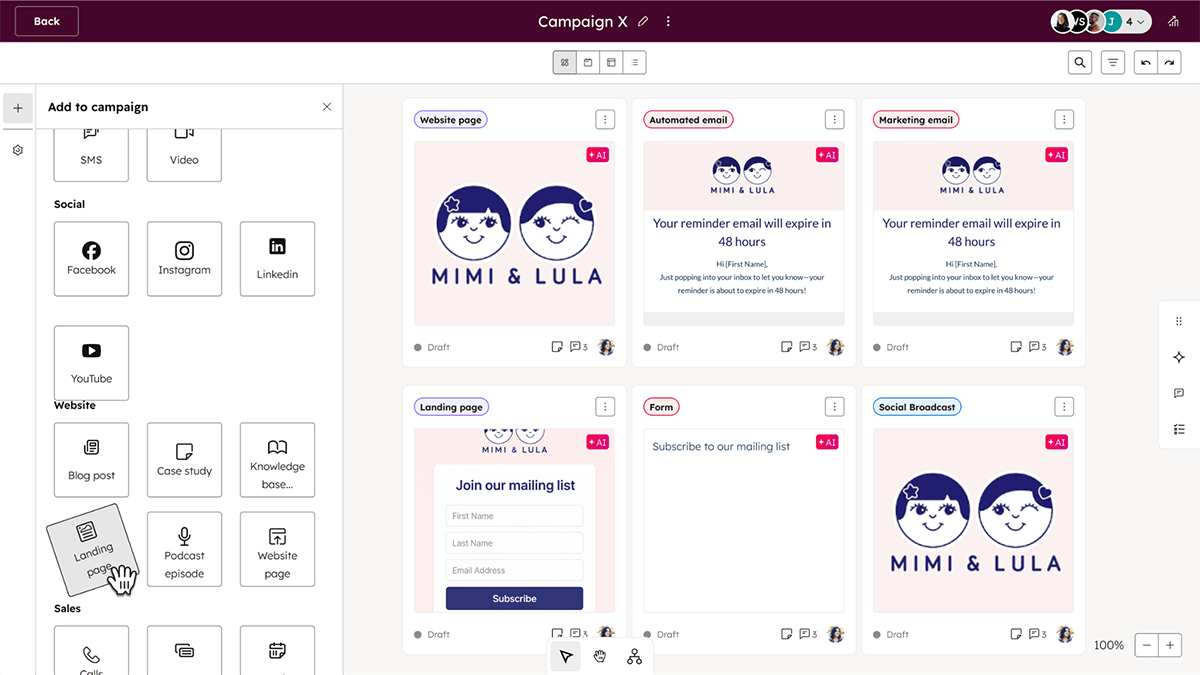
HubSpot Marketing Hub is more than just a tool; it is a complete customer platform built on top of a Smart CRM. Small businesses use it to bring order to chaos by connecting their marketing data directly to their sales pipelines.
Key benefits include robust email marketing, efficient contact management, and comprehensive CRM integration that improve customer journeys.
The biggest update for 2025 is the integration of Breeze AI. This is not just a chatbot; it includes “Breeze Agents” that can autonomously execute tasks like researching prospects or drafting blog posts based on your brand voice. For a small team, this is like hiring a digital intern who works 24/7.
This feature enhances workflow automation and content creation, allowing marketers to focus on strategic initiatives.
Beyond the new AI, the core value remains its “all-in-one” architecture. You can manage social media ads, landing pages, and SEO recommendations from the same dashboard where your sales team tracks deals.
The platform also supports in-depth data enrichment and predictive sending for email campaigns.
Security is another major selling point for U.S. businesses concerned with compliance. HubSpot maintains SOC 2 Type II security and offers strong features for GDPR compliance, which is critical if you have any international customers.
Pricing begins at roughly $15 to $20 per user monthly for the Starter plan. The key financial advantage here is the “Marketing Contacts” model, where you pay only for the contacts you actively market to, not the dormant ones sitting in your database.
This pricing model creates cost efficiency for small businesses while supporting scalable email marketing and pipeline management.
What is ActiveCampaign?
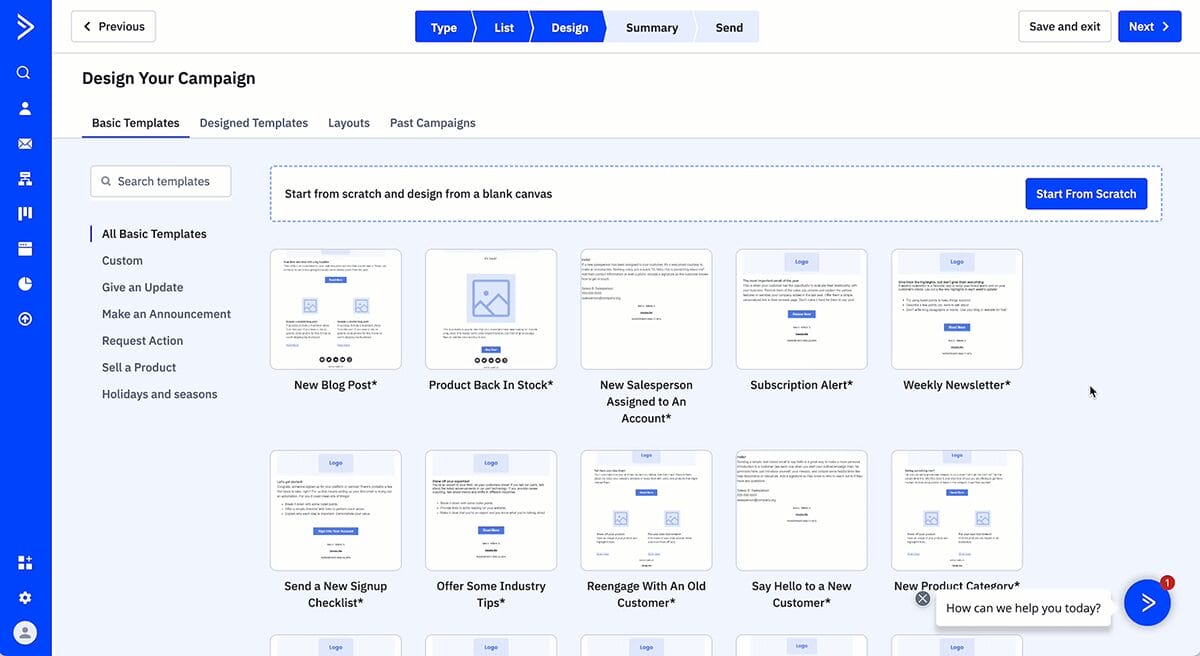
ActiveCampaign is widely recognized as the pioneer of Customer Experience Automation (CXA). While it started as an email tool, it has evolved into a powerhouse for businesses that live and die by their automation logic.
The platform excels in workflow automation, email marketing, and contact management for small businesses.
A critical advantage for ActiveCampaign is its acquisition of Postmark, a transactional email service known for incredible reliability. This infrastructure supports ActiveCampaign’s standout deliverability rate of 93.4%, which is significantly higher than many competitors.
ActiveCampaign delivers strong performance in email campaigns and predictive sending to boost user engagement.
The platform supports over 900 integrations, including deep data connections with Shopify and WordPress. These allow you to pull purchase history directly into your contact records to trigger “Recipes” – their term for pre-built automation templates.
Such integrations enhance data enrichment and streamline pipeline management for marketers.
Pricing starts at roughly $15 per month for the Starter tier, but be aware that this price scales with your total contact count. Unlike HubSpot, you generally pay for every contact you store.
This flexible pricing appeals to small businesses focused on efficient email campaigns and cost-effective contact management.
Small businesses benefit from unlimited pipeline management features in the bundled plans, making it a strong contender for B2B companies that need a solid CRM but cannot justify HubSpot’s steeper price tag.
The platform also supports comprehensive CRM (customer relationship management) and lead scoring to enhance customer journeys.
HubSpot Marketing Hub vs ActiveCampaign: A Detailed Comparison
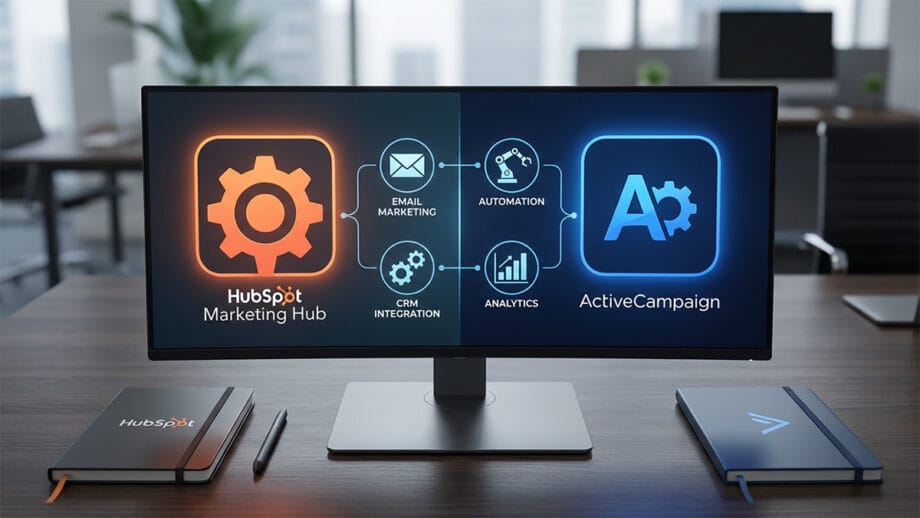
Let’s compare both tools and their features side-by-side to determine which one is more preferable for small-sized businesses. As I proceed with the comparison, I will score each platform. At the end of the article, we will count all scores and find which one is the winner. Let’s begin!
1. Ease of Use and Learning Curve
Small businesses need marketing tools that are simple, quick to learn, and require little technical expertise. The fundamental difference is in the design philosophy: HubSpot prioritizes a clean, polished UI, while ActiveCampaign prioritizes visual clarity in complex workflows. Here is a side-by-side comparison of HubSpot Marketing Hub and ActiveCampaign for usability:
| Category | HubSpot Marketing Hub | ActiveCampaign |
| User Interface | Known for a consistent, “Apple-like” user-friendly interface. Menus are standardized across all Hubs (Sales, Service, Marketing). Customizable drag-and-drop dashboards for personal views. | Famous for its visual “Workflow Map” that looks like a flow chart. Interface can feel dense due to the sheer number of options. “Recipes” allow you to import pre-made automation setups. |
| Onboarding Experience | HubSpot Academy sets the global standard for free training. 91% of users report learning the platform in one month or less. Professional tier requires a mandatory, paid onboarding fee ($3,000+). | ActiveCampaign University provides solid, functional training. Includes free migration services for moving from Mailchimp or others. One-on-one strategy calls are available on higher-tier plans. |
| Setup Time | Longer initial setup because it replaces your entire CRM. Best for companies ready to commit to a full platform switch. | Quick to set up, especially for standalone email marketing. You can launch your first automation “Recipe” in under 15 minutes. |
For this, both platforms are superior in their own way. So, let’s score them both a point.
2. Marketing Automation Capabilities
Small businesses demand marketing automation tools that save time, generate quality leads, and adapt to growth. If HubSpot is a Swiss Army Knife, ActiveCampaign is a surgical scalpel for automation. The systems support workflow automation and A/B testing to optimize customer journeys.
ActiveCampaign’s automation builder is arguably the best in the industry. It allows for “split actions,” where you can send 50% of your leads down Path A and 50% down Path B, then automatically declare a winner and funnel all future traffic to the successful path. This approach improves campaign performance through predictive sending and targeted email campaigns.
HubSpot’s workflows are powerful but generally more linear until you reach the expensive Professional or Enterprise tiers. HubSpot shines with its Data Hub features (available as an add-on), which allow for “Programmable Automation”. This flexibility supports a custom report builder and comprehensive data enrichment for enhanced pipeline management.
| Feature | HubSpot Marketing Hub | ActiveCampaign |
| Workflow Design | Linear, top-down workflow editor. Excellent for internal tasks (e.g., “Create a Task for Sales Rep”). Breeze AI can now draft workflows from a text prompt. | Non-linear, 2D visual map editor. Allows for “Go-To” actions to jump contacts between steps. Includes 900+ pre-built “Recipes” for common scenarios. |
| Triggers & Events | Strongest on CRM changes (e.g., “Deal Stage changed to Closed”). Great for lifecycle stage management. | Strongest on behavioral data (e.g., “Clicked specific link 3 times”). Native SMS triggers are available in lower tiers. |
The table underscores the differences in workflow design and trigger mechanisms crucial for email marketing and contact management.
Here, I have to say HubSpot is more advantageous.
3. Email Marketing Performance
Email marketing remains a pillar for growth-minded companies, but sending an email is useless if it lands in the spam folder. This is where the two platforms diverge most sharply.
According to 2024 tests by EmailToolTester, ActiveCampaign achieved a 93.4% deliverability rate, taking the top spot among major providers. HubSpot, in comparison, scored around 79.8%.
| Criteria | HubSpot Marketing Hub | ActiveCampaign |
| Email Editor & Design | Drag-and-drop builder with Breeze AI writing assistants. Smart Rules allow you to show different text to different lists. Focuses on simplicity and brand consistency. | New “Email Designer” offers granular control over mobile views. Supports AMP for Email for interactive content. Ideal for designers who want pixel-perfect control. |
| Testing & Optimization | Basic A/B testing (Subject lines, send times). AI tools help rewrite copy for different tones. Higher-tier plans include adaptive testing. | Advanced split testing (Subject lines, content, and automation paths). Win Probability AI predicts which leads will convert. Predictive Sending sends emails when users are most active. |
| Personalization | Uses “Personalization Tokens” connected to CRM data. Smart Content blocks change based on list membership. Great for B2B personalization (e.g., “Hi [Company Name] team”). | “Conditional Content” allows you to hide/show entire sections. Deep data integrations let you insert past purchase images. Best for B2C hyper-personalization. |
This analysis of email marketing performance reinforces the importance of reliable deliverability and effective email design for successful campaigns.
It seems the score is tied again.
4. CRM and Sales Alignment
HubSpot Marketing Hub gives small businesses access to a powerful CRM with custom workflows and advanced management tools. This is its home turf. The CRM is the foundation of the entire platform, not an add-on. This integrated crm supports efficient contact management, pipeline management, and dynamic lead scoring for better customer journeys.
ActiveCampaign’s CRM is primarily a deal-tracking tool designed to support the automation engine. It offers unlimited pipelines on every tier, which is a nice perk, and the drag-and-drop interface is easy for small sales teams to update. It lacks the depth of HubSpot’s sales acceleration tools. The direct integration between crm and the marketing hub in HubSpot provides better visibility into customer journeys.
HubSpot is the clear winner of this point.
5. Analytics, Reporting, and Insights
Integrated analytics in the HubSpot Marketing Hub is better than ActiveCampaign for measuring campaign effectiveness. The key differentiator here is multi-touch attribution. HubSpot can tell you that a customer first found you via a Google Ad, then read three blog posts, then clicked a nurture email, and finally bought your product. This detailed reporting allows marketers to track customer journeys and optimize email campaigns effectively.
ActiveCampaign offers solid reporting, especially regarding email performance and automation health. Its “Marketing Revenue” reports are helpful for e-commerce stores to see exactly how much money a specific email series generated. Users often find the custom reporting capabilities limited compared to HubSpot’s.
So the winner is again HubSpot.
6. Integrations and Ecosystem
HubSpot Marketing Hub supports over 2,000 external integrations through its App Marketplace. A standout feature is HubSpot Data Sync, which offers bi-directional syncing for over 100 popular apps (like Google Contacts, Outlook, and Mailchimp) without needing code. These integrations enhance contact management and improve data enrichment for seamless marketing automation.
ActiveCampaign provides about 900 to 1,000 integration options, with a heavy focus on e-commerce and lead generation tools. Its “Deep Data” integrations with Shopify, WooCommerce, and BigCommerce are exceptional. Such capabilities support personalized email marketing and targeted customer journeys.
Both platforms utilize open API access, allowing technical teams to build custom connections. HubSpot’s ecosystem is generally broader, covering everything from finance tools like QuickBooks to customer service tools like Zendesk, often with deeper native functionality.
The diversity of integrations solidifies HubSpot’s status as a comprehensive marketing hub with advanced seo tools and social media management features. So, again, we have to place HubSpot a bit ahead on this point.
7. Value for Money
This is where the math gets tricky. ActiveCampaign appears cheaper at first, with its Starter plan costing roughly $15-29 per month. This price increases as your contact list grows. If you have 10,000 contacts, even if you only email 500 of them, you pay for all 10,000. This pricing model affects email templates and overall campaign budgeting for small businesses.
HubSpot uses a “Marketing Contacts” model. You can store up to 15 million contacts for free. You only pay for the specific contacts you mark as “Marketing Contacts” – the ones you actively send email blasts to. This is a massive savings for businesses with large, dormant databases. The model supports scalable contact management and smart CRM functionality while easing cost pressures on email marketing campaigns.
There is a “cliff” with HubSpot. Moving from the Starter plan (approx. $9-20/mo per seat) to the Professional plan (approx. $800/mo for 3 seats) is a huge financial leap. ActiveCampaign has a much smoother pricing ramp, with mid-tier plans around $70 or $150 that bridge the gap perfectly for growing teams.
This factor is important when considering overall value and investment in marketing automation and pipeline management. Small businesses using HubSpot have reported a 47% drop in their marketing tool subscription costs after switching. The consolidation of tools supports efficient content marketing and data enrichment across marketing channels.
Here, I have to give one point to each platform. ActiveCampaign is more affordable at the start, but HubSpot shows its value in the long run.

8. Customer Support, Training, and Resources
ActiveCampaign stands out for small businesses needing quick help. Free migration is included with all plans, which is a huge stress reliever if you are terrified of losing data during a switch. They also offer “Study Hall” workshops and one-on-one training sessions that are very practical. These support features enhance the user experience in workflow automation and email marketing setup.
HubSpot owns the crown for education. HubSpot Academy is an industry standard; you can get certified in Inbound Marketing, Content Strategy, and Email Marketing for free. These certifications are so well-regarded that people put them on their LinkedIn profiles. This comprehensive knowledge base helps small businesses improve content creation and social media management. In terms of direct support, HubSpot offers 24/7 phone and chat support for Professional and Enterprise users. Starter users rely on email and chat.
Although you can say HubSpot has a very slight edge in this point, it is an injustice to ActiveCampaign if we do not give them a point. So, both tools have a point here.
9. Security, Compliance, and Data Management
For U.S. businesses, data security is no longer optional. HubSpot Marketing Hub features strong encryption and comprehensive compliance tools. It includes features like a “GDPR toggle” that automatically adds unsubscribe links and cookie consent banners to your pages. This focus on security benefits contact management and protects sensitive customer data during email campaigns.
ActiveCampaign also provides SOC 2 compliance and HIPAA compliance options on its Enterprise plans. Their data management allows for “Field-Level Security,” letting you control which users can see sensitive data like phone numbers or revenue figures. The enhanced data management supports effective crm workflows and leads to better attribution reports.
No platform has any significant drawbacks here. Let’s give them one point each.
10. Scalability and Long-Term Growth Potential
Many small businesses find that HubSpot Marketing Hub scales seamlessly from a garage startup to an IPO. Its Professional and Enterprise plans unlock advanced features like predictive lead scoring and hierarchical team permissions. Scalable contact management, a custom report builder, and workflow automation contribute to its strong growth potential for marketers.
ActiveCampaign works incredibly well for scaling up to the mid-market level. It handles hundreds of thousands of contacts effortlessly. The effective use of CRM and pipeline management enhances long-term value for small businesses.
Choosing ActiveCampaign gives simplicity early on and is often the better choice for high-volume B2C senders. HubSpot matches long-term growth needs for companies where the coordination between sales and marketing is the primary driver of revenue.
This balance between simplicity and advanced features makes the decision complex for small businesses. Here again, I have no other option but to give one point to each platform.
HubSpot Marketing Hub vs ActiveCampaign: Which One is Better for Small Businesses?

As I compared the features, HubSpot scored 9, whereas ActiveCampaign received a 6 out of 10. It seems you can close your eyes and choose HubSpot as your next marketing tool. In reality, although HubSpot has an edge, your choice may not be that straightforward.
Choosing between these two giants depends entirely on your business model. If you run a lean e-commerce shop or a newsletter-driven business where email deliverability and complex automation recipes are your lifeblood, ActiveCampaign is a good choice.
Both platforms support effective email marketing and workflow automation for better customer journeys.
If you are a growing business where your sales team needs to see exactly what marketing is doing, HubSpot is the better investment. The unified Smart CRM and the ability to scale into Sales, Service, Content, Data, and Commerce Hubs make it a true operating system for your business. This option excels in pipeline management and custom report builder features for sustained growth.
I recommend starting with HubSpot’s free tools to get a feel for the interface, and using ActiveCampaign’s trial to test a specific automation workflow. The right choice is the one that your team will actually use every day.
The decision influences your marketing automation and content marketing execution consistently over time. Making an informed choice here sets the stage for higher ROI – find what fits best today so you can grow smart tomorrow.


