Quick Summary
DevOps 2.0 upgrades traditional DevOps by embedding AI and intelligent automation directly into continuous delivery pipelines. Instead of relying on fixed rules and reactive processes, pipelines now learn from data, predict failures, optimize testing, strengthen security, and even self-heal when issues arise.
AI doesn’t replace engineers – it supports them by handling repetitive tasks, reducing alert fatigue, and offering smarter recommendations. The result? Faster releases, lower risk, stronger security, and less burnout.
DevOps 2.0 turns delivery pipelines into learning systems that continuously improve, helping teams ship software with greater speed, confidence, and consistency.
Introduction
DevOps revolutionised the way teams build and ship software. But modern systems are moving faster, scaling bigger, and generating more data than any human can handle. DevOps 2.0 rises to that challenge. It embeds artificial intelligence and deep automation into continuous delivery pipelines. This is a new model that helps teams release faster, lower risk, and stay calm under fire.
DevOps 2.0 is not replacing the engineers. It’s supporting them. AI watches over pipelines, learns patterns, and suggests smarter actions. Automation does the routine so teams can focus on design, quality, and innovation.
Why DevOps Needed an Upgrade
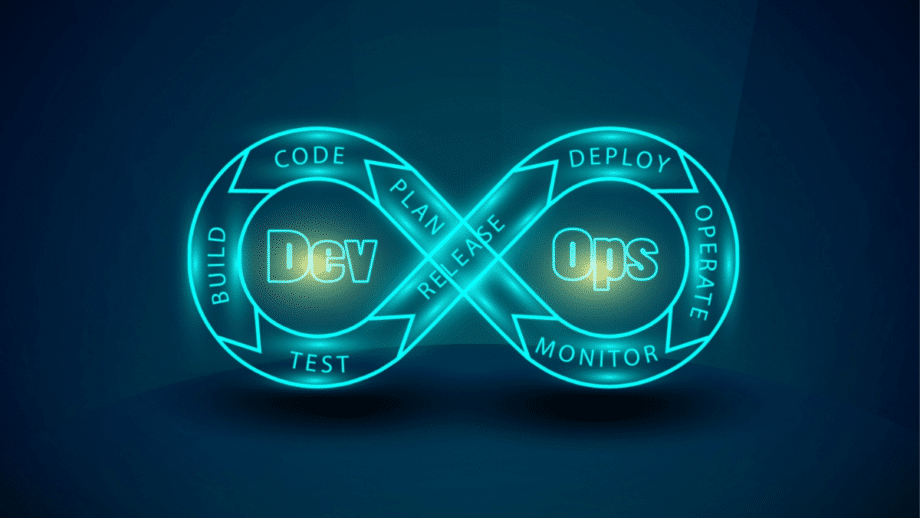
Traditional DevOps relies on fixed rules and manual decisions; therefore, pipelines cannot adapt when conditions change. This rigidity, in the case of growing systems, implies increasing delays, errors, and teams getting burnt out.
Complexity Increasing in Software Delivery:
- Microservices and cloud platforms produce huge volumes of data.
- Logs, metrics, tests, and alerts are always streaming in.
- There are challenges in integrating all the signals in a timely manner.
Pressure for Faster and Safer Releases:
- The users demand an uninterrupted flow of updates.
- They desire speed with no risk when it comes to security.
- Classic pipelines react to failures.
- Pipelines predict issues nowadays.
What DevOps 2.0 Really Means
This is DevOps 2.0, blending AI-driven intelligence with automated delivery. Pipelines no longer merely execute steps. They observe, learn, and improve continuously.
Automation to Intelligence:
- Basic automation only executes tasks.
- Automation with intelligence comprehends output.
- AI analyzes past builds, tests, and deployments.
- Hidden patterns are found, and it improves decisions with more time.
Continuous Learning Pipelines:
- Every pipeline run is a source of training data.
- The system learns which tests catch bugs.
- It identifies deployments that fail.
- It detects changes that create risk.
- This is the learning loop that will improve delivery every day.
AI Across the CD Pipeline
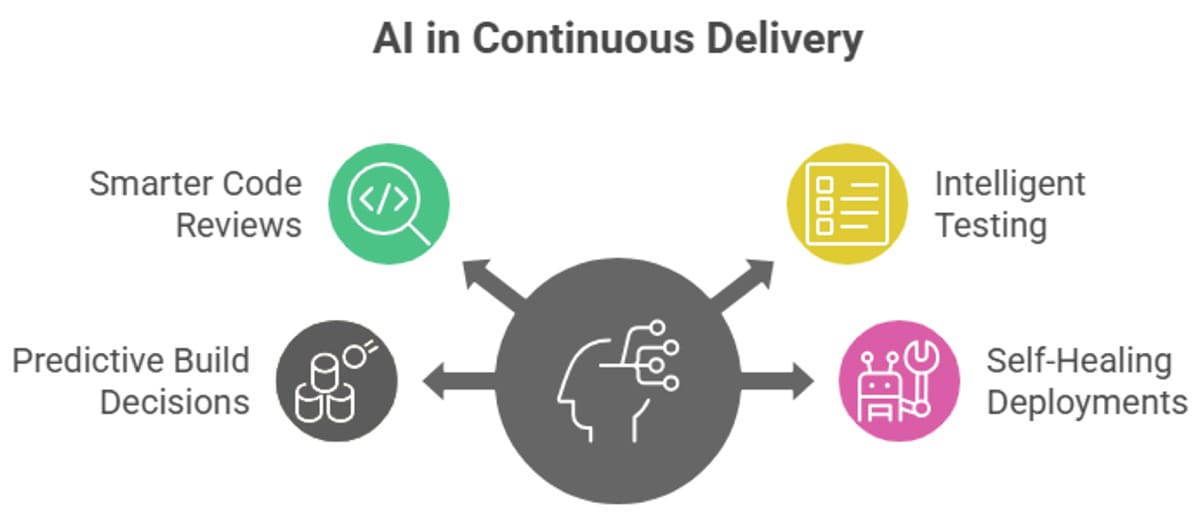
AI enhances all aspects of the delivery process. It is a passive partner that is always working.
- Smarter Code Reviews: The code changes are reviewed by the AI, and potentially dangerous patterns are identified. It points out the problematic code related to security, performance, and coding styles. The developers are able to solve the problems quickly.
- Intelligent Testing: With current testing, it is necessary to run all tests on every occasion. However, with artificial intelligence testing, only the most applicable tests are used. The AI tests only the areas that have changed recently.
- Predictive Build and Release Decisions: The model forecasts failures in builds, having studied past experience. It alerts teams before a release causes a problem. It encourages teams to be bold and release often.
- Self-Healing Deployments: When something goes wrong, it uses its analytics capabilities to automatically fix the problems by rolling back releases, restarting services, or notifying the right people.
Automation That Feels Human
Automation in DevOps 2.0 seems less robotic and more enabling. It adjusts rather than requiring an adjustment by the team.
Context-Aware Pipelines:
- AI is aware of workload patterns.
- It does risk-level analysis in real time.
- Pipelines adjust to actual conditions
- They don’t rely on set rules anymore.
Reduced Alert Fatigue:
- AI removes unnecessary noise.
- Only marks important notifications
- Engineers do not generate false alarms.
- Teams tackle real problems.
Security Built into DevOps 2.0
Security must not be deferred until the end. DevOps 2.0 has security built into all phases.
AI-Powered Threat Detection:
- It deals with the dependency graphs and configurations.
- It models runtime dynamics.
- Recognises unusual activity early.
- Attack risks are minimised.
Continuous Compliance:
- Analysing policies and standards: Powers & Richard’s research focuses on.
- Highlights violations instantly.
- Maintains systems audit-ready.
- It achieves delivery speeds free from delays.
The Role of Humans in AI-Driven DevOps
The involvement of AI in decision-making is aided by humans leading the strategies. Collaboration between humans and machines is incorporated in DevOps 2.0.
- Engineers as Decision-Makers: Suggestions for actions are made by the AI system. Engineers validate, modify, and override the suggestions.
- Skill Development Rather Than Job Destruction: AI eliminates repetitive tasks. Engineers develop skills in architecture, problem-solving, and innovation. Teams feel empowered rather than replaced.
Challenges Teams Must Handle
DevOps 2.0 has power, but the joy lies in using that power.
- Data Quality Matters: AIs require clean data. Clean data results in clean decision-making. Investment in observability, data hygiene, and such aspects is required.
- Integration with Other Tools: The legacy systems might show some form of reluctance to adapt to change. The team ought to integrate the use of AI in a progressive manner that corresponds to their systems.
- Trust and Transparency: Teams should know how AI algorithms make decisions. This enables them to trust the results.
The Future of Continuous Delivery
DevOps 2.0 is more about self-authoring delivery, which works towards predicting problems and optimising its performance capabilities and self-recovery. The engineers will be able to develop a strategy while the system can perform the execution parts.
- Pipelines forecast problems and optimise performance.
- Faults are automatically recovered by systems.
- Engineers must not oversee repetitive tasks.
- Teams are released faster and with greater consistency without burnout.
Final Thoughts

DevOps 2.0: The new software development paradigm changes continuous delivery to include intelligence in automation. The new technology reverses pipelines into learning tools that enable humans, not hinder them. Such teams using AI-powered DevOps not only accelerate but also improve their movement in a safe and confident manner.


