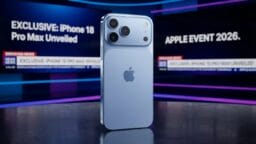
The iPhone 18 Pro: A Pinnacle of Imaging and Endurance
The iPhone 18 Pro emerges as the superior selection for those seeking enhanced camera capabilities, advanced video recording, robust battery life, and seamless performance.
Conversely, the iPhone 15 Pro remains a more portable device, while its compatibility with iOS 27 and Apple Intelligence alleviates concerns surrounding software support.
Ultimately, the choice hinges on whether the latest hardware addresses a specific need you possess.
Apple unveiled the iPhone 18 Pro on September 9, 2026. In the United States, the starting price is $1,199 for the 256GB variant; preorders commenced on September 12, with official availability slated for September 18.
Critical Comparison: Gains Versus Trade-offs
| Feature | iPhone 15 Pro | iPhone 18 Pro | Implications for You |
| Display | 6.1-inch OLED, max 120Hz | 6.3-inch OLED, max 120Hz | Increased screen real estate on the iPhone 18 Pro |
| Peak brightness outdoors | 2,000 nits | 3,000 nits | Enhanced outdoor visibility on the newer model |
| Main camera | 48MP, fixed ƒ/1.78 aperture | 48MP Fusion Main, variable apertures of ƒ/1.48, ƒ/1.8, ƒ/2.8, and ƒ/4.0 | Augmented control over aperture and depth of field |
| Ultra-wide camera | 12MP | 48MP Fusion Ultra Wide | Superior resolution for the secondary lens |
| Telephoto camera | 12MP, 3× zoom | 48MP, 4× zoom, with a quality optical 8× option | Enhanced resolution and optical reach |
| Rear video capabilities | Dolby Vision up to 4K/60 fps | Dolby Vision up to 4K/120 fps | Greater flexibility with high-frame-rate video recordings |
| Video production options | External ProRes up to 4K/60 fps | External ProRes up to 4K/120 fps, with ProRes RAW and Genlock | Expanded production capabilities |
| Video playback duration | Up to 23 hours | Up to 36 hours on U.S. eSIM-only model | Improved playback rating on the newer device |
| Wired charging capability | Approximately 50% in 30 minutes with a 20W or higher adapter | Approximately 50% in 15 minutes with a compatible 60W-capable USB PD 3.1 AVS setup | Faster rated charging under applicable conditions |
| Weight | 187g | 211g | The iPhone 18 Pro is 24g heavier |
| U.S. launch price and storage | $999 for 128GB | $1,199 for 256GB | The new device launched at a $200 premium with double the base storage |
Display and Design: Enhanced Dimensions Yet Increased Weight
The iPhone 18 Pro features a 6.3-inch OLED display, a step up from the iPhone 15 Pro’s 6.1 inches. Both models support ProMotion refresh rates of up to 120Hz, indicating that the upgrade focuses more on size and visibility rather than a higher refresh-rate threshold.
The outdoor peak brightness escalates from 2,000 nits to 3,000 nits, with the newer iteration also incorporating an anti-reflective coating. Additionally, the Dynamic Island has been made smaller on the iPhone 18 Pro.
This larger display necessitates a proportionally larger body: 150.0 × 71.9 × 8.75mm vs. 146.6 × 70.6 × 8.25mm. Weight increases from 187g to 211g.
The construction also diverges; the iPhone 15 Pro employs a titanium frame and glass back, while the iPhone 18 Pro takes advantage of an aluminum unibody structure complemented by a Ceramic Shield back.
For those who prioritize a lightweight device that seamlessly fits in a pocket, the iPhone 15 Pro holds the ergonomic advantage.
However, if you are inclined to read, edit, or consume media for extended durations, the iPhone 18 Pro offers a larger display area and superior outdoor brightness—albeit while carrying an additional 24 grams.
Cameras: The Variable Aperture Revolution
The iPhone 18 Pro retains a 48MP main camera but introduces four variable aperture settings: ƒ/1.48, ƒ/1.8, ƒ/2.8, and ƒ/4.0, contrasting with the iPhone 15 Pro’s fixed ƒ/1.78 aperture.
In practical terms, variable aperture grants photographers increased control over light entry and scene rendering. This feature becomes particularly advantageous when one aims to adjust exposure or depth of field intentionally, rather than simply aiming and shooting.
Significantly, the secondary cameras boast major enhancements. The ultra-wide camera experiences an upgrade from 12MP to 48MP.
The telephoto lens transitions from a 12MP, 3× variant with a 77mm-equivalent focal length to a 48MP, 4× lens featuring a 100mm-equivalent focal length, along with a high-quality 8× option. The front camera also improves from 12MP TrueDepth to an 18MP Center Stage camera.
These transformations position the iPhone 18 Pro as an appealing choice for users who frequently engage with all three rear cameras, frequently edit images, or desire greater control during shooting. However, it should be noted that these modifications do not guarantee universally improved photos in every context.
Video and Creation: The Tangible Upgrade
When it comes to video capabilities, the iPhone 18 Pro escalates rear-camera Dolby Vision recording from a maximum of 4K/60 fps to an impressive 4K/120 fps on the primary camera. Furthermore, external ProRes recording is upgraded from 4K/60 fps to 4K/120 fps as well.
This new model integrates ProRes RAW and Genlock support, essential features for filmmakers and creators who rely on an editing workflow.
ProRes RAW preserves more image data for post-production, while Genlock aids in synchronizing multiple cameras and production equipment—both considerations that are less pertinent for casual social media users.
The iPhone 18 Pro is equipped with an A20 Pro chip, 12GB of RAM, and a seven-core GPU, providing it with greater technical prowess compared to the iPhone 15 Pro, which houses an A17 Pro chip, 8GB of RAM, and a six-core GPU.
Additionally, Apple incorporates a vapor chamber in the newer device, designed to dissipate heat during intensive tasks such as gaming or prolonged video recording.
Battery and Charging: The Pragmatic Upgrade
Apple rates the U.S. eSIM-only variant of the iPhone 18 Pro for up to 36 hours of video playback and 33 hours of streamed video. In comparison, the iPhone 15 Pro is rated for up to 23 hours of video playback and 20 hours of streaming.
These figures represent Apple’s stated estimates under specific conditions and do not guarantee identical performance in everyday use.
However, the discrepancy is sufficiently significant to position battery capacity as a key upgrade factor—particularly for users of the iPhone 15 Pro who struggle to last through demanding days.
Wired charging capabilities also reflect considerable advancements on paper. The iPhone 18 Pro can achieve about 50% charge in just 15 minutes with a compatible 60W-capable USB PD 3.1 AVS setup. In stark contrast, the iPhone 15 Pro manages about 50% in 30 minutes with a 20W or higher adapter.
Wireless charging capacity grows from up to 15W using MagSafe and Qi2 on the iPhone 15 Pro to an impressive 25W on the iPhone 18 Pro. It’s important to note that Apple’s 30-minute MagSafe charging claim for the latter necessitates a 35W adapter.
Performance, Connectivity, and Software
The iPhone 18 Pro operates on Apple’s A20 Pro chip, which utilizes a 2nm process, features 12GB of RAM, a seven-core GPU, and dual 16-core Neural Engines, significantly bolstering its capabilities.
In contrast, the iPhone 15 Pro utilizes the A17 Pro chip, a 3nm-class process, 8GB of RAM, a six-core GPU, and a 16-core Neural Engine.
In terms of connectivity, the shift from Wi-Fi 6E and Bluetooth 5.3 to Wi-Fi 7 and Bluetooth 6, further enhanced by Apple’s N1 wireless chip in the iPhone 18 Pro, marks a notable progression.
Storage offerings also demonstrate an increase, as the iPhone 15 Pro debuted with 128GB, while the iPhone 18 Pro starts with 256GB, with options extending up to 2TB.
Both devices are compatible with iOS 27 and Apple Intelligence, ensuring that the iPhone 18 Pro’s upgraded processor and additional memory serve as a hardware enhancement without necessitating the latest software platform for existing iPhone 15 Pro users.
Pricing and Conclusion
The iPhone 18 Pro is priced at $1,199 for the 256GB model in the United States, while the iPhone 15 Pro launched at $999 for 128GB.
Although the $200 increase is tangible, the difference in storage capacity requires careful consideration; thus, a direct comparison is not unequivocal.
Consider the iPhone 15 Pro if…
- You prefer a device that is more compact and lightweight.
- Your current battery performance suffices for your daily demands.
- You primarily capture standard photographs and lack the need for advanced video formats.
- Your main focus is on continuing to utilize iOS 27 and Apple Intelligence without incurring additional expenses for new hardware.
Consider the iPhone 18 Pro if…
- You are seeking longer video playback times and expedited wired charging.
- You frequently utilize the ultra-wide and telephoto camera functions.
- The introduction of variable aperture, 4K/120 fps video capabilities, ProRes RAW, or Genlock aligns with your creative needs.
- You desire a larger, brighter display coupled with additional performance capability for demanding tasks.
- You are in the market for a new Pro iPhone with 256GB as the starting storage option.

In summation, the iPhone 18 Pro represents a considerable enhancement in various key performance areas: photographic versatility, secondary-camera resolution, video format capabilities, display brightness, battery specifications, charging speed, and overall sustained performance.
However, for individuals who are content with the iPhone 15 Pro’s dimensions, camera features, and endurance, the argument for upgrading becomes less compelling. Notably, iOS 27 ensures that the older model remains relevant within the current software ecosystem.
Source link: Neoteo.com.