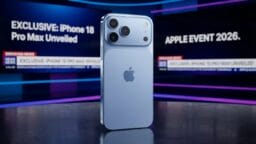
The iPhone 18 Pro stands as a judicious selection for enthusiasts of photography and videography, offering an intuitive phone design.
In contrast, the iPhone 18 Pro Max boasts the most expansive conventional display accompanied by the most robust battery specifications on record.
Meanwhile, the iPhone Duo is particularly advantageous for users who intend to frequently utilize its 7.6-inch folding display, multitasking capabilities, or support for the Apple Pencil. At a similar 256GB storage capacity, it commands a premium of $700 over the Pro Max.
Distinguishing the iPhone 18 Pro, Pro Max, and Duo
| Feature | iPhone 18 Pro | iPhone 18 Pro Max | iPhone Duo |
| US starting price, 256GB | $1,199 | $1,299 | $1,999 |
| Display | 6.3-inch OLED | 6.9-inch OLED | 7.6-inch inner OLED and 5.4-inch outer OLED |
| Rear cameras | 48MP triple-camera system | 48MP triple-camera system | 48MP dual-camera system |
| Main aperture | Variable: f/1.48, f/1.8, f/2.8 and f/4.0 | Variable: f/1.48, f/1.8, f/2.8 and f/4.0 | Fixed f/1.6 |
| Dedicated telephoto | Yes | Yes | No |
| Optical-quality zoom range | 16× | 16× | 4× |
| Typical battery rating | Up to 24 hours | Up to 30 hours | Up to 24 hours |
| Weight | 211g | 249g | 254g |
| Authentication | Face ID | Face ID | Touch ID in the side button |
| Apple Pencil support | Not listed | Not listed | Yes, with USB-C on the inner display |
All three devices harness Apple’s A20 Pro architecture, which features a 6-core CPU, a 7-core GPU enhanced by Neural Accelerators, as well as a dual 16-core Neural Engine.
This shared performance infrastructure ensures a unified experience; however, the surrounding hardware significantly influences the purchasing decision.
Screen and Form Factor: The Duo Expands Your Workspace
The hallmark of the iPhone Duo is its expansive 7.6-inch inner display, which, when folded, utilizes a 5.4-inch outer display.
When opened, it presents a significantly broader interface for documents, reading, gaming, videos, and multitasking via side-by-side applications.
The accompanying iOS 27 software includes a Split View feature, and the Duo is compatible with the Apple Pencil through USB-C on the inner screen.
This degree of versatility accompanies a distinct physical configuration. The Duo’s dimensions are 84.1mm in width and 11.3mm in thickness when closed, as opposed to the iPhone 18 Pro’s dimensions of 71.9mm in width and 8.75mm in thickness.
Weighing in at 254g, it is merely 5g heavier than the Pro Max and 43g more than the standard Pro. For those seeking a traditional, easily portable device, the iPhone 18 Pro remains the lightest alternative.
The Pro Max, meanwhile, showcases a 6.9-inch display while adhering to a conventional slab design. It occupies a middle ground: offering a larger screen than the Pro but lacking the Duo’s foldable versatility or dual-screen functionality.
Cameras: Pro Models as the Creative Contenders
For those prioritizing camera technology, the iPhone 18 Pro and iPhone 18 Pro Max are the preferred choices.
Both devices feature a 48MP Pro Fusion triple-camera system, variable aperture, and a dedicated 48MP telephoto camera. Their claimed optical zoom range reaches 16×, a stark contrast to the 4× offered by the Duo.
The Pro variants also embrace advanced photographic standards, supporting ProRAW, ProRes, ProRes RAW, Apple Log 2, ACES, Genlock, and spatial photography and videography.
These features are essential for serious editors, those utilizing manual settings, or individuals needing a device that seamlessly integrates into a more extensive production ecosystem.
On the other hand, the Duo is equipped with a 48MP Dual Fusion dual-camera setup featuring a fixed f/1.6 main aperture and lacks a dedicated telephoto lens.
Notably, it incorporates foldable-specific functionalities such as Smart Take and Duo Preview, which permit viewing the camera feed across both segments of the open display.
While innovative, this design does not compensate for the extra camera hardware present in the Pro models.
The front-facing camera configurations also differ significantly. The Pro models are fitted with an 18MP Center Stage camera featuring autofocus, whereas the Duo sports a 12MP outer Center Stage camera paired with an internal under-display camera restricted to 1080p at 30 or 60 frames per second.
Battery, Weight, and Controls
Setting the standard for battery longevity, the iPhone 18 Pro Max is rated for up to 30 hours of typical usage and up to 45 hours for local video playback.
Conversely, the iPhone 18 Pro is rated for up to 24 hours of standard utilization, with 36 hours of local video playback.
The Duo also boasts a 24-hour typical usage rating, while its local video capacity extends up to 44 hours on the outer display and 31 hours on the inner display.
This introduces a pertinent distinction: the Duo’s large display does not inherently guarantee superior battery performance.
The display in use significantly influences the rating, with the Pro Max remaining the preeminent option for both standard use and localized video playback.
Authentication methods present another decisive differentiation. The Pro models utilize Face ID along with the Action button, while the Duo employs Touch ID integrated within its side button, omitting the Action button altogether.
For individuals accustomed to Face ID functionality, this alteration represents more than a minor adjustment; it signifies a shift in interaction dynamics.
All models are compatible with MagSafe and Qi2 wireless charging at speeds up to 25W. The specified charging times indicate that approximately 15 minutes will yield a 50% charge for both Pro models, whereas the Duo necessitates around 20 minutes.
Pricing and Availability in the US
For the 256GB variants, Apple’s starting prices in the US are set at $1,199 for the iPhone 18 Pro, $1,299 for the iPhone 18 Pro Max, and $1,999 for the iPhone Duo.
Consequently, the Duo incurs a premium of $700 over the Pro Max and $800 over the Pro at the same storage capacity.
Apple unveiled the Pro models on September 9, 2026, with preorders commencing on September 12 and a release date slated for September 18.
Concurrently, the iPhone Duo was announced, with preorders initiated on October 16 and availability commencing on October 23.
Selecting the Model that Aligns with Your Lifestyle
Opt for the iPhone 18 Pro if…
- A more accessible entry price is essential.
- You desire the lightest conventional device at 211g.
- Access to the Pro camera system without the heft of the Pro Max is your preference.
- You favor Face ID and the Action button functionality.
Opt for the iPhone 18 Pro Max if…
- The most extensive conventional iPhone display (6.9 inches) is a priority.
- You prioritize battery life over compactness.
- You seek the Pro camera system, extended zoom capabilities, and professional-grade capture options.
- A willingness to spend an additional $100 for the 256GB model compared to the Pro is feasible.
Opt for the iPhone Duo if…
- Frequent unfolding of the device for reading, document handling, gaming, or multitasking is anticipated.
- The utility of Apple Pencil support on a phone-sized device is significant to your needs.
- The foldable display experience is of greater importance than the Pro models’ telephoto camera and advanced creative formats.
- You are prepared to invest $700 more than the Pro Max for the unique folding display and associated software enhancements.
The iPhone Duo represents a hybrid of phone and tablet, rather than a mere enhancement of the iPhone 18 Pro.

The Pro models allocate their cost towards superior cameras, optical zoom, creative capabilities, and, notably with the Pro Max, extended battery performance.
In contrast, the Duo directs its premium towards a significant 7.6-inch folding workspace. Ultimately, select the device that aligns with your ongoing usage patterns once the allure of novelty has diminished.
Source link: Neoteo.com.