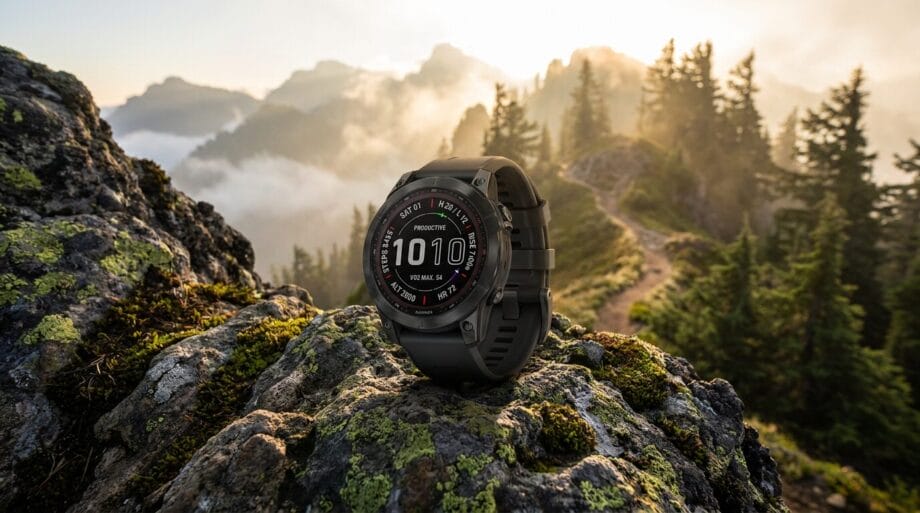
The Garmin Fenix 7, characterized by its substantial and cool presence on the wrist, is secured snugly against the skin as the fiber-reinforced polymer casing is tightened prior to a trail run; the stainless steel bezel glints subtly in the muted morning light.
A mere press of the Start button activates the vibrant MIP display, and within moments, the GNSS system acquires your location.
Multisport Orientation and Essential Features
The Fenix 7 series represents Garmin’s premier outdoor multisport smartwatch collection, strategically positioned beneath the more advanced Fenix 7 Pro yet above entry-level wearables.
The standard Fenix 7 features a 47 mm casing, complemented by 22 mm quick-release bands, and has a weight of approximately 79 grams, inclusive of the steel bezel and silicone strap.
Garmin specifies the casing material as fiber-reinforced polymer, enhanced by a metallic rear cover, and employs Corning Gorilla Glass DX for the standard model, eschewing sapphire crystal.
The display is a 1.3-inch diagonal, transflective memory-in-pixel panel with a resolution of 260 x 260 pixels designed to ensure optimal visibility under direct sunlight while minimizing energy consumption.
Garmin Fenix 7 and Its Impact on Garmin Ltd. Share Value
Exploratory reports, market analytics, and additional updates concerning Garmin Ltd.’s stock and wearable lineup.
Battery Life and Charging Mechanisms
The promise of enduring battery life is pivotal to the appeal of the Fenix 7. Garmin purports up to 18 days of operation in smartwatch mode for the 47 mm non-solar variant and an impressive 57 hours of unfaltering GPS tracking devoid of music.
In expedition GPS mode, users can extend the functionality to 40 days on a single charge, as per official specifications.
Charging employs Garmin’s proprietary 4-pin connector situated at the rear of the device. In day-to-day usage, one can detect the charging port’s recess by running a finger over the back plate.
Nonetheless, this watch retains a water resistance rating of 10 ATM, rendering it apt for aquatic activities and swimming.
The extended battery life affords outdoor aficionados the opportunity to embark on multi-day excursions without the necessity of carrying a power bank, especially when tracking is infrequent.
Satellite Positioning and Sensor Suite
The Fenix 7 boasts multi-GNSS positioning capabilities, encompassing GPS, GLONASS, and Galileo systems.
Recent firmware updates introduce multiband GNSS and multi-frequency modes for select models; however, the base variant emphasizes single-band GNSS with support across all available systems.
The underside of the watch integrates Garmin’s Elevate optical heart-rate sensor alongside SpO2 sensors facilitating pulse oximetry, which enables constant heart-rate monitoring and assessments of blood oxygen saturation.
Moreover, a barometric altimeter, compass, gyroscope, accelerometer, and thermometer coalesce into a sophisticated sensor suite designed to track variations in elevation, direction, and movement.
Training Features and Software Ecosystem
Garmin’s software architecture distinguishes the Fenix 7 from simpler wearable devices. Out of the box, the smartwatch accommodates profiles for activities such as running, trail running, cycling, hiking, skiing, swimming, and triathlon, among others.
Athletes benefit from structured workouts, PacePro pacing assistance, and training load computations based on heart-rate metrics and estimated VO2 max.
The watch’s stamina feature provides immediate real-time assessments of remaining energy during activities, showcased in a clear data field that shifts color as exertion increases.
A gentle vibration on the wrist upon completion of intervals or laps offers tactile feedback, particularly useful when one is fatigued during a climb.
Mapping, Navigation, and Storage
The Fenix 7 comes preloaded with TopoActive maps for various regions or allows convenient downloads via Wi-Fi from Garmin’s servers.
Street maps facilitate turn-by-turn guidance for running and cycling, while ski maps delineate resort trails and lifts. The standard model encompasses 16 GB of internal storage for maps and select music files.
Even on overcast days in the mountains, the advantages of the transflective display become evident: contour lines and route markers remain legible without backlight interference.
Users can navigate via breadcrumb trails or complete mapped routes, with the watch gently vibrating to signal deviations from the intended path.
Smart Features, Connectivity, and Application Ecosystem
Beyond athletic pursuits, the Fenix 7 incorporates smartwatch functionalities, including smart notifications, calendar access, and weather updates when linked to a smartphone.
The device connects via Bluetooth, while ANT+ and Bluetooth capabilities enable compatibility with external sensors such as heart-rate monitors, cycling power meters, and foot pods.
Through the Garmin Connect IQ platform, users can install third-party data fields, watch faces, and straightforward applications.
This ecosystem nurtures a collaborative environment for developers to create tailored experiences, with advanced users often incorporating specialized metrics for various activities.
This strategic platform approach is notable, as CEO Clifton Pemble consistently emphasizes the significance of wearables and connected fitness for sustainable growth.
Durability and Design Considerations
Garmin asserts that the Fenix 7 meets a 10 ATM water resistance standard, equating to a depth of 100 meters, making it suitable for swimming and snorkeling but not for deep-sea diving.
Furthermore, the watch has undergone rigorous testing for thermal, shock, and corrosion resistance, adhering to MIL-STD-810 standards as documented in reviews.
Aesthetically, the Fenix 7 adopts a utilitarian, tool-watch design. The raised steel bezel shields the glass from abrasions, while the exposed Torx screws contribute to its robust appearance.
On the wrist, its construction feels sturdy and resilient, appealing to users seeking a device capable of withstanding the rigors of outdoor activities rather than a fragile accessory.
Variants Within the Fenix 7 Lineup
The Fenix 7 family is diverse, encompassing various case sizes and configurations. The more compact Fenix 7S features a 42 mm case with a reduced battery lifespan, while the Fenix 7X boasts a larger 51 mm case and additional features such as an integrated LED flashlight.
Solar and Sapphire Solar editions offer solar charging capabilities and enhanced durability through the use of sapphire crystal.
Garmin’s naming conventions may perplex casual consumers; however, they serve a purpose in the context of pricing stratification.
The standard Fenix 7 stands as a versatile model, appealing for its robust battery life and comprehensive mapping features.
Market Position and Competition
In terms of pricing and features, the Fenix 7 competes with high-performance wearables from brands like Polar, Suunto, and Coros, alongside Apple’s more ubiquitous Apple Watch models.
However, Garmin leverages its extensive expertise in navigation and fitness metrics, targeting endurance athletes and outdoor enthusiasts rather than merely lifestyle consumers.
Analysts typically categorize the Fenix line as premium multisport devices, boasting average selling prices significantly above those of mass-market fitness trackers.
This premium positioning directly impacts average selling price metrics of interest to investors within Garmin’s Fitness and Outdoor segments, where high-margin products are integral to profitability.
Pricing, Availability, and Target Demographics
Garmin presents the Fenix 7 at an MSRP of approximately 699.99 USD, as indicated on the US product page, with European pricing generally aligned near 699.99 EUR for the standard model, subject to regional variations and taxation.
Over time, retail prices may fluctuate; nevertheless, Garmin maintains stable official prices as new variations, such as the Fenix 7 Pro, are introduced.
The watch is readily accessible through Garmin’s online store, specialized electronics retailers, and select outdoor shops.
The typical user demographic includes runners training for marathons, triathletes, hikers, and ski enthusiasts who necessitate dependable GPS, mapping capabilities, and extended battery life.
Corporate wellness initiatives and B2B clients occasionally adopt Fenix devices for executive fitness offerings, yet the bulk of sales derives from individual consumers.
Significance Within Garmin’s Business and Stock Landscape
In Garmin’s financial reporting, the Fenix line predominantly falls within the Outdoor segment, which CEO Clifton Pemble and CFO Doug Boessen frequently cite during earnings discussions as a catalyst for revenue expansion and enhanced operational margins.
Successor models, including the Fenix 7 Pro and Epix, build upon the same foundation, but the Fenix 7 remains a vital component of the active portfolio for many distributors.
For shareholders, robust sales of the Fenix 7 and its associated variants bolster Garmin Ltd.’s stock performance on Nasdaq, alongside offerings in marine, aviation, and automotive sectors.
It is noteworthy that Garmin’s share price may also be influenced by broader technology market trends and foreign exchange developments rather than solely by product life cycles.
Source link: Ad-hoc-news.de.