Samsung and Apple’s Foldable Phone Landscape
SEOUL – Samsung Electronics finds itself in a rather fortuitous position as it anticipates the debut of Apple’s inaugural foldable iPhone: the higher Apple sets its price, the more palatable Samsung’s own pricing strategy becomes.
As Samsung gears up for the anticipated launch of its Galaxy Z Fold 8 series in London this July, the mobile segment faces a challenging market environment.
Rising costs of memory and processing components loom large, and speculation suggests an uptick in the pricing of Galaxy devices.
Meanwhile, Apple, having been absent from this niche for several years, is expected to make a grand entrance in September with what may be the most exorbitant iPhone to date.
Nabila Popal, senior research director at IDC, informed The Korea Herald that she predicts Samsung will increase the prices of its flagship foldables by approximately $100 this year.
However, these prices will remain “significantly lower” than Apple’s anticipated entry point, which IDC estimates could soar to an astounding “sticker price of $2,500.”
This scenario offers Samsung an unusual advantage—pricing cover—something rarely afforded in its rivalry with Apple.
Nonetheless, as margins narrow due to rising costs, Samsung faces additional competitive pressure, particularly with Motorola expanding in the US market and Huawei solidifying its presence in China.
The Impending Cost Shock for Apple
The ramifications of these cost increases are no longer hypothetical. Recently, Apple CEO Tim Cook disclosed to The Wall Street Journal that price hikes have become “unavoidable” due to soaring memory and storage expenses, likening the situation to a “hundred-year flood.”
Popal observed this development with little astonishment. The tripling of memory costs this year means no vendor can bear such an impact indefinitely.
What struck her was the timing of Cook’s statement; she deemed it a “deliberate and astute move” to acclimatize consumers to impending price realities.
Contrarily, Samsung lacks the luxury of controlling its narrative, with its financial results already feeling the pinch.
The mobile division’s operating profit plummeted by 35 percent in Q1 compared to the previous year, despite strong sales of the Galaxy S26, as the escalation in component costs outpaced the ability to raise prices.
Some analysts in Korea now speculate that this division could enter the red in the latter half of the year.
Linda Sui, founder of Smart Analytics Global and former mobile devices head at TechInsights, explained to The Korea Herald that Samsung’s anticipated price hikes serve dual purposes: managing cost pressures and strategizing against Apple.
She forecasts that the Fold 8 Ultra will hover around $1,999, while a broader book-style Fold 8 might retail for approximately $1,799—an intentional lineup designed with Apple in mind.
Should Apple launch a foldable iPhone exceeding $2,000, it would create a “price umbrella” for the category, thereby positioning other competitors as more reasonable options.
For Samsung, this pricing strategy holds heightened significance this year. With profit margins compressing, it is imperative for the next Fold to be marketed as a premium offering rather than a luxury miscalculation. Apple’s anticipated $2,500 model makes a $1,999 Galaxy Fold 8 Ultra appear the judicious choice.
However, Samsung must execute this strategy promptly. Its foldables are set to debut in July, while Apple’s offerings are expected in September.
Thus, Samsung is establishing prices for a broader, book-style model that aligns with the rumored specifications of Apple’s product, even as it competes against a yet-to-be-seen rival.
Samsung’s Position in the Foldable Market
As July approaches, Samsung retains its status as the largest global manufacturer of foldable devices; however, this title appears increasingly tenuous.
In the United States, the second-largest market for foldables, Samsung has already ceded its lead. Popal noted that Motorola captured 48 percent of the market in 2025, while Samsung trailed with 43 percent. This disparity widened significantly to 65 percent versus 19 percent in Q1 of this year, according to IDC.
Counterpoint Research still places Samsung marginally ahead for 2025, anticipating a market share of 50.9 percent compared to Motorola’s 44.1 percent, yet this represents a sharp decline from 65.6 percent just one year prior.
As Popal stated, Apple is poised to exert “increased pressure, especially in the US.”
In contrast, China—the largest market, accounting for about 60 percent of global shipments—poses a different challenge for Samsung.
Historically, Samsung has struggled to penetrate this market, dominated by Huawei, meaning Apple’s entry may pose a more significant threat to Huawei than to Samsung, which has little to lose.
The global lead remains with Samsung for the time being. Sui of SAG projects it will maintain this position throughout 2026, with anticipated shipments surpassing 7 million foldables against Apple’s estimated 5 million.
The concern, however, lies in the future: “2027 could signify a significant turning point,” she cautions, with Apple “well-positioned to eclipse Samsung” due to its robust ecosystem and customer loyalty.
The Fundamental Query: Why Purchase a Foldable?
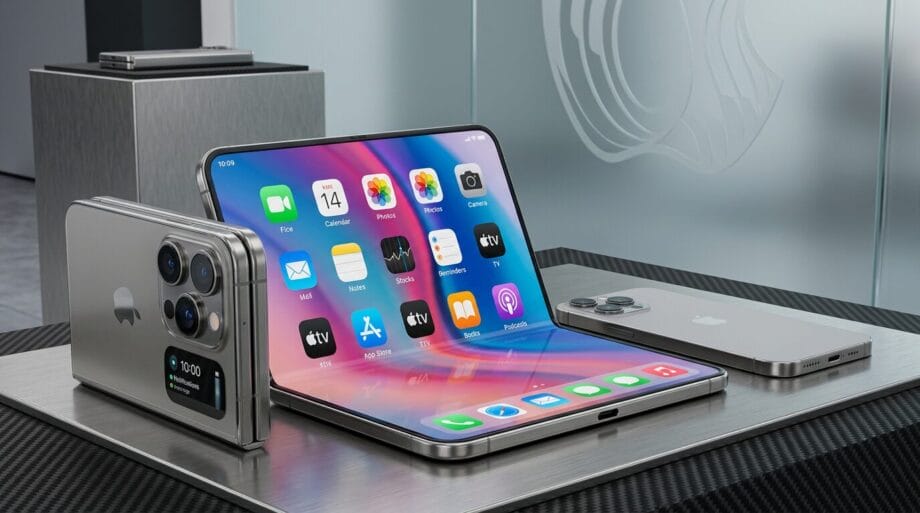
Ultimately, this scenario leads to an unresolved question that pricing cannot answer: Why invest in a foldable phone?
Historically, price has represented the most substantial obstacle to the adoption of foldable devices, and with costs now escalating, the justification for such a purchase becomes more challenging.
While hardware improvements are essential, Sui argues they may not suffice on their own. What truly matters is whether these devices prove their value in daily use.
She maintains that a successful niche market is attainable even without mainstream adoption. “Much like a luxury car elevating a mass-market brand,” a halo product can enhance brand perception and safeguard margins without necessitating high sales volumes.
Conversely, Popal remains less accommodating. She insists that foldables remain “a niche segment, accounting for less than 2.5 percent of the total smartphone market,” with only two pathways available for transformation: “Either prices must plummet drastically, or a groundbreaking use case needs to emerge.”
Source link: Asianews.network.