Imagine standing in a crowded room, trying to tell a story, but every time you open your mouth, the scene shifts. The person you were talking to changes faces. The background warps from a cozy cafe to a sterile office. And worst of all, it is completely silent.
This is the reality for most creators trying to leverage early-generation AI video tools. You have the vision. You have the script. But the execution feels like a fever dream – disjointed, mute, and frustratingly chaotic.
For years, we were promised a revolution in digital storytelling. We were told that text-to-video technology would democratize filmmaking. Yet, most of us are still stuck stitching together three-second clips that look more like hallucinations than cinema. You spend hours refining prompts, only to get a result that lacks continuity, audio, or soul.
But what if the barrier wasn’t your creativity, but the tool itself?
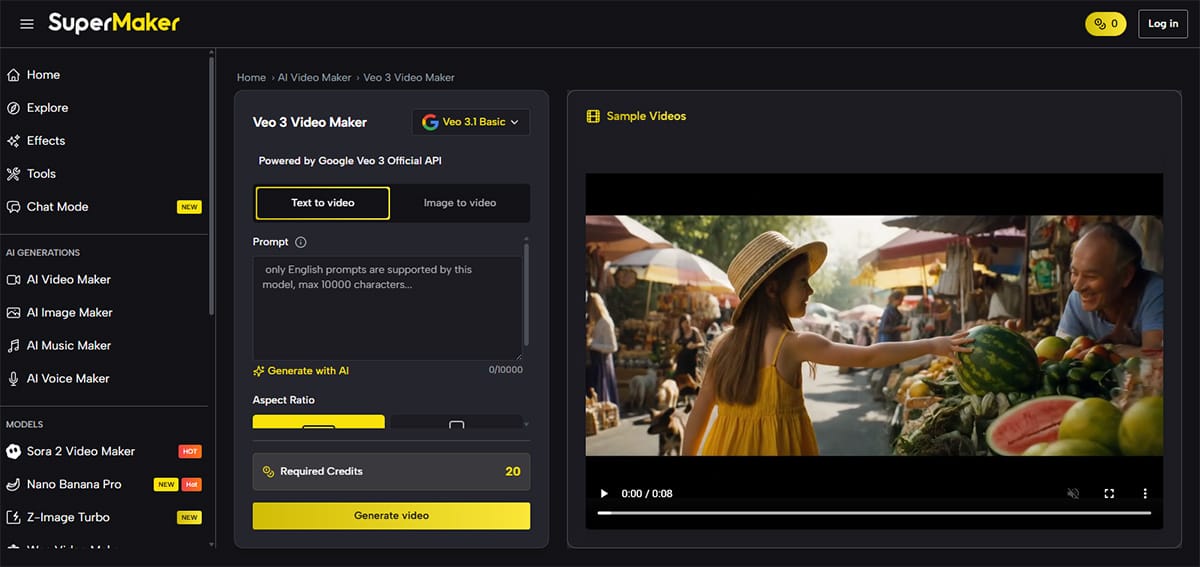
I recently stumbled upon a shift in this landscape. It wasn’t just another update; it felt like the moment movies went from black-and-white to Technicolor. This is where the Veo 3 Video Maker by Supermaker AI enters the frame, not just as a tool, but as a co-director that finally understands the assignment.
The “Silent Movie” Problem in a 4K World
Let me share a quick personal story. Last month, I needed a simple 10-second clip for a client: a futuristic car driving through a neon city with synth-wave music. Simple, right?
I used three different “leading” AI tools.
- Tool A gave me a car that morphed into a toaster halfway through the drive.
- Tool B kept the car consistent, but the city looked like melted wax.
- Tool C looked great, but it was dead silent. I had to spend another hour hunting for stock audio that didn’t quite match the vibe.
The friction was unbearable. I wasn’t creating; I was troubleshooting.
This is the “Agitation” phase of the creative process that burns out so many marketers and storytellers. You want to be a director, but you are forced to be a technician. You settle for “good enough” because perfection seems technically impossible without a Hollywood budget.
Enter Veo: The Bridge to Cinematic Consistency
When I first tested the Veo engine on Supermaker, I expected the usual trade-offs. I typed in a prompt, bracing myself for the weird artifacts or the silence.
Instead, I got something that shocked me: Cohesion.
The video didn’t just move; it flowed. And crucially, it sounded like something. The integration of audio isn’t just a nice-to-have feature; it is the heartbeat of persuasion. A video without sound is just a moving image. A video with synchronized audio is a story.
Here is how Veo bridges the gap between “AI chaos” and “Professional Cinema.”
1. From Randomness to Narrative Control
Think of traditional AI video generators like a slot machine. You pull the lever (the prompt) and hope the symbols align. Sometimes you win, mostly you lose.
Veo functions more like a sculpting tool. It understands the physics of the scene. If you ask for a character to turn their head, the background shifts in perspective correctly. This “spatial awareness” is what separates a gimmick from a professional asset.
2. The Audio-Visual Symphony
We often forget that 50% of the video experience is audio. Watching a storm without thunder or a bustling street without the hum of traffic feels uncanny. Veo 3 integrates audio generation directly into the video creation process. This means the mood of the sound matches the visual style automatically. You are no longer a DJ trying to sync tracks; you are a conductor leading an orchestra.
Visualizing the Difference: The Creator’s Upgrade
To truly understand why this matters for your brand or personal projects, let’s look at a direct comparison. This isn’t just about specs; it is about how the tool respects your time and vision.
| Feature Dimension | Standard AI Video Tools | The Veo 3 Experience on Supermaker |
| Audio Integration | Usually silent; requires external editing tools to add sound. | Native Audio Generation: Creates soundscapes that match the visual mood instantly. |
| Visual Consistency | Characters often “morph” or change faces between frames. | Narrative Threading: Maintains character identity and object permanence across the clip. |
| Prompt Adherence | Often ignores complex instructions or specific details. | Deep Context Understanding: Grasps nuance, lighting, and camera angles with higher fidelity. |
| Resolution & Clarity | Often blurry or low-res (480p/720p), requiring upscaling. | Native 1080p: Crisp, usable footage right out of the gate without extra processing. |
| The “Vibe” Check | Feels robotic and cold. | Cinematic Empathy: Captures the emotional tone (melancholy, energetic, serene). |
Why “Good Enough” is No Longer Enough
In the early days of the internet, having a website was enough. It didn’t matter if it was ugly. Today, design is non-negotiable.
We are at the same inflection point with AI video. The novelty of “look, a computer made this!” has worn off. Your audience is sophisticated. They can spot low-effort AI generation from a mile away – the jittery hands, the dead eyes, the silence.
Using a tool like Veo is about respect for your audience. It signals that you care about the quality of the story you are telling.
The Metaphor of the Chef
Imagine you are a chef.
Old AI Tools are like buying pre-packaged microwave meals. They are fast, but they taste like plastic, and you can’t change the ingredients.
Veo is like having a sous-chef who preps your ingredients perfectly. You still choose the menu (the prompt), but the execution is Michelin-star quality. You get the sizzle, the aroma, and the presentation, all without having to chop every onion yourself.
Unlocking New Possibilities for Your Brand
So, how do you actually use this? Because features are meaningless without application. Here is where the rubber meets the road for your strategy.
For the E-Commerce Giant
Stop using static images of your products. Use Veo to generate a 10-second clip of your product in a lifestyle setting – with the sound of the environment included. If you sell coffee beans, show the steam rising and the rich dark pour, accompanied by the sound of liquid filling a ceramic cup. That sensory detail converts browsers into buyers.
For the Content Creator
Your retention rates drop when your B-roll looks generic. With Veo, you can generate specific, hyper-relevant B-roll that matches your script perfectly. Need a “cyberpunk detective looking at a rainy window”? You don’t have to search stock libraries for hours. You just create it.
For the Educator
Abstract concepts are hard to explain. Instead of a boring slide deck, generate a video that visualizes the metaphor. If you are explaining data flow, show a river of glowing light moving through a digital canyon. The visual anchor helps students retain information faster.
The Future is Moving (and Speaking)

We are moving past the era of static content. The algorithms of Instagram, TikTok, and LinkedIn heavily favor video. But high-quality video production has traditionally been a “rich man’s game,” reserved for brands with five-figure budgets.
Veo levels this playing field. It hands you the keys to the studio.
When I finally delivered that video clip to my client – the one with the futuristic car – I used Veo. The car didn’t morph. The neon lights reflected accurately on the wet pavement. And the low hum of the electric engine sold the reality of the scene.
The client didn’t ask, “Did you use AI?” They asked, “How did you shoot this?” That is the difference. That is the power of narrative consistency.
If you are ready to stop fighting with tools and start telling stories, it is time to upgrade your toolkit. The silent film era of AI is over. Don’t let your brand be the last one to find its voice.
Explore the engine, test your wildest prompts, and see what happens when technology finally catches up to your imagination.