United Airlines Reinforces Headphone Usage as a Binding Policy
United Airlines has transformed what many regarded as mere cabin courtesy into a strict mandate. In a recent revision of its contract of carriage, the airline has established that travelers who neglect to utilize headphones for audio or video content on their devices may face denial of boarding, removal from a flight, or even expulsion from future travel with the airline.
From Informal Courtesy to Formal Policy
This significant alteration, enacted on February 27, places headphone usage into the official “Refusal of Transport” section of United’s contract, situating it alongside disruptive behavior and smoking violations, which justifies denial of service.
Consequently, it endows flight crews with explicit authority to address instances where a passenger broadcasts sound into the cabin and refuses to comply with requests to cease.
The newly articulated clause delineates that passengers who “fail to use headphones while engaging with audio or video content” could find themselves refused transport, including a permanent ban.
While flight attendants have historically requested that audio be kept private, this is the inaugural occasion that a principal U.S. carrier has enshrined the headset requirement as a formal condition rather than a mere suggestion.
United describes this measure as an enhancement of standard decorum rather than a punitive action. However, the language juxtaposes the headphone mandate alongside behaviors warranting immediate removal, generating astonishment among travelers, many of whom have only recently become aware of the update through news media and social platforms.
At present, there is no dedicated preflight announcement regarding the headphone rule, and the policy primarily resides in the fine print of the contract. Yet, industry analysts highlight that once incorporated into official policy, such conditions can profoundly influence how cabin crews address conflicts.
The Practical Implications of “No Headphones, No Flight”
Despite sensationalist headlines, United does not mandate that every passenger don headphones for the entirety of their journey, nor during safety briefings.
The rule pertains specifically to scenarios where a traveler emits an audible sound from a personal device and neglects to use headphones or reduce volume upon request. Activities such as quietly browsing social platforms or utilizing a device with the sound muted remain unregulated.
Enforcement will heavily rely on the discretion of cabin crews. Initially, flight attendants may issue a polite request, escalate to a stronger warning, and only subsequently consider removal or notifying corporate security if noncompliance continues.
United emphasizes that expulsion or a permanent prohibition will be reserved for more severe or recurrent infractions, not isolated incidents of miscommunication.
Travelers who find themselves without earbuds have a minor safety net: United has indicated that passengers can request complimentary disposable headphones, subject to availability.
This option aims to mitigate confrontations at cruising altitude due to a forgotten accessory, although it cannot guarantee sufficient supplies on every flight.
The headphone policy intersects with existing regulations as well. Like numerous airlines, United prohibits voice and video calls post-boarding and during flight.
A passenger engaging in a loud video call without headphones could now simultaneously contravene two clauses, thereby granting crews additional justifications to demand cessation or remove the individual from the flight.
Motivations Behind United’s Policy Shift
The timing of this update is not coincidental. United is in the process of deploying high-speed Starlink satellite internet across its fleet, a development anticipated to catalyze increased streaming, social media interactions, and live messaging during flights.
With a larger number of passengers online, the potential for auditory disturbances escalates, particularly as short-form video content frequently defaults to autoplay with sound.
Moreover, airline executives and cabin staff have been contending with a notable rise in in-flight disturbances since 2021, documented by regulators and industry organizations.
These incidents often commence with relatively minor etiquette violations, such as reclining seats or disputes over armrests, only to escalate from there.
By clarifying that audible device usage is non-negotiable, United aims to mitigate common sources of unrest preemptively.
There is also a competitive dimension. Other U.S. airlines advocate for headphone use, albeit none have articulated it as explicitly as United.
For travelers weary of enduring fellow passengers’ videos and music, this new policy could serve as a key marketing strategy, reinforcing United’s commitment to quieter cabin environments amid increasingly crowded flights.
Simultaneously, advocates for privacy and individual liberties are monitoring the application of this rule. If enforced primarily to mitigate repeated loud disturbances, it may be welcomed. However, inconsistent application or perceptions of overreach could kindle further friction between airlines and their customers.
Navigating the New Policy Effectively
For travelers wishing to comply with United’s headphone policy, the steps to avoid complications are uncomplicated but require foresight.
A primary recommendation is to stow reliable wired or wireless earbuds in an easily accessible pocket, as opposed to out of reach in checked luggage.
Additionally, boarding with devices pre-set to low volume or muted until headphones are connected can avert inadvertent auditory outbursts during takeoff or congested boarding procedures.
Patrons relying on Bluetooth headphones should remain cognizant that some in-flight entertainment systems still necessitate a wired connection. While streaming from personal devices should function seamlessly, it is prudent to carry a backup wired option or adapter to avert connectivity dilemmas that might compel a switch to speaker mode.
When approached by a crew member regarding device volume, perceiving the interaction as an issue of safety and comfort rather than a personal affront can greatly ease tension.
Lowering the volume, plugging in headphones, or muting the device as requested usually suffices. Refusing a reasonable request under the newly articulated contract terms could swiftly escalate from a minor etiquette adjustment to documented noncompliance.
Families traveling with young children are also advised to prepare accordingly. Child-sized headphones can facilitate a child’s viewing of cartoons or gaming without disturbing adjacent passengers.
Many travel experts recommend testing volume-limiting options at home, ensuring they are both comfortable and sufficiently audible without necessitating unsafe sound levels.
Implications for Air Travel Etiquette
United’s headphone policy encapsulates a broader evolution in the institutionalization of etiquette within airline operations.
Behaviors previously governed informally by disapproving glances from fellow passengers, such as barefoot ambulation down the aisle or loud phone conversations, are increasingly being codified into official agreements and cabin communications as delineated guidelines.
For frequent flyers, this policy may represent a formal acknowledgment of a norm that has been largely established.
Many travelers routinely utilize noise-canceling headphones, and grievances regarding excessive noise from videos and music have consistently featured in online discussions.
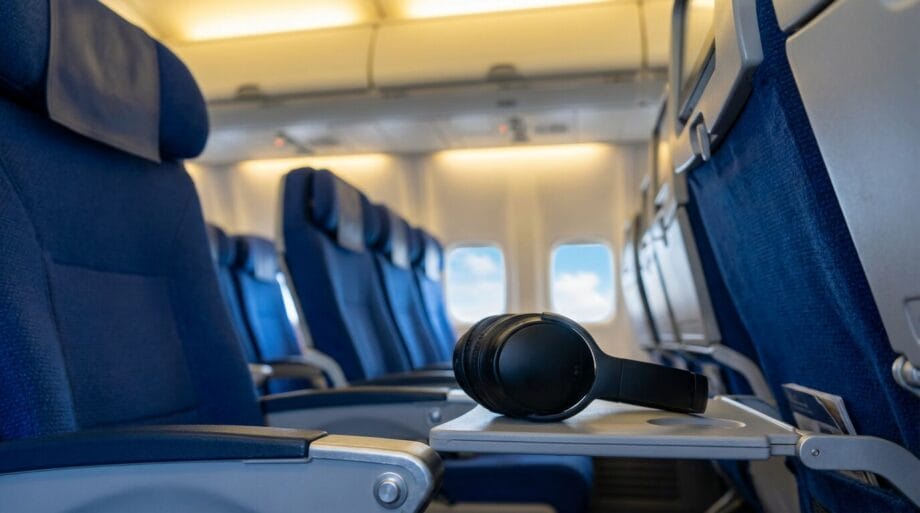
Codifying such expectations into a rule empowers crews with unequivocal support when intervention is necessary.
Conversely, occasional travelers, particularly those unfamiliar with perusing extensive contracts of carriage, may be caught off guard at the gate or aboard.
As word spreads regarding United’s updates, other airlines will be closely observing traveler reactions, deliberating whether to implement similar explicit policies or continue with more lenient reminders.
Clearly, the struggle for a more serene cabin atmosphere has transitioned from social conventions to formal regulations.
For passengers, the simplest yet most practical takeaway remains: if one plans to view, listen to, or engage with audible content on a forthcoming United flight, ensuring a pair of headphones is readily accessible is paramount.
Source link: Thetraveler.org.