United Airlines has introduced a new regulation that aims to address a long-standing grievance among passengers.
The airline has revised its Contract of Carriage to explicitly permit the removal of passengers during flights and to impose temporary or permanent bans on those who refuse to use headphones while playing audio on board. This policy transforms a matter of basic courtesy into a formal condition of carriage.
Modifications in United’s Headphone Policy
The updated policy delineates that the airline can refuse transportation—to an individual on a case-by-case basis or indefinitely—for travelers who neglect to don headphones while engaging with music, videos, or any sound-emitting devices.
Furthermore, cabin crews are now authorized to deplane passengers “at any moment” should they fail to adhere to the directive of maintaining audio privacy. CBS News was the first to report this contract amendment.
In a commendable gesture towards customer service, United stipulates that passengers removed or banned under this regulation may request restitution for any unused travel segments.
Additionally, the airline offers complimentary earbuds, contingent on availability, recognizing that not all travelers arrive equipped with their own.
Rationale Behind United’s Timely Formalization of the Rule
According to United representatives who spoke to The Verge, the airline has consistently encouraged the use of headphones; this new policy merely codifies a practice routinely enforced by crews.
The decision comes during an era of rapid advancements in in-flight connectivity. As high-speed satellite Wi-Fi—such as Starlink—becomes prevalent in the industry, the likelihood of loud audio, and the potential conflicts it engenders, inevitably increases.
Heightened connectivity facilitates multiple passengers engaging in video streaming, gaming, and browsing short-form content simultaneously.
Independent speed assessments have demonstrated that modern satellite connections routinely provide bandwidth exceeding tens of Mbps, easily sufficient for high-definition streaming.
While streaming offers convenience, the lure of avoiding headphones presents a challenge. United’s formal policy serves as a revert to basic etiquette in shared spaces.
Enforcement Protocol in the Cabin: A Sequential Approach
The enforcement process will adopt a graduated approach. Flight crews will generally commence with a courteous reminder, escalating their response if a passenger remains noncompliant. At that juncture, the issue transitions from “noise nuisance” to “failure to comply.”
Under federal regulations and standard airline practices, disregard for crew directives may result in severe consequences, including removal from the aircraft and potential civil penalties.
Flight attendants emphasize that this is not merely a hypothetical scenario. Unionized crew members report encountering situations where passengers refuse to cease playing loud videos or using speakerphone on almost every flight.
An explicit policy equips them with a more robust framework to address these incidents swiftly, mitigating potential unrest within the cabin.
Comparison of United’s Policy with Other Airlines
While many major U.S. airlines advocate for headphone usage through standard announcements and general “courtesy” language, few have articulated specific consequences of noncompliance in their official contracts.
As per CBS News, United is the inaugural major U.S. carrier to formally connect the issue of loud audio to removal from the flight and potential future travel restrictions. This explicitness is critical: embedding the rule in the contract facilitates consistent application.
The Intersection of Air Travel Etiquette, Safety, and Compliance
Although this regulation is primarily framed as an issue of etiquette, it also intersects with broader safety concerns.
The FAA has reiterated its stringent stance on unruly behavior, emphasizing that compliance with crew instructions—including wearing headphones—is imperative.
Surveys have indicated that a significant number of flights still grapple with disruptive conduct, despite a notable decline in reports since the pandemic’s peak.
By anchoring the headphone mandate in the Contract of Carriage, United aims to curtail minor irritants from escalating into substantial altercations.
This framework may well establish a blueprint for other carriers to adopt as connectivity and personal device usage continue to proliferate.
Guidance for Travelers to Mitigate Onboard Audio Challenges
- Pack a backup: Include a low-cost wired headset in your carry-on, even if you prefer Bluetooth options.
- Inquire promptly: If you forget your headphones, request complimentary earbuds during boarding; supplies may be scarce.
- Consider children: Volume-limited, child-friendly headsets can save your row—and yourself—from unwanted disturbances.
- Avoid escalation: If a neighboring passenger is playing audio at a high volume, notify a flight attendant instead of confronting them directly.
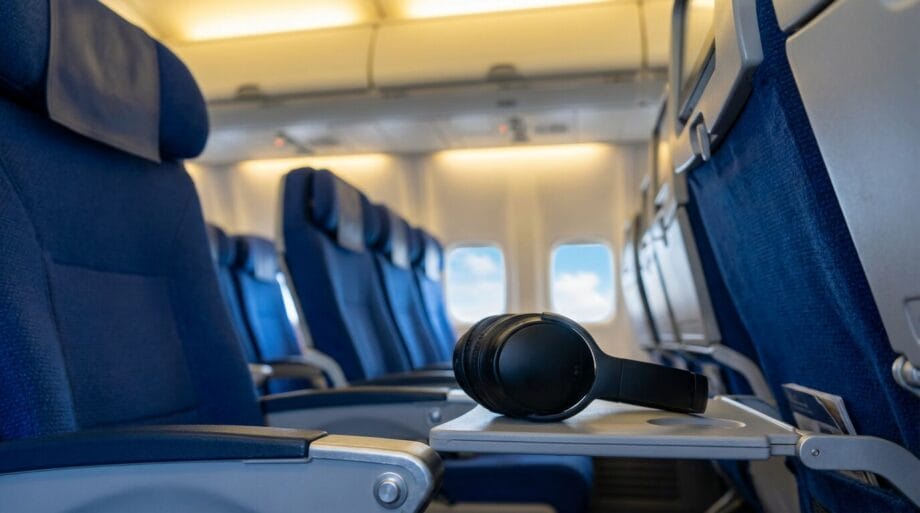
Aboard an aircraft, shared space is at a premium. United’s updated policy crystallizes common sense into a coherent guideline, aligning crew authority with passenger expectations amidst improving Wi-Fi capabilities.
Remember to bring your headphones to foster a peaceful environment. Should you forget, don’t hesitate to ask before the soundtrack of your journey becomes a communal concern.
Source link: Findarticles.com.