US Marines Innovate with Cost-Effective “LUCAS” Drone, Drawing from Iranian Models
- The United States Marine Corps has developed an economical combat drone called “LUCAS,” closely modeled after Iran’s Shahed-136, according to recent reports.
- An expert cautions that this emulation of Iranian technology undermines the perception of Iran as a nation lacking military sophistication.
The reverse-engineering of Iranian drone technology by the United States signifies a striking departure from a nation historically regarded as a vanguard in military innovation, according to an article in The National Interest.
This analysis indicates that the latest strides in unmanned aerial vehicles have laid bare an unforeseen vulnerability, with Washington now appropriating concepts from its foes rather than defining the trajectory of military aviation.
Transition from Leader to Copycat
The report posits that the US defense sector has lagged in innovation, as allies and adversaries—ranging from China and Russia to Turkey and Ukraine—have heavily invested in drone advancements, while the US has leaned on erstwhile advantages.
Within this context, the US Marine Corps is finalizing the design of the “LUCAS” drone, described as remarkably similar to Iran’s Shahed-136 loitering munition.
According to Weichert, this scenario embodies a profound historical irony; Iran initially launched its drone development by reverse-engineering a US RQ-170 surveillance aircraft captured in 2011. Today, he contends, the effectiveness of Iranian designs has advanced to the point where they now serve as models for US military adaptation.
Specifications of the LUCAS System
The LUCAS drone is projected to cost approximately $35,000 per unit. The Pentagon intends to mass-produce this system, employing a strategy reminiscent of World War II shipbuilding techniques, while incorporating artificial intelligence to facilitate autonomous target acquisition and engagement.
Preliminary testing in Arizona is reportedly yielding favorable results, potentially paving the way for deployment across various regions, from the Pacific to Europe.
Implications for Strategic Assessment
Experts caution that the reliance on Iranian technology may significantly undermine Washington’s long-held narrative of Iranian technological inferiority.
This analysis maintains that the adoption of Iranian weaponry signifies not merely a reactive measure but rather an implicit acknowledgment of a more formidable adversary. Consequently, this should trigger a comprehensive reevaluation of Iran’s military capabilities and the potential sophistication of additional systems possessed by Tehran.
Advancements in Iran’s Drone Technology
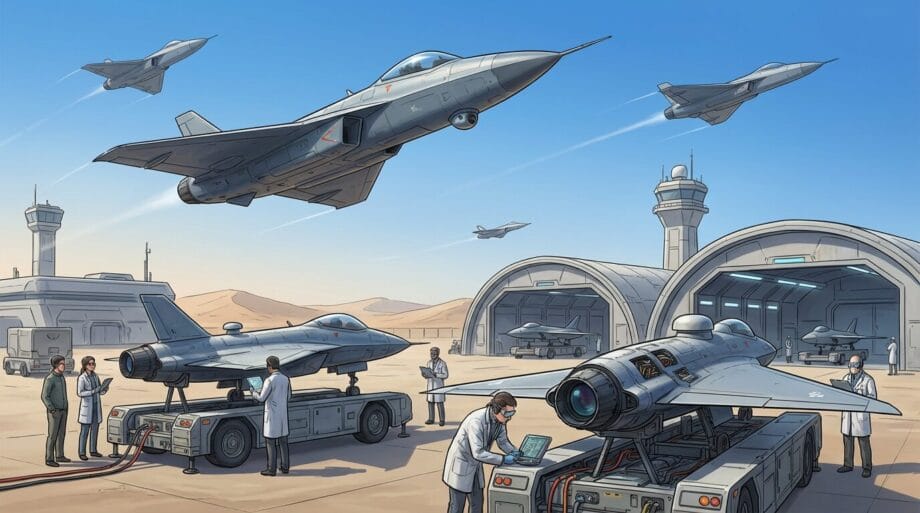
The report highlights that Iran has already unveiled an advanced iteration of the drone, designated the Shahed-136B, under the auspices of the Islamic Revolutionary Guard Corps Aerospace Force.
This variant boasts an operational flight duration ranging from 16 to 20 hours and an impressive range of up to 4,000 kilometers.
It is equipped with a 50-kilogram warhead and features thermal shielding to diminish its heat signature, enhancing its survivability against air defense systems and radar detection.
Ultimately, this evolving narrative surrounding Iran’s drone capabilities challenges entrenched assumptions within Washington and signals a transformative shift in the arena of low-cost, high-impact warfare technologies.
Source link: En.royanews.tv.