Amazon’s Pioneering Emphasis on Speed in Retail
The observation by Amazon CEO Andy Jassy underscores a pivotal moment in the landscape of commerce. With rapid technological evolution reshaping business norms, the imperative of operational efficiency—characterized by a lean structure, flattened hierarchies, and rapid execution—has never been more pronounced.
Jassy’s remarks resonate profoundly in the online retail sector, particularly within the grocery domain, where consumer expectations for immediacy are paramount.
Instant delivery options have transitioned from being exceptional to becoming standardized; indeed, same-day delivery has become a de facto requirement, and even two-hour delivery windows are increasingly prevalent. Customers simply do not wish to languish in waiting for their groceries.
In recent years, Amazon has made substantial advancements within the online grocery arena, leveraging the immediacy of delivery as a strategic asset against formidable competitors like Walmart and Kroger.
The company has recently announced a significant expansion, doubling the availability of same-day delivery across the United States to encompass 2,300 municipalities.
This rapid proliferation is particularly remarkable considering that just this past August, Amazon initiated same-day delivery of perishable goods for Prime subscribers in a more limited network of 1,000 cities.
Prime members enjoy complimentary same-day delivery on orders surpassing $25; otherwise, a fee of $2.99 is applied for smaller orders. Conversely, non-Prime subscribers face a flat fee of $12.99 regardless of their total purchase.
Despite these strides, Amazon is entering a fiercely competitive online grocery sector where it plays catch-up. Data from eMarketer indicates that Walmart reigns supreme, controlling approximately one-third of the U.S. grocery e-commerce market, while Amazon holds about 23%.
Kroger trails with an eight percent market share, currently undergoing a reevaluation of its digital commerce strategy, as noted by diginomica.
A Paradigm Shift in Consumer Behavior
The current dynamics of the online grocery market have been markedly influenced by evolving consumer preferences, as observed by Jassy, who notes:
“This transformation is recalibrating the trajectory and size of our grocery operations. Many of our customers now purchase from us multiple times weekly, often including household staples alongside perishables like milk and eggs, all conveniently combined in a singular shopping cart.”
He further elucidates how the company’s foray into this realm has exceeded initial projections
“Since we ventured into select markets last year, we’ve been astonished by the rapid adoption rates, not just in the volume of perishable purchases, but in the frequency of customer return visits.”
Jassy encapsulates a burgeoning departure from traditional grocery shopping routines, asserting that Amazon is contributing significantly to this transformation.
At Uber, where the online grocery delivery sector now boasts an impressive $12 billion run rate, Chief Financial Officer Prashanth Mahendra-Rajah echoed similar sentiments during the UBS Global Technology and AI Conference 2025:
“As an industry, we find ourselves merely at the nascent stages of profound behavioral shifts, as consumers increasingly opt for grocery deliveries. Uber has indeed positioned itself as the premier option for those needing immediate top-up items.”
He further reflects on the divergence in shopping habits:
“The American tendency to perform extensive grocery runs is unique. Globally, shoppers tend to frequent grocery stores multiple times per week. This distinction in consumer behavior will continue to evolve in the U.S. as individuals weigh the convenience of meal preparation options available via Uber Eats.”
Expanding Horizons for Faster Delivery
In this context, Amazon’s determination to amplify its delivery capabilities comes as little surprise:
“We are committed to enhancing our infrastructure to expedite rural deliveries, pledging over $4 billion towards the expansion of our rural delivery network in the United States. Unlike other companies retreating from service in smaller towns, we have increased access to both same-day and next-day deliveries in rural areas by 60%.”
Moreover, enhanced delivery options are already in motion, including three-hour delivery windows across select U.S. cities and the piloting of Amazon Now, which promises 30-minute delivery for groceries and household items in regions like Seattle and Philadelphia.
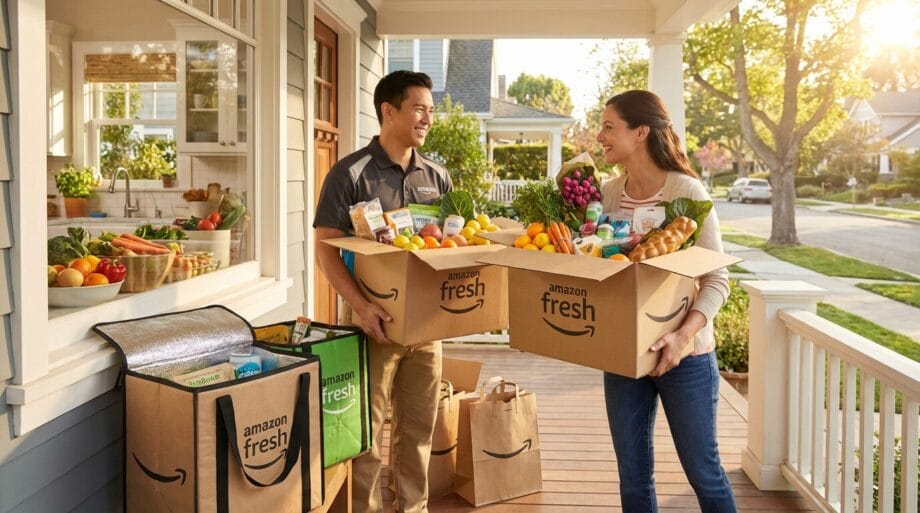
The impact of this competitive expansion may pose a challenge not solely to mainstream grocery retailers, but also to courier giants such as Instacart and Uber, both of which saw their stock values delve following Amazon’s recent developments.
Instacart, for its part, has forged what could be a lucrative partnership with Kroger, making the grocery delivery sector a pressing priority.
Instacart CEO Chris Rogers asserted:
“We’ve meticulously crafted the premier end-to-end online grocery marketplace in North America, prioritizing customer-centric factors such as exceptional selection, quality, affordability, and seamless experiences.”
He elaborates on Instacart’s progress:
“Our growing, loyal customer base reflects our commitment to enhancing service and delivery efficiency, as those who initially use our platform return for more frequent shopping experiences.”
Regarding the Amazon threat, he confidently states:
“We continually analyze our competitive landscape and are achieving growth in overlapping markets, demonstrating stability in our sales mix and maintaining strong average order values.”
Rogers welcomes competition:
“The online grocery market is enticing, and we have adapted well to shifts in competition, driving us to succeed in niches our adversaries haven’t fully explored.”
Notably, as an observer, it is apparent that the UK has actually made considerable advancements in the e-commerce grocery sector. The weekly online delivery experience, complemented by smaller in-store purchases, has become indispensable.
Lastly, when it comes to expedited delivery, perishables prominently benefit—Amazon’s data indicates that top purchases via its same-day service include bananas, avocados, strawberries, and, intriguingly, toilet paper—an unexpected yet telling requirement in modern grocery shopping.
Source link: Diginomica.com.