The Dawn of a New Era in Tech: The 2026 AI Supercycle
As the year 2026 approaches, the technology sector is undergoing what many analysts deem the most monumental hardware upgrade cycle in over a decade.
Fueled by the comprehensive rollout of Apple Intelligence, the so-called “AI Supercycle” has transitioned from a mere marketing phrase into a concrete market phenomenon.
At the nucleus of this transformation lies the iPhone 17 Pro, a device that has redefined consumer engagement with mobile technology, evolving the smartphone from a passive utility into an active, agentic ally.
The launch of the iPhone 17 Pro in late 2025, paired with the innovative iOS 26 software framework, has instigated a significant wave of device upgrades.
For the first time, the attractiveness of a new smartphone hinges not on camera quality or screen brightness, but rather on its “Neural Capacity”—the capability to execute intricate, multi-step AI functions locally while safeguarding user privacy.
Technical Advancements: The A19 Pro Chip and 12GB RAM Standard
At the core of this technological renaissance is the A19 Pro chip, fabricated using TSMC’s advanced 3nm (N3P) process. Unlike previous iterations that aimed for modest improvements in peak clock speeds, the A19 Pro achieves an extraordinary 40% enhancement in sustained performance.
This advancement stems not merely from improved transistor density but from a radical redesign of the iPhone’s internal architecture.
Notably, Apple has made a pioneering move by incorporating a vapor chamber cooling system into the Pro lineup, enabling the A19 Pro to sustain high-performance operation during extensive local LLM (Large Language Model) processing.
To accommodate these sophisticated AI functionalities, Apple has established 12GB of LPDDR5X RAM as the new standard for the Pro series. This augmentation in memory was essential for the deployment of “local agentic intelligence.”
In contrast to the 8GB models of prior generations, the 12GB configuration allows the iPhone 17 Pro to maintain a 3-billion-parameter language model within its memory.
This design ensures that the device can perform complex tasks—ranging from real-time language translation to semantic indexing of a user’s entire digital trove and on-device image generation—without incurring latency or relying on remote servers.
Initial feedback from the AI research community has been overwhelmingly favorable, particularly regarding Apple’s “Neural Accelerators” embedded directly within the GPU cores.
Experts point out that this methodology starkly contrasts with competitors who often depend on cloud-based processing.
By championing local execution, Apple has effectively sidestepped the “latency wall” that previously impeded widespread adoption of voice-based AI assistants, rendering the new Siri both prompt and conversational.
Apple’s Strategic Market Position and the Competitive Landscape
The 2026 supercycle has positioned Apple strategically, prompting rivals such as Samsung and Google (NASDAQ: GOOGL) to expedite their own on-device AI initiatives.
Through a meticulous combination of proprietary silicon and the iOS 26 ecosystem, Apple has forged a “privacy moat” that is challenging for data-centric advertising firms to replicate.
A critical element of this strategy has been the integration of Private Cloud Compute (PCC); when a task surpasses the iPhone’s local processing capacity, it is transferred to Apple Silicon-based servers in a “stateless” setting, where data remains impermanent and inaccessible to Apple itself.
This development has enkindled a seismic shift in the app economy. Conventional applications are increasingly supplanted by “intent-based” interactions, wherein users engage with Siri as opposed to launching individual apps.
This transition has compelled developers to abandon traditional UI paradigms in favor of “App Intents,” thereby ensuring their offerings are discoverable through the iOS 26 agentic engine.
Tech giants traditionally reliant on high “time-in-app” metrics are now pivoting to maintain relevance in a landscape where the operating system, rather than the app, governs user workflows.
Revolutionizing Human-AI Interaction: The Agentic Siri
The broader implications of the 2026 AI Supercycle hinge on the evolution of Siri from a simple voice-activated tool into a multifaceted digital agent. Within the iOS 26 framework, Siri can now perform intricate, cross-application tasks.
A user might issue a single command, such as “Locate the contract I received in Mail yesterday, emphasize the revisions in the indemnity clause, and draft a summary for my legal team on Slack,” and the system autonomously manages the entire sequence.
This capability is facilitated by “Semantic Indexing,” which enables the AI to comprehend the context and interconnections between data across various applications.
This advancement signifies a departure from the “chatbot” era of 2023 and 2024, with far-reaching societal implications, as it democratizes sophisticated productivity tools that were previously accessible only to elite users.
However, it has also sparked apprehensions regarding “algorithmic dependency.” As individuals become increasingly reliant on AI agents for professional and personal management, questions surrounding the transparency of AI’s decision-making processes and the potential for “hallucinations” in essential workflows are gaining traction in public discourse.
Peering into the Future: iOS 26.4 and AI’s Evolution
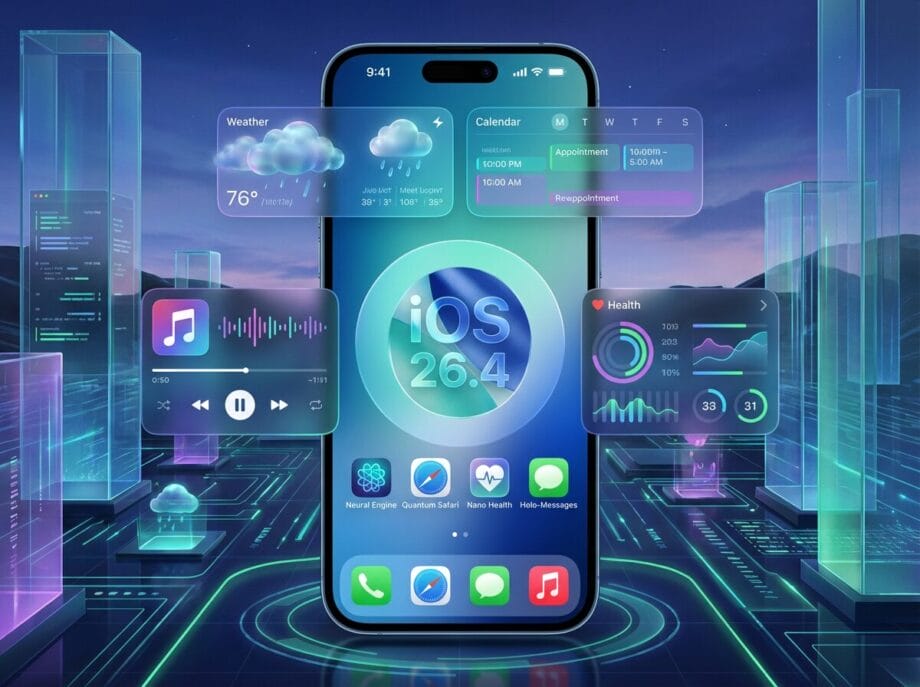
As we look toward the remainder of 2026, industry observers anticipate the forthcoming release of iOS 26.4, rumored to introduce “Proactive Anticipation” features.
This would empower the iPhone to suggest and even preemptively execute tasks based on user habits and real-time contextual clues.
For instance, should it detect a flight delay, the device might automatically inform contacts, reschedule calendar entries, and vet a ride-share service, all without user initiation.
Apple faces the long-term challenge of striking an intricate balance between utility and privacy. As Siri becomes more intricately woven into users’ digital lives, the amount of sensitive information processed through Private Cloud Compute is set to escalate exponentially.
Experts foretell that the next frontier will encompass “federated learning,” wherein AI models are enhanced based on user interactions without the raw data ever being transferred from the individual’s device.
Conclusion: The AI Supercycle’s Unfolding Narrative
The 2026 AI Supercycle marks a pivotal juncture in the landscape of personal computing. By merging the 40% performance enhancement of the A19 Pro with the 12GB RAM standard and the agency-driven capacities of iOS 26, Apple has effectively ushered in the “Intelligence” era for smartphones.
The essential takeaway for the industry remains that hardware is paramount; even the most sophisticated software is constrained by the silicon on which it operates, and Apple’s vertical integration has enabled it to redefine the benchmarks of mobile device capabilities.
As we navigate through the first quarter of 2026, attention will focus on the efficacy of these AI agents in tackling the complexities of the real world.
The significance of this evolution cannot be overstated—it marks the juncture where AI transitioned from a feature to the quintessential interface.
For both consumers and investors, the upcoming months will serve as a litmus test for whether this new paradigm of “Personal Intelligence” can fulfill its aspirations of fostering a more efficient and privacy-centric digital future.
Source link: Markets.financialcontent.com.