Samsung Messages to Cease Operations: User Transition Guide
The recent revelation regarding the termination of Samsung Messages, showcased on the company’s website this past weekend, bears an intriguing yet somber note.
Users are encouraged to launch the application to ascertain the exact date of its impending closure—a peculiar farewell for an app approaching its twilight.
The emotional response to this news may range from a bittersweet sense of nostalgia to a palpable melancholy, depending on one’s attachment to the service.
| Topic | Samsung Messages App Discontinuation |
|---|---|
| Developer | Samsung Electronics Co., Ltd. |
| Headquarters | Samsung Digital City, Suwon, South Korea |
| App Successor | Google Messages |
| Discontinuation Date | July 2026 (exact date available in-app) |
| Affected Devices | Samsung Galaxy devices running Android 12 (One UI 4) or higher |
| Unaffected Devices | Android 11 or lower; Tizen OS smartwatches (partial impact) |
| Key Features Lost | Samsung Messages UI/design consistency with One UI; full conversation history on older Tizen smartwatches |
| Google Messages Replacement Features | RCS messaging, AI-powered spam/scam detection, Gemini integration, multi-device sync |
| Galaxy S26 Status | Ships with Google Messages as default; Samsung Messages not pre-installed |
| Reference Links | Samsung Official — Switch to Google Messages / Android Authority — Samsung Messages End-of-Life |
Samsung Just Surrendered Its Own Messaging App to Google. Should You Be Worried?
On April 5, Samsung officially announced that its native messaging application would be retired in July 2026.
This announcement, presented as an “End of Service” notification, targets users of Galaxy smartphones operating on Android 12 or higher—essentially encompassing the vast majority of Samsung devices actively utilized in the United States.
The directive to “Upgrade to Google Messages as your default messaging app today to maintain a consistent messaging experience on Android” leaves little room for ambiguity.
There is no promise of an alternative Samsung product; one is met only with a countdown and a shift toward Google’s offering.
This change is likely to be perceived as a minor irritant by long-term Samsung users, who may find the adjustment to a new default app a mere inconvenience.
However, for many, particularly those who valued how seamlessly Samsung Messages integrated into the One UI design ethos, the news has provoked a different kind of reaction.
Social media discussions, particularly on platforms such as Reddit, reveal a considerable sentiment of discontent.
Users acknowledge the efficacy of Google Messages but lament its unfamiliarity, noting discrepancies in font styles, background aesthetics, and overall visual continuity.
The sentiment likens Google Messages to an unwelcome guest rearranging furniture, whereas Samsung Messages resonated harmoniously with the design language of the platform.
This decision has not emerged in a vacuum. Over recent months, Samsung has subtly been stepping back from its messaging service rather than making an abrupt declaration.
The absence of Samsung Messages from the recently launched Galaxy S26 series—a phone preloaded exclusively with Google Messages—highlights a gradual, deliberate shift.
Observant tech journalists had been noting this trajectory prior to last weekend’s announcement, where Samsung finally affixed a definitive timeline alongside the subtle hints.
Nevertheless, for a considerable number of users, the practical implications may be negligible. As WhatsApp dominates messaging among Android users—garnering over three billion global users—a significant fraction of Samsung device owners rarely interact with either messaging app for daily communications.
The true competition for Samsung Messages lay within the SMS and RCS texting realms, where Google Messages progressively gained ground.
Google’s consolidation around its messaging platform has always posited that RCS, the protocol designed to emulate iMessage-like functionalities on Android, operates effectively only when all participants utilize the same application.
More crucially, this trend hints at a broader narrative that transcends the confines of a single messaging app.
Despite its position as the premier Android manufacturer globally, Samsung appears to be ceding territory—an unthinkable notion a decade prior—while Google deftly extends its influence deeper into the Android ecosystem.
The integration of Google’s Gemini on Samsung devices has begun to overshadow Bixby, Samsung’s native voice assistant. Despite Samsung’s own capable suite of AI tools, the reliance on Google’s framework is increasingly evident across flagship features.
This scenario mirrors the fate of the messaging app, suggesting a slow but intentional shift in the very definition of “Samsung Android” vis-à-vis “Google Android.”
For the majority, transitioning to Google Messages will be an uncomplicated process. Samsung has provided a comprehensive tutorial for devices running Android 12 and 13, detailing steps to launch or download Google Messages, set it as the default SMS app, and ensure the alteration is recognized.
While standard SMS and MMS services will persist during this period, users of older Galaxy devices may face temporary disruptions in their ongoing RCS conversations.
Moreover, post-July, those possessing older Tizen OS smartwatches will find their access to complete message history curtailed, even though basic functionality remains intact. This constitutes a more lasting limitation.
Looking forward, the trajectory of Samsung’s relationship with its software ecosystem remains shrouded in uncertainty.
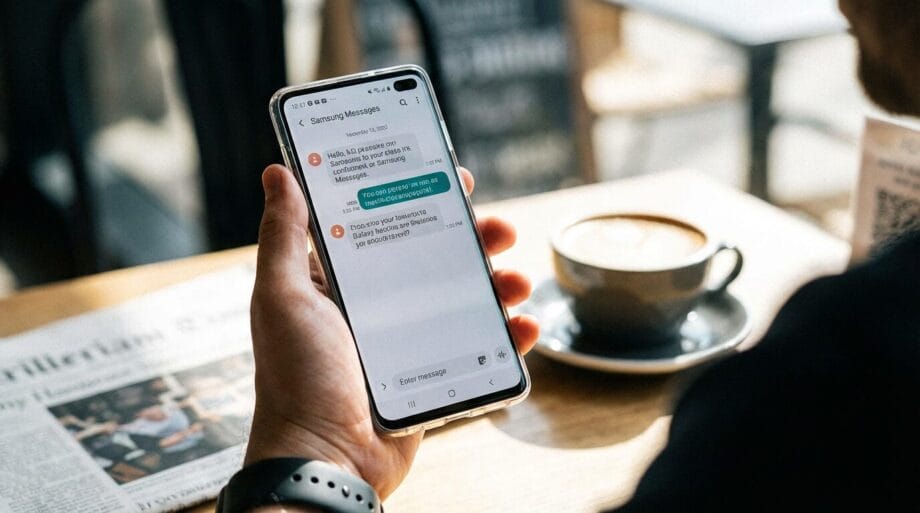
While the Samsung Internet browser and the Galaxy Store continue to coexist alongside the Play Store, and Google’s camera application remains distinct from Samsung’s, the decision to cede its messaging application to a competitor signifies a noteworthy shift.
Texting is a fundamental mode of communication that permeates daily life, making its transfer to a rival’s service all the more resonant, revealing the evolving landscape of competition between Samsung and Google, and posing the question of whether Samsung is still poised to defend its territory.
Source link: Creativelearningguild.co.uk.