Alpamayo: Nvidia’s Revolutionary AI Platform for Autonomous Vehicles
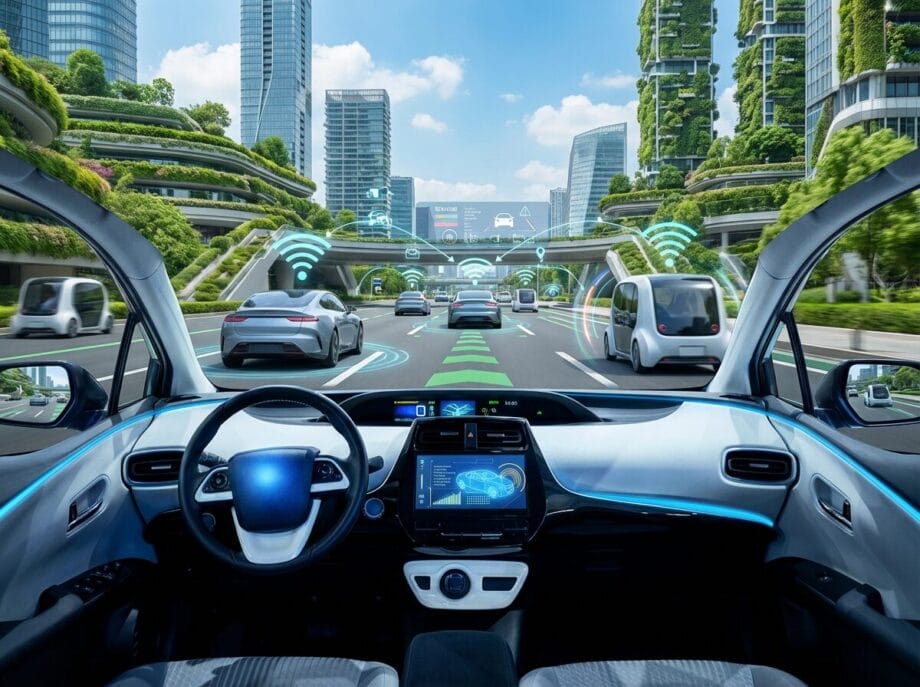
In an extraordinary announcement on Monday, Jensen Huang, the CEO of Nvidia, unveiled Alpamayo, an innovative technology platform designed to enhance the cognitive capabilities of self-driving cars.
At the esteemed CES technology conference in Las Vegas, Huang articulated that “Alpamayo introduces reasoning to autonomous vehicles, enabling them to navigate rare scenarios, drive safely in intricate environments, and elucidate their driving decisions.”
In a significant collaboration with the renowned German automaker Mercedes-Benz, Huang disclosed that Nvidia has commenced production of a driverless vehicle—the Mercedes-Benz CLA—powered by their cutting-edge technology.
The highly anticipated model is set to debut in the United States within the upcoming months, with subsequent launches planned for Europe and Asia.
Dressed in his signature black leather jacket, Huang conveyed to a captivated audience that the initiative has provided Nvidia with “an enormous amount” of knowledge regarding the facilitation of robotic systems for their partners.
Industry analysts assert that this announcement bolsters Nvidia’s preeminence in the integration of AI hardware and software, signifying a robust advancement into the realm of physical AI.
“Nvidia’s strategic shift towards large-scale AI and AI systems as unique differentiators will propel it far ahead of its competitors,” noted Paolo Pescatore, an analyst at PP Foresight, speaking from Las Vegas.
Moreover, he posited that “Alpamayo epitomizes a significant transformation for Nvidia, transitioning from a primary focus on computation to being a platform provider within physical AI ecosystems.”
Following Huang’s compelling presentation, Nvidia’s shares experienced a modest uptick in after-hours trading.
A captivating video demonstrated the AI-driven Mercedes-Benz traversing the streets of San Francisco, all while a passenger maintained a hands-free position behind the steering wheel.
“It operates so intuitively because it has learned directly from human demonstrators,” Huang stated, adding, “yet in every scenario, it communicates its intended actions and reasons through its decisions.”
Alpamayo is classified as an open-source AI model, with its foundational code now accessible on the machine learning platform Hugging Face, granting autonomous vehicle researchers the ability to utilize and retrain the model without charge, according to Huang.
“Our ambition is that, one day, every single car and truck will be autonomous,” he affirmed to the audience.
Additionally, Nvidia intends to launch a robotaxi service by next year, collaborating with an undisclosed partner whose location has yet to be revealed.
Presently, Nvidia stands as the world’s most valuable publicly traded entity, boasting a market capitalization exceeding $4.5 trillion.
It previously marked a historic milestone by becoming the first firm to reach a $5 trillion valuation in October during the AI boom, although it has since seen a decline amidst concerns regarding the sustainability of the technology’s demand.
Furthermore, Nvidia announced that its Rubin AI chips are currently in production and scheduled for release later this year.
This much-anticipated hardware is engineered to operate with reduced energy consumption compared to Nvidia’s existing AI chip lineup, potentially lowering the costs associated with AI technology development.
Source link: Bbc.co.uk.