OpenAI Launches GPT-5.2-Codex: A Revolutionary Step Towards Autonomous Software Engineering
On December 18, 2025, OpenAI officially revealed GPT-5.2-Codex, an advanced iteration of its renowned GPT-5.2 model suite. This specialized version marks a significant transition in artificial intelligence, evolving from a mere programming assistant to an autonomous software engineering entity.
No longer limited to basic code completion, the model excels in executing “long-horizon” tasks, enabling it to manage intricate code repositories, refactor entire systems, and independently rectify security vulnerabilities across lengthy sessions.
The launch occurs amid fierce competition in the intense “Agent Wars” of late 2025, where leading laboratories are vying to provide tools that emulate the cognitive processes of seasoned engineers.
Analysts hail GPT-5.2-Codex’s capability to maintain an enduring “mental map” of extensive codebases and its innovative integration of multimodal vision for technical schematics as the most significant enhancement in developer productivity since the inception of GitHub Copilot.
Innovative Features: SWE-Bench Pro and Native Context Compaction
At the core of GPT-5.2-Codex lies a series of technological advancements aimed at maximizing performance. Noteworthy among these is “Native Context Compaction,” a proprietary architectural innovation that enables the model to condense historical session data into token-efficient “snapshots.”
This feature empowers GPT-5.2-Codex to operate independently for over 24 hours on single tasks, such as comprehensive legacy migrations or extensive architectural refactors—minimizing the context drift and “forgetting” issues that plagued prior models.
The productivity enhancements are evidenced by recent industry evaluations. GPT-5.2-Codex obtained an astonishing 56.4% accuracy on the SWE-Bench Pro, a demanding test that challenges models to resolve real-world GitHub issues within expansive, unacquainted software environments.
Although its closest competitor, Claude 4.5 Opus from Anthropic, slightly outperforms it on the SWE-Bench Verified set (80.9% to OpenAI’s 80.0%), the 64.0% score of GPT-5.2-Codex on Terminal-Bench 2.0 highlights its superior prowess in navigating live terminal environments, compiling code, and managing server configurations in real-time.
Moreover, the model’s vision capabilities have seen substantial enhancements, now allowing it to interpret architectural schematics, flowcharts, and even Figma UI mockups, converting them directly into functional React or Next.js prototypes.
This multimodal reasoning equips the AI to pinpoint structural logic flaws in designs before any code is penned, thereby bridging the chasm between high-level system architecture and low-level implementation.
Market Implications: Microsoft and the “Agent Wars”
The debut of GPT-5.2-Codex carries profound implications for the technology sector, particularly for Microsoft (NASDAQ: MSFT), OpenAI’s primary collaborator.
By incorporating this agentic model into the GitHub ecosystem, Microsoft fortifies its position to dominate the enterprise developer market.
Preliminary adopters, including Cisco (NASDAQ: CSCO) and Duolingo (NASDAQ: DUOL), report integrating the model to streamline their engineering processes, with several teams noting a 40% reduction in time-to-market for sophisticated features.
As competitive pressure escalates among tech behemoths, Google (NASDAQ: GOOGL) endeavors to enhance its Gemini 3 Pro model, lauded for its 1-million-plus token context window, while Anthropic emphasizes the superior reasoning and design capabilities of the Claude series.
However, OpenAI’s strategic emphasis on “agentic autonomy”—the capacity for a model to utilize tools, conduct tests, and self-correct devoid of human intervention—offers a distinct edge in the rapidly expanding automated software maintenance sector.
Startups in the AI development arena also sense the disruption. As GPT-5.2-Codex inches closer to fulfilling the role of a junior to mid-level engineer, numerous existing “wrapper” companies offering basic AI coding functionalities may find their market relevance eroded by the inherent capabilities of the OpenAI platform.
The landscape is evidently shifting toward “agent orchestration” platforms, tasked with overseeing fleets of these autonomous coders across distributed teams.
Cybersecurity Breakthrough: The CVE-2025-55182 Revelation
A particularly striking facet of the GPT-5.2-Codex launch is its demonstrated competence in defensive cybersecurity. OpenAI spotlighted a pivotal case involving the discovery and rectification of CVE-2025-55182, a critical remote code execution (RCE) vulnerability dubbed “React2Shell.”
Although a preceding model initiated the investigation, GPT-5.2-Codex has effectively “industrialized” the approach, leading to the detection of three additional zero-day vulnerabilities: CVE-2025-55183 (source code exposure), CVE-2025-55184, and CVE-2025-67779 (a significant Denial of Service flaw).
This advancement in vulnerability identification has ignited a complex discourse within the security community. While the model affords unprecedented speed to defensive teams like those striving to patch systems, the underlying “dual-use” risk is irrefutable.
The same reasoning that facilitates GPT-5.2-Codex in locating and rectifying bugs could, hypothetically, be exploited maliciously.
In light of these concerns, OpenAI has initiated an invite-only “Trusted Access Pilot,” extending access to the model’s comprehensive features to vetted security professionals while ensuring rigorous oversight against offensive misuse.
This development parallels prior milestones in AI security, yet the stakes are considerably amplified. As AI agents gain the capability to autonomously write and deploy code, the window for human intervention in cyber incidents diminishes rapidly.
The industry is now turning its attention to “autonomous defense” frameworks wherein AI agents such as GPT-5.2-Codex constantly scrutinize their infrastructure for vulnerabilities, engendering a relentless cycle of automated fortification.
Future Prospects: Automated Maintenance and AGI in Engineering
As we look ahead to 2026, the trajectory for GPT-5.2-Codex suggests an imminent realm where software “maintenance” largely becomes automated.
Experts anticipate that the ensuing iteration of the model will incorporate native capabilities for video-based UI debugging—enabling the AI to observe users encountering errors in web applications and trace these issues back to the specific lines of code responsible.
OpenAI’s long-term ambition remains the attainment of Artificial General Intelligence (AGI) within the software engineering sphere.
This endeavor entails creating a model capable of discerning business necessities and architecting complete software solutions from inception, necessitating minimal human oversight.
Nonetheless, challenges persist, particularly regarding the dependability of AI-generated code in safety-critical domains and the legal intricacies surrounding copyright and code ownership in an era characterized by autonomous generation.
There exists a consensus among researchers that the “agentic” milestone has been achieved.
The inquiry is no longer whether an AI can oversee a software project; it now revolves around how many projects a single engineer can supervise effectively when bolstered by fleets of GPT-5.2-Codex agents.
The forthcoming months will prove crucial as these models begin to integrate with the production environments of the largest software enterprises worldwide.
A Milestone in Computing History
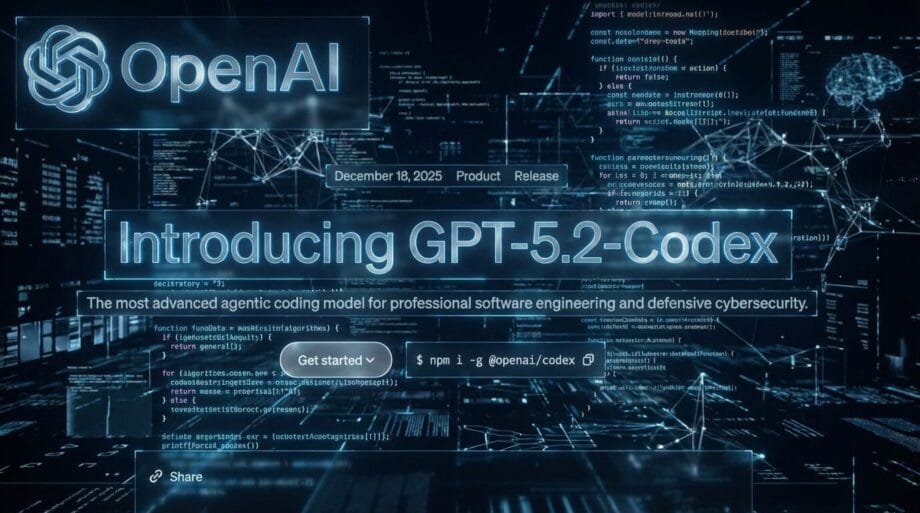
The introduction of GPT-5.2-Codex transcends a mere model update; it signifies a fundamental transformation in the interplay between humans and computers.
By attaining a 56.4% score on SWE-Bench Pro and showcasing its autonomous vulnerability discovery capabilities, OpenAI has established a new benchmark for “agentic” AI performance.
The model’s ability to “visualize” technical diagrams and retain contextual information over extended tasks effectively mitigates many of the bottlenecks historically impeding AI’s efficacy in high-level engineering.
As we transition into 2026, focus will inevitably shift from the raw capacities of these models to their practical deployment and the robust safeguards necessary to manage them.
For now, GPT-5.2-Codex stands as a testament to the rapid evolution of AI, heralding a future where the role of the human developer metamorphoses from code author to conductor of intelligent agents.
The tech landscape will remain vigilant as the “Trusted Access Pilot” expands, and the initial wave of enterprise-oriented autonomous migrations commences. Should early outcomes from partners like Cisco and Duolingo serve as any indication, the era of the autonomous engineer has indeed commenced.
Source link: Markets.financialcontent.com.