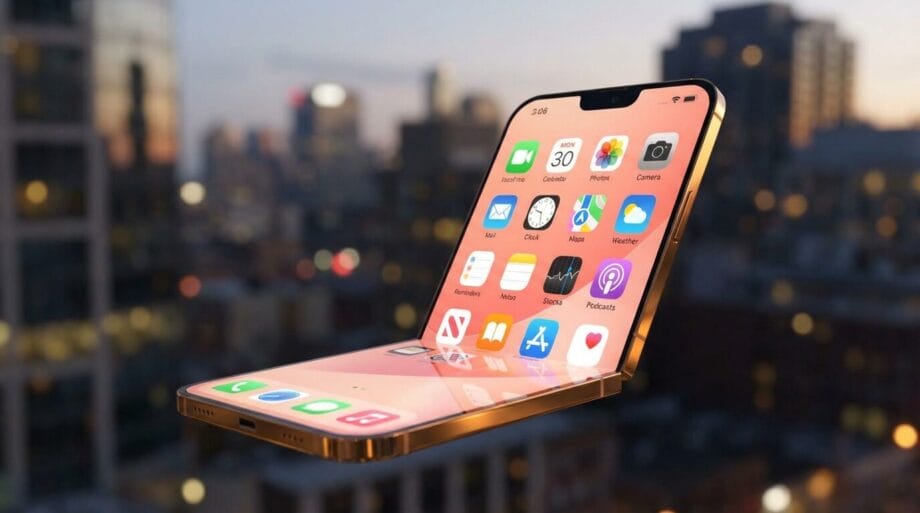
iPhone Fold Expected to Feature 3D-Printed Hinge and Dual-Layer Glass for Enhanced Durability
Since the inception of foldable smartphones, the notorious crease has remained an intractable issue. This discernible line along the fold has emerged as the primary aesthetic and structural grievance for users, spanning from Samsung’s Galaxy Fold series to offerings from Oppo and Huawei.
As Apple gears up to venture into the foldable arena, emerging reports indicate that the tech giant is adopting a meticulously engineered approach to address this concern.
Apple Poised to Integrate 3D-Printed Hinge in iPhone Fold
Leaked information from the reputable tipster Fixed Focus Digital via Weibo suggests that Apple may employ 3D-printed components for its hinge, potentially minimizing crease visibility while enhancing overall durability.
The tipster asserted that Apple is investing significant resources into the development of its foldable iPhone. The process purportedly involves “chip-level high-molecular 3D printing technology,” with further advancements in hinge design yet to be disclosed.
This initiative is not entirely alien to Apple; the iPhone Air already incorporates a USB-C port crafted from 3D-printed titanium, and its Apple Watch cases also utilize this cutting-edge technology, underscoring the company’s innovative spirit.
Anticipated Dual-Layer Glass for iPhone Fold
In addition to the hinge advancements, the construction of the display is equally ambitious. The screen is expected to boast a dual-layer glass configuration, effectively segregating the display panels from the hinge and mitigating stress over time.
Apple’s inaugural book-style foldable is likely to employ two layers of ultra-thin glass (UTG) or ultra-thin flexible glass (UFG), with the display positioned between these layers.
This arrangement aims to distribute mechanical stress across multiple surfaces rather than concentrating it on a single layer, which may significantly enhance durability and reduce visible creasing as time progresses.
If these reports hold true, the outcomes could be remarkable. Apple has collaborated with suppliers to achieve a crease depth of less than 0.15mm.
For comparison, the Samsung Galaxy Fold 7 features a crease depth of around 0.7mm, implying that Apple’s foldable could present a crease approximately a quarter as deep as its closest competitor.
Key Specifications and Features of the iPhone Fold
The forthcoming smartphone is anticipated to debut with a 7.8-inch flexible OLED main display, showcasing a 120Hz refresh rate, alongside a 5.5-inch OLED cover screen for standard usage when folded.
Under its sleek exterior, the iPhone Fold is expected to be powered by Apple’s upcoming A20 Pro chip, fabricated using a 2nm process.
Speculations indicate the device will support up to 12GB of RAM and storage capacity reaching 1TB, complemented by a 5,800mAh battery, the largest ever installed in an iPhone.
The Apple iPhone Fold is projected for release in fall 2026, coinciding with the anticipated iPhone 18 series, with a reported pricing exceeding Rs. 2 lakh.
Source link: Freepressjournal.in.