A singular dataset has illuminated a captivating paradox: the iPhone Air emerges as significantly more favored than the Plus model it supplanted; however, Apple’s premium Pro models maintain a staggering preeminence among users assessing their connectivity.
What Do Q4 2025 Statistics Reveal About iPhone Air—Design Triumph or Specialized Upgrade?
In a report from mobile analytics firm Ookla, data compiled from owners of the iPhone 17 series who conducted Speedtests during the fourth quarter of 2025 reveals that the iPhone Air constituted 6.8% of the iPhone 17 series devices surveyed.
In contrast, the preceding generation—the iPhone 16 Plus—accounted for merely 2.9%. This stark uptick implies a significant rise in popularity for Apple’s sleek, 6.5-inch model when juxtaposed against the larger 6.7-inch variant it replaced.
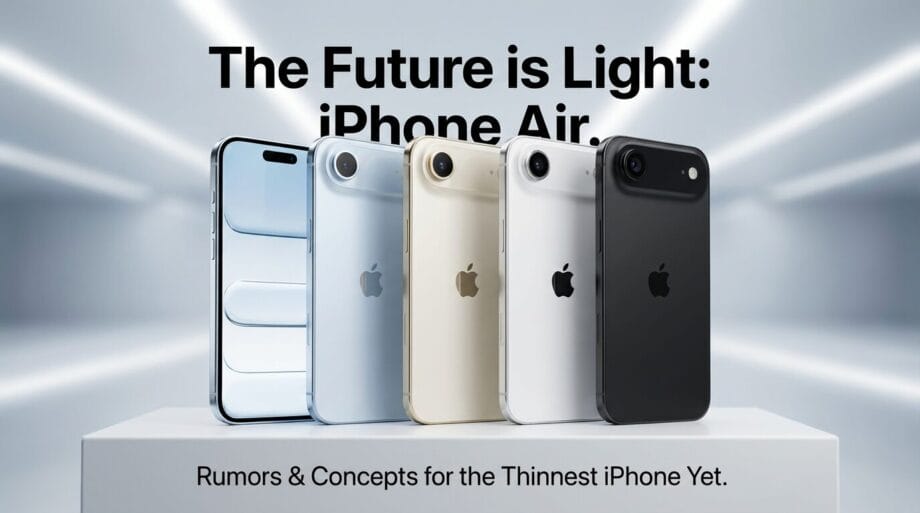
Last September, Apple introduced the diminutive iPhone Air, displacing the larger baseline model, the iPhone 16 Plus.
The figures presented by Ookla serve as evidence that the company’s strategic pivot towards design has resonated with a particular user demographic—at least among those who utilize Speedtest to evaluate connectivity.
However, the same report delineates a boundary on the extent of this design appeal. Despite this increase, usage of the iPhone Air remains marginal compared to its Pro counterparts.
In essence, while design may have garnered some traction, it has not fundamentally altered the hierarchy within the iPhone 17 lineup among the surveyed users.
Who Truly Influences iPhone 17 Usage—and What Remains Unmeasured?
The most compelling insight from Ookla’s analysis is the overwhelming dominance of the Pro models. Within the sample, a remarkable 55.5% of Speedtest users were operating the iPhone 17 Pro Max, with an additional 30.6% possessing the iPhone 17 Pro.
Collectively, this results in a commanding 86.1% of the iPhone 17 series devices represented in the dataset—underscoring a substantial inclination towards Apple’s more expensive offerings.
This shift in consumer preference appears partially attributed to the smaller Pro model. The data indicates that the share of the iPhone 17 Pro declined to 30.6% from 34.9% the previous year, while the iPhone 17 Pro Max experienced only a slight dip. Meanwhile, the standard iPhone 17 saw a rise, hitting 7%, compared to 5.9% the year prior.
Equally important as the measurements provided is the recognition of what remains unexamined. Ookla’s findings are confined to users of their Speedtest application, raising the question of whether this sample accurately reflects the broader spectrum of iPhone users.
Additionally, the report delineates a model distribution among Speedtest participants, which may not correlate with actual sales figures—merely showcasing a subset of individuals engaged in connectivity testing. A request for clarification on this data has been directed to Ookla.
Is iPhone Air Surpassing Rivals—and Where Does It Matter Most?
Ookla’s report also conducted a comparative analysis of global Speedtest usage between Apple’s slim device and Samsung’s Galaxy S25 Edge.
The findings indicate a higher global user base for the iPhone Air compared to its Samsung rival, with the disparity even more pronounced within the United States, where Apple’s device outnumbers Samsung’s by a striking 3-to-1.
In South Korea, a market characterized by robust brand loyalty to Samsung, the iPhone Air still commands a lead, albeit with a narrower margin.
Geographical preferences further shape the impact of Apple’s slender model within its own portfolio. While the U.S. share registers a modest 6.8% for the iPhone Air among iPhone 17 series devices, its popularity appears to surge in other nations—though the report clarifies that it has not fundamentally challenged the Pro models in any significant region.
In this dataset, South Korea reported the highest share for the slim device at 11.2% of iPhone 17 series users, followed by Japan at 8.9%, Sweden at 8.6%, and Singapore at 8.4%.
These statistics suggest that users in these regions prioritize design aesthetics over features exclusive to the Pro models, such as an additional telephoto camera and extended battery performance.
What the Data Reveals—Verified Insights Versus Informed Interpretation
Verified insights from the Ookla report and its summary are as follows: Within the Speedtest-using sample, the share of the iPhone Air rose in relation to the iPhone 16 Plus, while Pro models dominated, making up 86.1% of the observed iPhone 17 series devices.
Furthermore, the iPhone Air exhibited greater Speedtest usage compared to Samsung’s Galaxy S25 Edge on a global scale, particularly pronounced in the U.S.
Informed interpretation grounded in these insights: The apparent contradiction lies in the fact that while Apple’s design-oriented strategy seems to gain ground, it remains confined within a narrow scope.
Although it has enhanced the standing of the large non-Pro niche previously occupied by the Plus, it has yet to disrupt the Pro-oriented nucleus.
The growth of the thin model is veritable within the dataset, yet the Pro supermajority suggests that an “aspirational” demand for fully-featured, premium-priced devices continues to prevail among Speedtest users.
There exists a methodological intricacy that tempers sweeping generalizations. Engaging in Speedtest does not equate to overall ownership, and the distribution of models within a connectivity-testing demographic could be influenced by self-selection regarding the timing and rationale for measuring performance.
This ambiguity does not undermine the emerging patterns but does impose limits on how far these findings can be extrapolated without further insights from Ookla.
If Apple’s strategic overhaul was aimed at rendering the large baseline segment more enticing, the Q4 2025 Speedtest data indicates a measure of success—yet the same findings starkly reveal the substantial journey the iPhone Air must undertake before transcending its status as a design-centric alternative beneath the shadow of Pro ascendance.
Source link: El-balad.com.