Apple has markedly curtailed its investment in both the manufacturing and promotion of the Vision Pro headset throughout 2025. Reports from International Data Corporation (IDC) indicate that Luxshare, a key partner based in China, ceased assembly of the device at the onset of the year.
Sales figures for this innovative foray into spatial computing have proven disappointing, failing to meet initial forecasts.
Launched with a starting price of $3,499, the Vision Pro has managed to achieve shipments of approximately 390,000 units in 2024.
However, projections for the final quarter of 2025 suggest a mere 45,000 additional units will find buyers. Such figures stand in stark contrast to the millions of iPhones Apple traditionally moves on a quarterly basis.
Furthermore, the tech giant has slashed its digital advertising expenditure by over 95% in significant markets like the United States and the United Kingdom, as reported by Sensor Tower. This drastic reduction underscores the challenges Apple faces in enticing consumers to embrace its mixed reality headset.
Main Factors Contributing to Limited Adoption
The exorbitant price point of the Vision Pro serves as a formidable impediment for the general populace. Consumers have voiced concerns that the $3,499 cost effectively relegates this product to an elite category, particularly when juxtaposed with more economically accessible alternatives.
Additionally, users consistently criticize the discomfort experienced during extended use. The device’s weight and the original headband design frequently inhibit pleasant, prolonged engagement, thereby constraining overall daily usability.
- Prohibitive starting price at $3,499
- User-reported excessive weight
- Inadequate battery life under heavy usage
- Deficiency of native applications
Currently, the catalog of available applications for VisionOS remains limited. Apple has announced approximately 3,000 specifically developed apps, a figure that pales when compared to the initial offerings during the App Store’s inception in 2008.
Latest Updates to the Device
In October 2025, Apple introduced a new iteration featuring an M5 chip. This update brought enhancements in processing power and extended battery life, aimed at addressing persistent user grievances.
The refreshed model also boasts an overhauled headband design to enhance comfort. These modifications aspire to rectify some of the ergonomic issues identified in earlier versions.
Technical refinements have indeed heightened performance in mixed reality applications. Users within corporate environments report tangible improvements in specialized undertakings, including simulations and training activities.
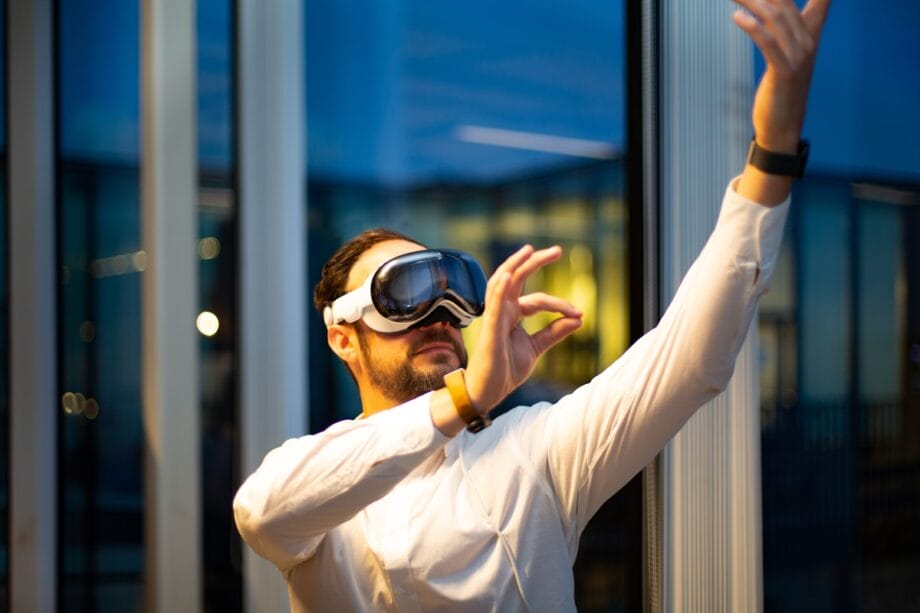
Despite these advancements, sales of the updated model have failed to exhibit substantial growth. Analysts observe that the business impact remained marginal even during the critical holiday shopping season. Apple – i viewfinder/ Shutterstock.com
Performance in the Business Sector
The Vision Pro has carved out niches in specific professional fields, where companies leverage the headset for purposes such as pilot training and intricate medical procedures.
These applications underscore potential in controlled environments. Organizations have reported gains in efficiency through advanced three-dimensional visualizations and virtual interactions.
The corporate sector currently constitutes a significant portion of sales. Apple remains focused on demonstrations and collaborations to nurture this segment.
Overview of the Headset Market
The global virtual reality device market experienced a 14% decline in 2025, according to Counterpoint Research. This contraction influences various manufacturers and signals a prevailing consumer hesitance.
Meta captures approximately 80% of the market share with its Quest line, priced from $370. While these models boast lower technical specifications, they are considerably more accessible.
Mark Zuckerberg’s firm has similarly reduced its marketing budget for virtual reality—an analogous tactic that reflects widespread challenges within the product category.
Competing companies confront a cycle where a lack of users deters developers, perpetuating the sluggish adoption of robust content.
Forecasts for Future Models
Apple is reportedly gearing up to introduce a more affordable version of the headset in 2026. This forthcoming model is expected to incorporate adjusted specifications alongside a lower price to broaden its market reach.
Analysts predict that this strategy will prioritize cost-effective components, aiming for larger-scale commercial viability. In 2025, the company refrained from expanding direct sales to additional countries, maintaining availability in only 13 selected markets.
These strategic choices indicate a recalibration of aspirations for the spatial computing line. Nonetheless, Apple continues its investment in related technology advancements concurrently.
Comparison with Historical Releases
The Vision Pro represents a pivotal experiment in innovation beyond the iPhone, which accounts for nearly half of Apple’s total revenue.
Historically, the company’s prior launches rapidly spawned expansive app ecosystems, with the App Store attracting countless developers in its formative years.
The headset, however, navigates a different adoption trajectory. Experts highlight the necessity for a measured balance between advanced hardware and available content.
Lessons from accumulated experiences are crucial for future refinements, as Apple maintains its commitment to researching spatial interfaces.
Source link: Mixvale.com.br.