Prospective 2028 iPhone Quad-Curved OLED: A Paradigm Shift in Display Technology
Transformations in the 2028 iPhone Display
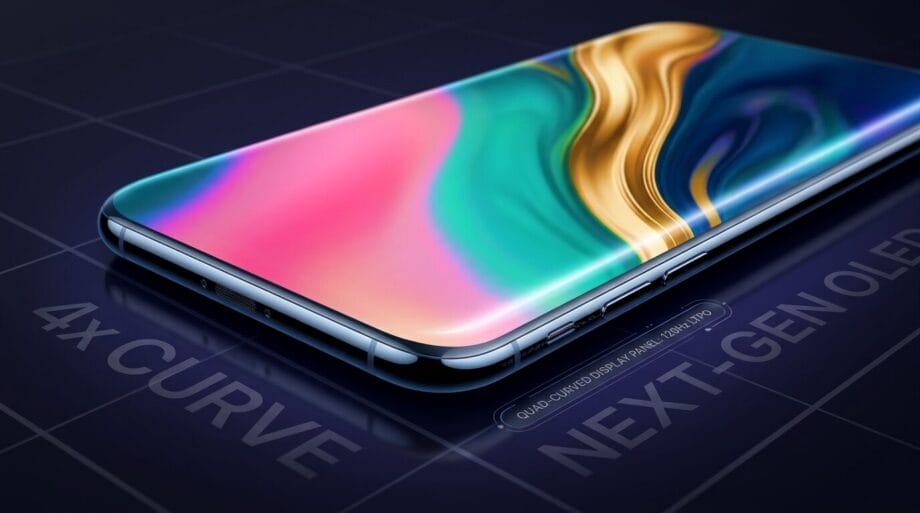
Reports indicate that Apple is collaborating with Samsung Display and LG Display to enhance its display portfolio with an innovative quad-curved OLED panel, slated for release with the 2028 iPhone model.
A recent report from South Korean publication ET News reveals that discussions are underway regarding the incorporation of Indium Zinc Oxide (IZO) as a cathode material for these state-of-the-art panels.
Traditional curved OLEDs predominantly utilize a magnesium-silver alloy cathode. This choice often results in image distortion, diminished brightness, and excessive heat accumulation around pronounced curves.
In contrast, by shifting to a transparent IZO cathode layer, Apple aims to elevate light transmission efficiency throughout the display stack while ensuring uniform brightness across all four elegantly curved edges.
The 2028 iPhone Quad-Curved OLED and the Preceding 2027 Milestone
The anticipated introduction of the 2028 quad-curved OLED is expected to follow the launch of the inaugural “four-edge bending” display, featured in Apple’s commemorative 20th-anniversary iPhone, informally known as the iPhone 20, due in 2027.
It is speculated that this earlier iteration will debut a novel quad-curved “micro-curved” design, which brings the display closer to its edges, fostering an almost bezel-less aesthetic while still employing MgAg cathodes.
Insiders suggest that Apple may integrate Samsung’s COE (Colour Filter on Encapsulation) OLED technology into the 2027 model, reportedly enhancing light transmission by as much as 33 percent and decreasing power consumption by around 25 percent in comparison to conventional designs.
Additionally, there are whispers that the beloved Dynamic Island feature may persist in this model, even as it transitions to a predominantly all-screen facade.
Suppliers and Strategic Investments for the 2028 iPhone
In a concurrent development, LG Display has unveiled an investment of 1.106 trillion won towards augmenting its OLED production capabilities, a move that industry experts link to advanced technologies, including IZO-based electrodes for forthcoming smartphones.
Meanwhile, Samsung Display is deliberating whether to enhance existing production lines or establish dedicated facilities tailored for IZO cathodes, which necessitate specialized low-damage sputtering equipment not commonly employed in current OLED manufacturing plants.
Both display manufacturers are reportedly collaborating with Apple to overcome challenges related to durability, touch sensitivity, and manufacturing yields associated with a four-sided curved display.
However, given that supply chain dynamics are unpredictable, Apple might modify its planned schedule. Nonetheless, the significant financial investments involved indicate that the 2028 iPhone quad-curved OLED initiative is regarded as a serious, long-term endeavor.
The Importance of the 2028 iPhone Quad-Curved OLED
Should Apple achieve its goals, the forthcoming 2028 iPhone quad-curved OLED design could yield a refined borderless appearance, enhanced brightness uniformity at the edges, and potentially improved energy efficiency compared to contemporary curved screens.
For end-users, this evolution may transcend mere aesthetic appeal, manifesting as a subtle yet tangible improvement in the overall display functionality on a daily basis.
Moreover, the company’s two-pronged strategy—introducing the new design in 2027 and subsequently addressing its primary technical limitations with the IZO-enhanced panel a year later—highlights a well-established Apple approach: advancing design while allowing the underlying display technology to evolve sufficiently before it reaches a wide audience.
Source link: Punemirror.com.