Quick Summary
Flask and Django are two powerful Python web frameworks built for different needs. Django is a full-featured, “batteries-included” framework ideal for large, secure, and data-heavy applications where speed of development and structure matter. Flask is a lightweight, flexible framework best suited for smaller projects, APIs, or teams that want full control over architecture. Choose Django for scalability and built-in tools; choose Flask for simplicity, customization, and minimal overhead.
Introduction
There are a few frameworks, like Flask and Django, that come to mind when we’re talking about constructing web apps with Python. Both frameworks are especially useful, yet they reflect distinct developer and project requirements. If you’re a beginner trying to understand the best Python framework for web development, or a professional picking the appropriate framework to use for your project, knowing the differences between Flask and Django will help you make the right decision.
What is Django?
Django is a complete, high-level Python framework for web development. In keeping with a “batteries-included” philosophy, it supplies almost every component necessary for constructing a web application. These components include automated support for user authentication, admin panels, an ORM, and robust form handling.
With Django, the architectural pattern is termed Model-View-Template (MVT). As a consequence, it retains complete separation between application logic, user interfaces, and data management storage. For those lacking the desire to complete the setup and configuration, it remains a popular choice.
Some well-known projects built with Django include:
- Instagram.
- Pinterest.
- Mozilla.
- Disqus.
Django is often preferred for large, data-driven applications that need scalability, security, and rapid development.
What is Flask?
Another distinct framework is Flask. Flask is a lightweight, micro Python framework for web development. It is purposely minimalistic for web development and is quite the opposite of Django. Flask provides the essential features of an application: routing, request handling, and templates. After that, it is up to the developer to implement any additional features, such as user authentication, databases, and form validations with external libraries.
Flask follows the Model-View-Controller (MVC) pattern, albeit with no enforced application architecture. As a consequence, software developers are free to implement application designs as preferred.
Some popular projects built with Flask include:
- Netflix.
- Reddit.
- Lyft.
- Airbnb (early prototypes).
Flask is perfect for smaller projects, APIs, or applications that need high flexibility and minimal overhead.
Flask vs Django: The Key Differences
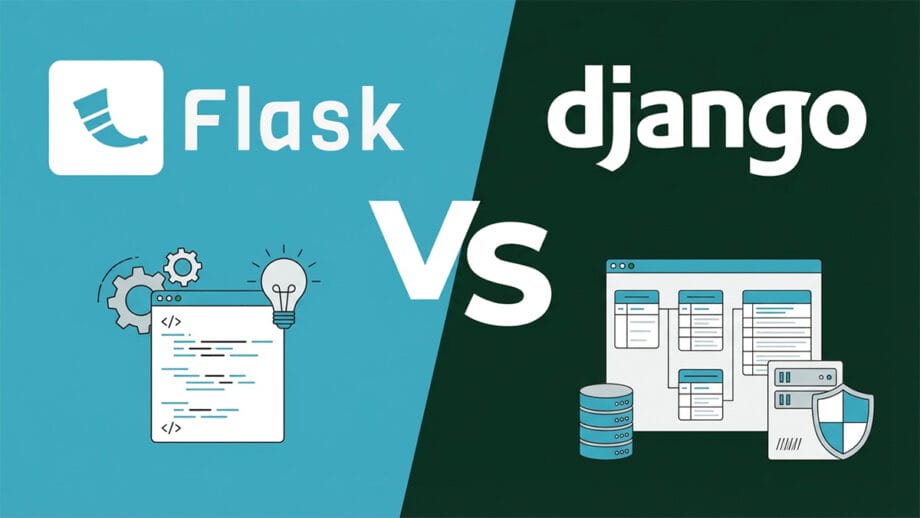
Let’s break down how Flask and Django differ across important parameters that influence development.
1. Project Size and Complexity
- Django: For large and highly complicated projects where you desire an all-inclusive solution, Django is the best fit. It automatically manages databases, handles user management, and integrates security features.
- Flask: For smaller or medium-scale projects, where you would wish to exert control over each of the constituent parts, you would use Flask. It allows you to build gradually from a small size.
2. Flexibility and Structure
- Flask: Flask tends to allow for the greatest degree of flexibility. You can unrestrictedly use the tools, libraries, and file architectures of your choice.
- Django: The balanced provision of a guided arrangement tends to help a large degree with consistency. However, to some developers, especially those who are seeking the provision of tools and greater freedom, this can feel constraining.
3. Learning Curve
- Django: It is inevitably the case that the learning curve is steeper. This is because learning its system helps simplify and streamline complex tasks.
- Flask: With its minimal and lightweight structure, it is easier to learn and understand the basic functions of the web framework.
4. Speed of Development
- Django: The application development process is generally quicker because of the built-in features such as the admin interface, ORM system, and user authentication.
- Flask: It might take longer to develop an application because of the need to manually integrate other tools, but it allows for greater final control over the application.
5. Performance
- Flask: Slightly faster for small-scale applications due to its minimalistic design.
- Django: Can be heavier because of its additional layers, but performance is rarely an issue for modern web servers.
6. Community and Ecosystem
Both Flask and Django have active communities. However, Django has been around longer and offers more ready-to-use plugins and extensions. Flask, on the other hand, provides a more modular ecosystem with lightweight packages.
The Bottom Line

Flask and Django are both impressive Python frameworks for web development, and choosing one will ultimately depend on the objective of the project and the preferences of the developer. If you prioritise speed, security, and tight control, then you’ll want to stick with Django. However, if you would rather have full control over the project with simpler building blocks, go with Flask.
Overall, Django offers an extensive one-stop-shop toolkit, containing everything needed to complete the job. In contrast, Flask gives you a blank specialisation canvas to build from.