Quick Summary
Modern quality engineering is moving beyond traditional script-based automation toward AI-driven testing frameworks that are more adaptive, intelligent, and scalable. By leveraging capabilities such as self-healing locators, predictive risk analysis, and dynamic test generation, organizations can reduce the burden of script maintenance, improve code coverage, and focus testing efforts on the areas that matter most.
This shift enables QA teams to spend less time fixing brittle automation and more time ensuring overall software reliability. As AI becomes a core part of the software development lifecycle, the role of QA engineers is evolving from test execution to strategic oversight.
Success now depends on building expertise in validating AI-powered systems, optimizing prompts, managing high-quality test data, and integrating intelligent automation into CI/CD pipelines. Organizations that adopt a structured AI testing roadmap can accelerate releases, strengthen product quality, and prepare their QA teams for the future of autonomous quality engineering.
Introduction
For years, our contribution as QA testers was measured by how many test cases we could line up, write automation scripts, and follow up on UI bugs. For hours, we had to debug with flaky automation suites, and when a developer altered a button ID or tweaked an API response, we knew our automation suites were in trouble.
The data indicates that standard automation solutions demand quality teams to spend a significant amount of their time on script maintenance. This “always-on” maintenance cycle places us in a reactive loop that has nothing to do with software stability. The deployment of smart structures is changing how work gets done today. A data-driven approach to product dependability is based on a move from inflexible, hardcoded claims to risk-adaptive verification models.
To stay competitive, we need to understand the structural move toward autonomous validation, advanced automation plans, and continuous quality engineering. To fully realize the benefits of AI testing for QA engineers, we must embrace these smarter systems, as they represent a fundamental shift in software validation at scale and redefine how we, as QA engineers, do our work.
The Architectural Reset: Fixing Our Fragile Test Suites

Everyone who has ever worked with an automation suite has experienced flaky tests. In most modern development iterations, many script failures are related to traditional user interface element modifications. We spend more time trying to figure out whether it is a bug or a broken locator string than we do testing new functionality.
Modern test frameworks address this limitation by embedding machine learning models, semantic data streams, and context-aware validation routines in the test code pipeline. Advanced setups enable consideration of code changes, live telemetry data, and bug history trends to identify where to invest the most time in bug verification, rather than running a full unmanaged regression library for each code change.
By incorporating AI in QA, modern software teams can move from assisted to intelligent and autonomous automation frameworks. In addition to this structural change, the average code coverage has increased to 88.4%, with a significant drop in total regression time and test failures. Some of the core features of the framework that make our daily job simpler are:
- Self-Healing Locators: Machine learning engines assess the Document Object Model (DOM) layout in real time to adjust to code revisions. This reduces false-positive test alarms and saves us from continual script updates.
- Predictive Risk Evaluation: Smart analysis components analyze system data points to identify potential problems in product design and pinpoint where bugs are most likely to lurk.
- Dynamic Scenario Generation: Beyond static datasets, sophisticated language models can generate complex test inputs, simulated database states, and diverse operating settings automatically.
The Shifting Paradigm: AI Testing for QA Engineers
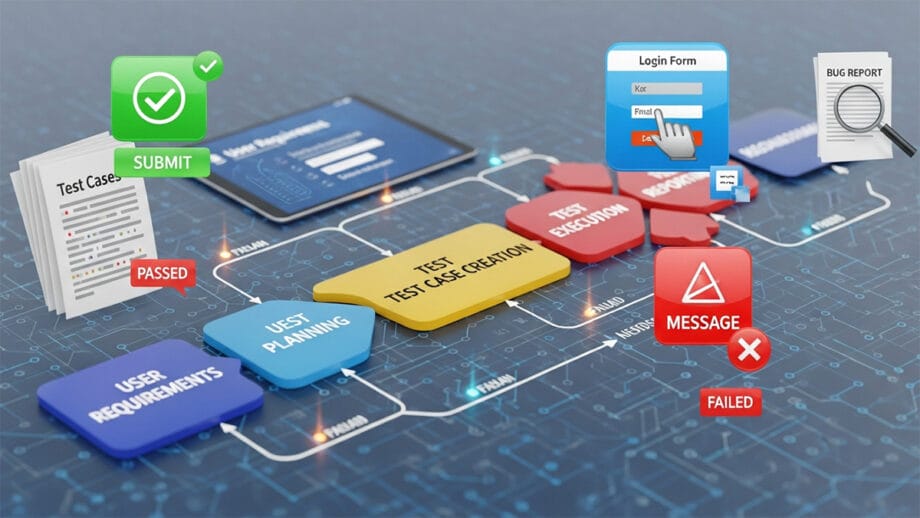
This technological shift doesn’t make professional human testers useless; it completely changes our day-to-day technical obligations. Systematic system overview tasks replace the manual authoring of unstable UI routes or the line-by-line following of test processes. As we move to current settings, the focus for QA engineers should be on a systematic AI testing roadmap so that we learn to build, lead, and audit smart, automated environments rather than wasting our days correcting faulty locator strings.
Teams will have shorter sprint cycles. A standardized baseline for AI testing for QA engineers would help them detect regression anomalies early in the development cycle.
| Roadmap Stage | Primary Capabilities | Human Tester Role |
| Level 1: Assisted | Generates linear test scripts and basic data patterns | Manages execution, analysis, and environment |
| Level 2: Augmented | Self-healing scripts adapt to basic UI modifications | Reviews predictive model recommendations |
| Level 3: Autonomous | Framework generates, validates, and optimizes code | Audits system architecture and core business logic |
Modern quality specialists work closely with AI QA automation tools, managing smart engines that handle initial script creation, test oracle verification, and complex input design. For engineers eager to excel, mastering AI testing for QA engineers means shifting away from simple execution tasks to take full control of automated test setups.
Key Technical Objectives for the Modern Tester

We need to develop excellent technical capabilities in multiple areas of operation in an automated engineering world.
1. Verification of Non-Deterministic Environments
The first is the “verification of non-deterministic environments.” In classic software, a specific input always produces the same output, based on rules. A modern software system using LLMs, retrieval pipelines, and independent agents handles probabilistic, context-aware information.
The systems are non-deterministic and, unlike traditional binary systems, cannot be verified by traditional binary verification methods; they should be continuously verified using statistical methods to reduce the risk of the system running. To become proficient in AI testing, QA engineers must learn to create semantic evaluation models, monitor model variance, and integrate customized evaluation loops into their continuous delivery pipelines.
2. Analytical Prompt Optimization
No more writing text descriptions of test steps. Instead, we are taught to create specific prompt routines, custom context data packages, and system variables to drive directed tools toward edge cases and hidden logic bugs.
3. Comprehensive Data Governance
Smart validation engines depend entirely on the quality of their underlying data. Modern specialists must build deep expertise in managing large data sets, anonymizing operational data for safe case evaluations, and constructing complex semantic variation matrices to train autonomous test tools effectively.
Integrating AI QA Automation into the CI/CD Lifecycle

There is a need for a clear engineering approach to deploy smart test tools. Throwing away uncalibrated model calls into a non-structured codebase causes all sorts of problems, including system determinism issues, higher execution costs in the cloud, and noisy pipelines with uncertain outcomes.
By incorporating smart features into traditional continuous integration pipelines across three levels, enterprises may re-invent innovation with AI-enhanced engineering. Deterministic checks at the base level pertain to fundamental infrastructure, system settings, and unambiguous unit-validation criteria. Moreover, a semantic analysis layer validates interrelated dynamic interface updates, API replies, and application processes through targeted model assessments.
Finally, an independent workflow layer uses specialized agents to validate complex, multi-step end-user scenarios, checking overall business paths without requiring hardcoded scripts. This tiered approach keeps the deployment pipeline fast and stable, ensuring that core code builds complete quickly while model processing power is reserved for complex user paths.
Embracing the Future of QA Engineering

The future of QA engineering depends on our ability to combine automated execution tools with thorough technical human oversight. Automated tools are excellent for processing large chunks of system data, running long regression suites, and predicting technical risk areas among large codebases.
But human analytical thinking is still crucial for defining overall testing strategies, reviewing architectural decisions, and overseeing system governance. By proactively integrating a well-defined AI testing roadmap into their deployment strategies, organizations can guide their QA engineers towards becoming highly efficient, autonomous testing teams.
By adopting these cutting-edge practices, we can drastically reduce script maintenance expenses, boost code coverage, and execute software deployments with operational certainty at scale. Planning these theoretical shifts into a realistic action plan is where we redefine the future of QA engineering for our team and the larger industry.