Quick Summary
In 2026, AI and Machine Learning are no longer add-ons in mobile apps – they are the foundation. Apps have evolved from reactive tools into proactive, intelligent assistants that anticipate user needs through hyper-personalization, contextual awareness, and predictive intelligence.
Natural interactions like voice, vision, and multimodal AI are replacing traditional taps, while AI-powered development and QA are dramatically accelerating build cycles. At the same time, demand for custom AI services is rising, with businesses fine-tuning models on proprietary data to gain a competitive edge.
On-device AI and edge computing are redefining privacy and performance, while behind the scenes, AI strengthens security through real-time fraud detection, behavioral biometrics, and predictive maintenance.
The new baseline for mobile apps is clear: intelligence is expected, personalization is standard, security is invisible, and the best experiences feel effortless.
Introduction
The smartphone is no longer a simple tool. It is more of a companion today. It no longer works in isolation; it interacts with you. The advent of Artificial Intelligence (AI) and Machine Learning (ML) has taken the capabilities of smartphones higher. Now, these technologies form the core architecture of successful applications.
This shift brought transformational change in user behavior, and apps are becoming proactive and intelligent agents rather than merely reactive tools. This evolution has brought new kinds of mobile apps that function on smarter technologies.
In this blog, we are going to shed light on the role of AI and ML in transforming mobile experiences and the key trends driving this innovation in 2026.
The Hyper-Personalization Engine

AI is changing the user experience from mass-market to granular, individual utility. Generic recommendations are over. The new standard is hyper-personalization.
Contextual Awareness
Apps now factor in time, location, and user behavior patterns to adjust the interface in real time. An app will not just suggest a restaurant. It will suggest a quiet restaurant nearby, knowing the user’s calendar shows a demanding day. The interface itself adapts. Fonts may change size based on ambient light. Feature menus rearrange themselves based on predicted current needs. The app becomes invisible. It simply works the way the user needs it to, moment by moment.
Predictive Pathfinding
This is intelligence at its peak. Predictive AI anticipates the user’s need before the user performs the action. In finance apps, the system flags a large or unusual payment before the user even confirms it, preventing fraud. In retail, the app initiates the return process for an item based on predictive analysis of browsing and behavioral data, suggesting buyer’s remorse. Mobile app development now focuses on training these predictive models. They use unique, deep, behavioral datasets. This creates a competitive edge. The app is proactive. It serves as a helpful, silent assistant.
Evolution of Interaction: Beyond the Tap
Taping a mobile screen is becoming secondary as AI offers more natural, human-like interactions. There are various technologies that power this shift.
Natural Language Processing (NLP)
Voice commands are the new normal for mobile usage. Now they are not rigid command structures. Advanced NLP allows apps to understand context, intent, and nuance for every command. Users can speak conversationally, and the app processes the request, carries context across multiple steps, and executes complex commands. This is crucial for accessibility. It also saves time. The interface simplifies user interactions with conversational experiences, replacing cluttered menus.
Computer Vision (CV) and Multimodal AI
AI gives mobile apps the power to process visual things thanks to Computer Vision. Today, it is utilized across different sectors like:
- Retail: A user points the camera at a pair of shoes in a store. The app instantly identifies the brand, finds the best online price, and suggests complementary items.
- Logistics: The drivers utilize the camera to scan packages. In an instant, the app verifies, routes, and updates the inventory in the cloud.
A mixture of vision, text, and voice is what they term Multimodal AI. Models like Google’s Gemini allow the app to process all these inputs simultaneously. This creates applications that mimic human reasoning more closely. They handle ambiguous requests better. They provide richer, faster answers.
Redefining the Development Pipeline

Another change that AI has brought is how applications are built. The use of AI has accelerated the speed of app development while also reducing its cost. Thanks to automation, apps can be developed faster and without requiring a lot of resources.
AI-powered Development and QA
Generative AI is now playing a vital role in coding. AI tools generate boilerplate code, suggest optimized function structures, and instantly fix bugs. This accelerates the coding phase significantly. Consequently, developers can focus on core innovation and complex logic.
In Quality Assurance (QA), AI agents automate testing. They create test scripts that adapt to UI changes. They simulate real user behavior better than manual testing ever could. This speed increases the pace of release cycles. It lowers the cost of maintaining the software. Mobile app development relies on these tools. The time from concept to market shrinks from months to weeks.
The New Role of Custom Services
Paradoxically, the rise of AI increases the demand for specialized mobile app development. Generic AI is available everywhere. The value is now fine-tuned. Firms need to develop unique AI models. These models must be trained on proprietary business data. They must reflect the specific tone and operational logic of the brand.
Example: A general LLM is fine-tuned to act as a regulatory compliance assistant for a specific financial institution. This requires specialized data integration and secure model deployment. The expertise needed to build, deploy, and monitor this custom AI layer is the new premium service.
Edge Computing and Local-First Design
The most significant architectural change is the movement toward on-device AI. The processing of data at the local level ensures user privacy. Sensitive data remains on a user’s phone. This reduces reliance on a constant cloud connection. Apps work smoothly offline. This local-first design pattern is now prioritized. Cloud connectivity enhances the app. It does not enable the core functions.
The Invisible Revolution: Security and Backend
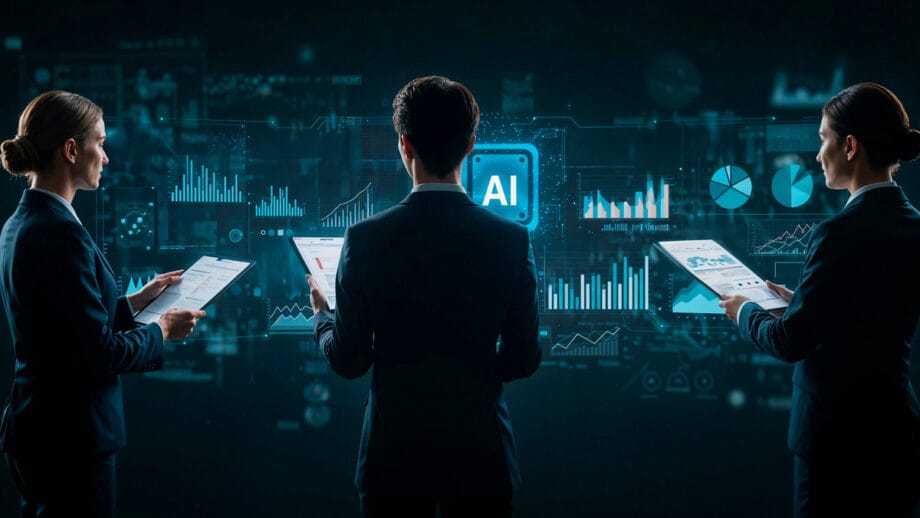
AI’s most critical impact often goes unnoticed. It plays a vital role in infrastructure and security that users take for granted.
Real-Time Fraud and Anomaly Detection
Financial and retail applications are using AI for security. Algorithms constantly analyze transaction patterns and user behavior. They establish a baseline of “normal” behavior. Any deviation triggers an immediate alert or a preventative block. This real-time anomaly detection is far faster and more accurate than traditional rule-based systems. It prevents fraud before losses occur.
Predictive Maintenance
On the backend, AI can help monitor server performance and network traffic. It predicts hardware failure or system overloads before they result in downtime. AI agents automatically reroute traffic or provide new server resources. It avoids developer frustration by eliminating errors and downtime that once plagued large-scale applications. The application remains stable and efficient under high stress.
Behavioral Biometrics
AI improves authentication over and above passwords or even simple fingerprint scans. It looks at how the user interacts with the device: speed of typing, pressure of a tap, and the angle they hold the phone. This unique learned pattern of behavior continuously and invisibly authenticates the user. If the behavioral rhythm changes, the app flags a potential security breach. Access becomes secure without feeling intrusive.
The Future Baseline

In 2026 and beyond, the expectations for mobile apps will change. Users expect intelligence. They expect personalization. They expect the app to anticipate their needs. The technology driving this shift is complex, resting on LLMs, on-device processing, and advanced computer vision. The development effort is intense, requiring specialized mobile app development to manage the AI integration.
The smart app is here. It is quieter. It is faster. It is more secure. Its intelligence is the baseline. Technology is hidden. The experience is flawless. This is the new standard of mobile utility.