Quick Summary
Stock image APIs are now essential for brands that need fast, scalable, and consistent visual content. Tools like VistaCreate API stand out with AI-powered image generation, templates, white-label editing, and workflow automation. Unsplash API excels at free, high-quality, responsive photography with unlimited requests. Pixabay API offers simple integration and reliable scaling for mixed visual formats, while Dreamstime API delivers deep, diverse libraries with strong licensing control. The right API helps eliminate manual design work, speed up delivery, and keep brand visuals consistent across every channel.
Introduction
Manual design workflows can’t keep up with the demands of multichannel marketing and personalized content, and teams are fully aware of this challenge. Brands are now vying for users’ attention, integrating new tools to distribute visual content in ways that excite and engage. Stock image APIs have become essential solutions that boost productivity, automate repetitive tasks, speed up delivery, and standardize visual creation and distribution.
These interfaces can be integrated into websites, e-commerce stores, and apps. Their primary purpose is to streamline content creation by cutting redundant steps like downloading, editing, and uploading. Stock photo APIs differ greatly, from request limits and pricing to image variety and interfaces. With such a saturated market, which content APIs stand out for quality, reliability, and feature-richness? Read on to explore the top performers.
1. VistaCreate API: A Feature-Packed Editor with Image Generation
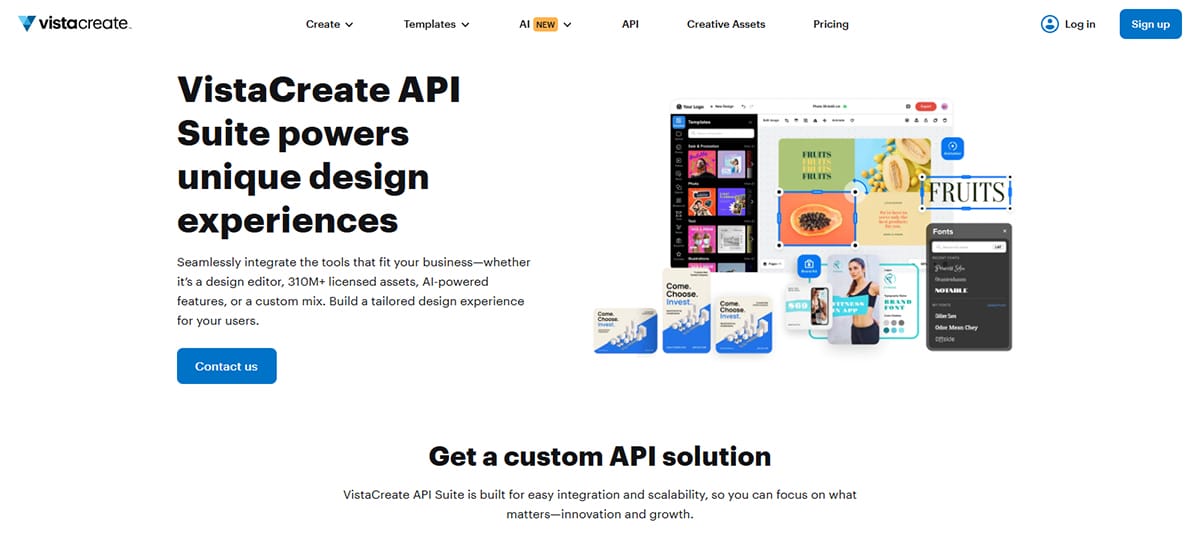
VistaCreate isn’t a traditional image API – it’s an all-in-one visual creation engine. The VistaCreate API covers everything related to graphic design and visual appeal, including ready-made template customization, personal design editing, and team collaboration. Supporting businesses around the world, VistaCreate highlights several game-changing features:
- A massive collection of licensed royalty-free images, videos, vectors, and effects.
- An AI-powered image generator inside an API for unique, commercially usable visuals.
- White-labeling options that allow users to embed the editor within their own interface.
- A large template library with thousands of layouts for social posts, ads, print, thumbnails, and posters – editable programmatically or via the embedded editor.
- AI-driven tools (background remover, upscaler, modifier, and writer) that improve workflows and help brands serve multiple audience segments.
- Editing features for seamless resizing, on-brand filters, and automated cropping.
- Smooth collaboration, enabling teams to sync and track changes, revert errors, and coordinate publishing directly within the editor environment.
- A modular solution that lets companies integrate only what they need, whether licensed content, template personalization, image generation, or team collaboration.
VistaCreate API is among the best image generation platforms in 2026. It stands out with aspect-ratio control, smart prompt suggestions, and outputs cleared for commercial use. Whether you need high-volume background removal, quick product ads, or branded content for client projects, this API delivers. Analysts estimate that visual systems can automate up to 70% of repetitive creative tasks – the kind of manual sourcing and resizing that APIs like VistaCreate help eliminate. With its ease of use, modularity, and white-labeling option, the VistaCreate API is an excellent long-term solution for design-driven teams.
2. Unsplash API: A Trusted Stock Photo Bank
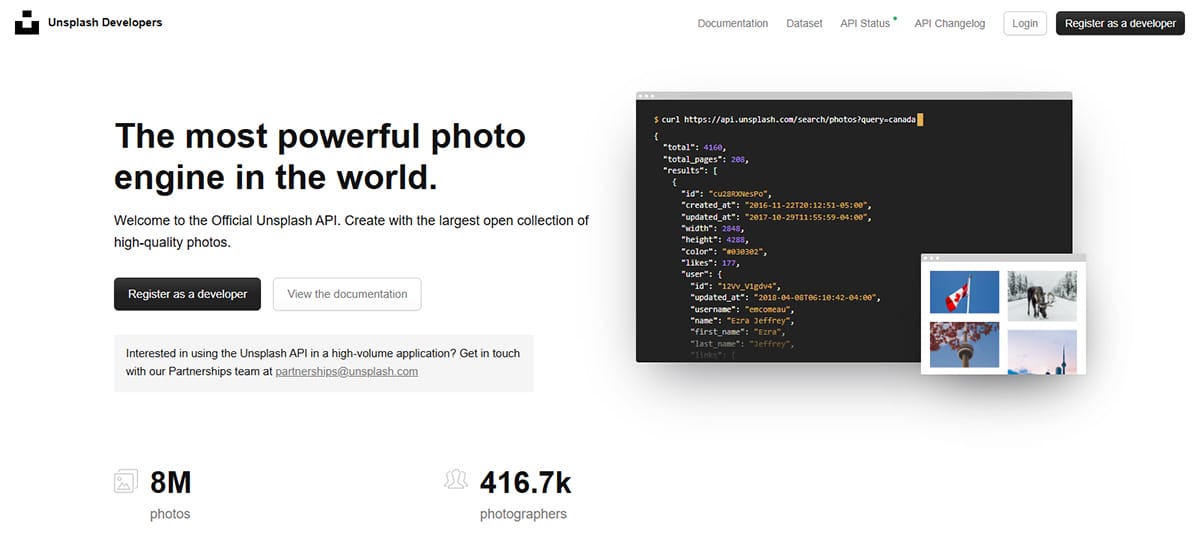
Unsplash has earned its sterling reputation through authentic, high-quality photography used by designers, developers, brands, and nonprofits alike. While the platform offers a premium tier, it remains best known for its extensive gallery of free photos. The Unsplash API mirrors the website’s simplicity and provides:
- Dynamically resizable images, shifting picture size on the fly, and delivering optimized assets for responsive UI, faster loading, and improved Core Web Vitals.
- Straightforward REST integration, clear documentation, and wide ecosystem support.
- Unlimited requests – ideal for high-traffic feeds and community platforms.
Unsplash remains one of the best photo API providers for content management systems and blog engines that need fast access to responsive imagery without manual sourcing. As optimized, on-demand visuals become essential for capturing user attention, the API’s capability to enhance onboarding flows and return images quickly is invaluable. High-quality placeholders help teams maintain clean layouts and performance across devices, boosting engagement and reducing bounce rates – especially on mobile.
3. Pixabay API: A Well-Known Stock Image Platform
Pixabay is known for its crisp photos, illustrations, vectors, and videos. While it doesn’t offer as many licensed photographs as the VistaCreate API, it remains a strong image API for e-commerce businesses. Key advantages include:
- High request capacity at 100 calls per minute, helping teams predict scaling for automated content workflows.
- Simple operation, where you basically connect the platform and don’t need to bother with settings.
- A global contributor base consistently adding new, free, and premium content.
Pixabay API is ideal for products needing a mix of visual formats. Content teams use it to enrich blog posts, tutorials, and resource hubs with lightweight, commercially safe visuals. For beginners or organizations experimenting with API-driven creative pipelines, its predictable limits and ease of setup make it an excellent option for prototyping, automating asset sourcing, and scaling visual delivery.
4. Dreamstime API: A Creative, Diverse Content Provider
Dreamstime is a long-established stock platform with a breadth of photos, vector art, and editorial content. Its strong contributor community is impossible to overestimate; thanks to worldwide creators, Dreamstime is a fantastic website that offers diverse and highly engaging content. Its API offers:
- Multiple license types, ideal for publishing across different channels and formats.
- Built-in search filters suitable for commercial-grade projects.
- Reliable metadata tagging for better categorization, plus advanced endpoints for collections and team workflows.
Dreamstime API shines in design automation, particularly when accuracy, compliance, and content depth matter more than sheer volume. Platforms rely on their clean licensing structure to reduce downstream risks, while editorial teams tap into their global contributor base to source visuals for news updates, interviews, and niche stories. Creative agencies frequently integrate the API into their production pipelines to develop highly targeted campaign sets. For products that maintain curated image libraries or team workspaces, Dreamstime’s collection endpoints simplify the process of assembling, organizing, and reusing visuals across ongoing projects.
Final Thoughts

Building visually compelling web experiences isn’t a one-time effort – it’s an ongoing process of refining, adapting, and delivering assets that look great everywhere. Stock photo APIs make that consistency achievable by reducing manual workload and enabling brands to focus on creative direction. Your ideal platform ultimately depends on goals, scale, and experimentation needs, but each API listed here provides a clear path to faster, cleaner, and more dependable visual delivery.


