Quick Summary
Building your own generative AI solution gives organizations greater control, customization, privacy, and long-term cost efficiency compared to relying solely on third-party tools. Success starts with a clear business use case, followed by choosing the right model approach (fine-tuning, training from scratch, or RAG), curating high-quality and ethical data, and setting up suitable infrastructure.
Rigorous evaluation, thoughtful deployment, and continuous monitoring are critical to ensure reliability, safety, and real business value. When aligned with domain needs and governance best practices, in-house generative AI can evolve into a powerful, defensible competitive advantage.
Introduction
Generative AI has expanded from the research lab to become a part of countless boardrooms, design studios, and classrooms. It’s a practical tool that can produce text, code, pictures, audio, and insights at scale. Businesses are drawn to its productivity, creativity, and personalization possibilities. And many organizations start wondering what it would look like if we constructed our own generative AI strategy rather than depending entirely on external vendors.
Building your own generative AI can help you gain control, free you from reliance on third-party APIs, and enable the ability to tailor the models specifically to your domain. But creating such a solution isn’t as easy as downloading a model and starting. It involves strategy, data, infrastructure, and governance.
This guide follows the critical steps and best practices you have to consider while looking to seriously develop your own generative AI solution.
What Generative AI Means Exactly
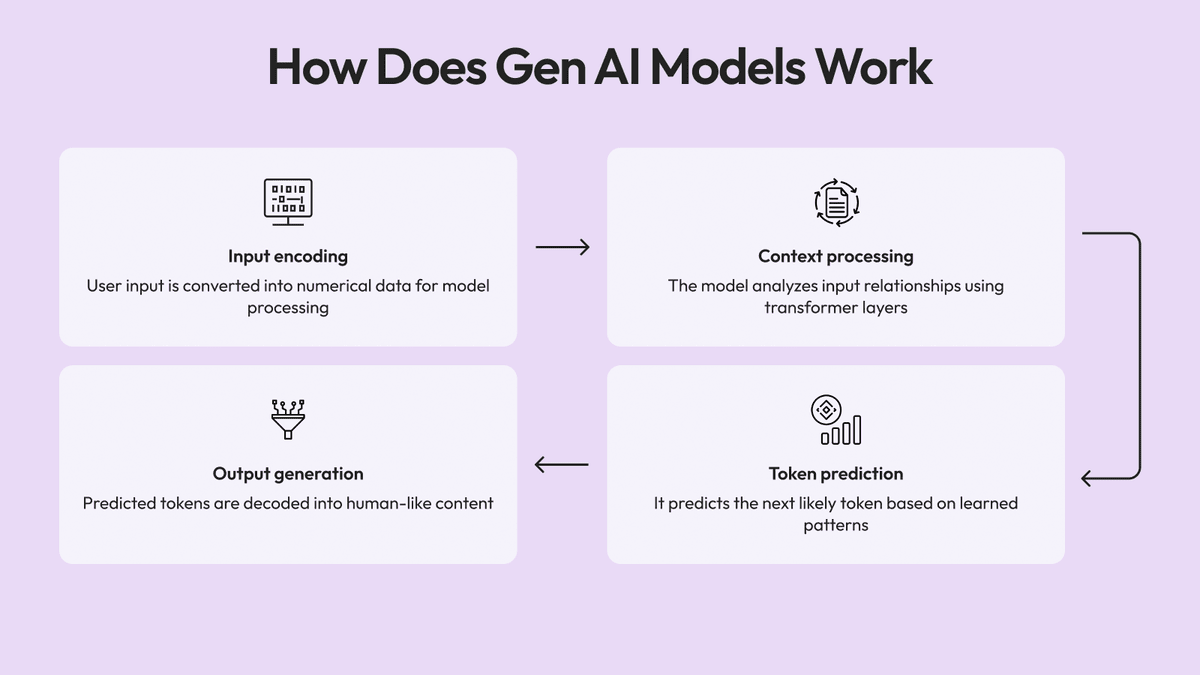
Let’s work out what we mean by generative AI. It is a model that comes up with new outputs (as opposed to discriminative models that give us labels we want). Unlike typical AI that classifies, detects, or predicts, generative AI creates.
As of today, generative models in AI are normally founded on:
- Transformers (GPT, BERT, LLaMA): Ideal for use in language-based applications such as chatbots, summarization, or document generation.
- Diffusion-based methods (e.g., Stable Diffusion or DALL·E): Suitable for image and visual assets generation.
- GANs (Generative Adversarial Networks): Formerly queen of images, now somewhat less so than the diffusion methods.
- Multimodal architectures: Able to handle different types of data (text + image, audio + video).
The “generative” part is there because models learn from large datasets and then are able to “generate” or produce new globals by training on examples of those reactions. That’s what allows them to write a persuasive product description or create a synthetic medical image.
Why Develop a Generative AI Solution?
There are many off-the-shelf products: ChatGPT, Claude, MidJourney, Gemini, and Copilot. And then, why bother making your own? Several reasons stand out:
- Customization to domain-specific needs: A law firm might want models tuned to legal cases. A health care company might be looking for medical accuracy that general-purpose models don’t provide.
- Data privacy and compliance: Sensitive sectors such as finance and healthcare usually cannot send data to outside providers. In-house model to keep regulated.
- Cost control: Heavy usage of commercial APIs can be costly. You will never pay a recurring fee if you own your model, and if your drone usage is heavy enough, the savings can add up over time.
- Differentiation: You could also make a custom generative AI product or service that is the cornerstone of your offering and has a competitive moat.
- Scalability: You can customize your infrastructure configuration for your workloads, not the other way around, with API limitations.
Building isn’t always the solution, as it’s resource-heavy. But when strategic goals align, it can be transformational. That’s why understanding your potential AI development cost early on helps align scope with business value and avoid wasted investment.
Step 1: Clearly Define Your Use Case
The great failure is to begin with technology as a means rather than ends. Ask yourself before downloading models or configuring GPUs:
- What problem am I solving?
- Who will use this system?
- What value will it create?
- How will I measure success?
A retailer could concentrate on bettering product descriptions. A bank may focus on automatic report generation. A media company might use AI to assist editors in thinking of article drafts.
But having a laser-sharp use case makes sure you don’t spend time building a “cool model” that no one adopts.
Step 2: Selecting the Appropriate Model Method
There are several ways to construct your solution. The choice depends on resources, risk area, and urgency.
- Option A: Fine-tuning a pretrained model. This is most likely the way that people do. Begin with a big pre-trained model and fine-tune it on your domain-specific data.
- Option B: Training from scratch. This is resource-intensive and generally the domain of big tech players. This requires us to pull in billions of tokens or images and train on gigantic GPU clusters.
- Option C: Hybrid with RAG. You don’t try to retrain: You let the model “look up” relevant documents before answering.
Step 3: Data Gathering and Preprocessing
Generative AI is only as good as the examples it learns from. Key practices here:
- Curate domain-specific datasets. Pull in text, images, or code from internal databases, open databases, or licensed data sources
- Ensure data quality. Take away the duplicates, as with the irrelevant and biased content. For example, if you are training a healthcare chatbot, try to maintain high clinical accuracy and discard less-trusted content obtained from the web.
- Balance diversity. If your dataset is too limited, the outputs won’t have enough flexibility. Too broad, and you risk diluting.
- Apply annotation where needed. Labeled datasets can improve fine-tuning results, particularly in tasks such as summarization or Q&A.
- Respect ethics and IP. Web scraping copyrighted content without the consent of the author might result in a lawsuit. Always verify data licensing. Good data hygiene is one of the most robust signals that separates an average AI product from a great AI product.

Step 4: Infrastructure and Tools
Startups use managed cloud AI services (e.g., AWS SageMaker, Azure OpenAI, Google Vertex AI). And so for startups in particular, this is where managed cloud AI services can reduce upfront costs. So enterprises bound by regulation typically scale up on-prem clusters.
Step 5: Evaluation and Metrics
Evaluation confirms whether your generative AI model behaves reliably outside training data. A model that looks strong during training but fails to generalize, produces biased outputs, or generates low-quality text will undermine user trust and business value. To prevent this, teams validate the model through a mix of quantitative metrics and real-world testing.
Core metrics to track:
- Perplexity: Measures how confidently the model predicts the next token. Lower values mean more coherent and fluent output, especially important for LLMs tuned for open-ended generation.
- Accuracy/F1: Key metrics for classification and extractive summarization tasks that show how well the model identifies correct labels or spans.
- BLEU, ROUGE, METEOR: Standard metrics for translation, summarization, and content fidelity tasks, often paired with human review to ensure semantic alignment.
Additional factors to evaluate:
- Hallucination frequency and grounding accuracy in RAG pipelines.
- Toxicity and bias levels.
- Latency, throughput, and robustness under noisy or adversarial input.
Together, these checks ensure the model is not only accurate but also stable, safe, and production-ready.
Step 6: Deployment and Integration
Yet, when your model is trained, it’s not done until it fits back into the real workflows. Best practices include:
- Containerization: leverage Docker or Kubernetes for scalable deployment.
- API endpoints: Expose your model to internal apps or external users.
- Latency-friendly design: Perform model compression, quantization, or distillation to boost the inference throughput.
- UI/UX design: Even the greatest model is doomed to failure if it’s not intuitive. For example, a chatbot works best when it’s embedded within Slack or Teams or on a website.
- Monitoring: Continuously monitor performance, hallucinations, and uptime.
And remember, deployment is not a one-off thing; it’s a continual lifecycle.
Real-World Use Cases
Putting all these steps together, you can see a few examples below of what this process looks like for companies that have developed their own generative AI-tech:
- Pharmaceuticals: Customized LLM had assisted company owners in abstracting information from the clinical trial reports. Research time was shortened to one-fifth.
- Retail e-commerce: Built AI-based product description engines optimized by brand voice and SEO parameters.
- Education: Universities developed chat-based tutors personalised to curriculum content, and tailored to offer individual students support while studying.
- Banking: Banks employed generative AI to write reports and be compliant with regulations while taking the writing task away from analysts.
These cases highlight that success does not lie in the technology alone, but in how one commensurates it with specific domain requirements.
The Next Era of Generative AI Development
Generative AI is maturing from a research curiosity, where novel ideas can be explored in canonical settings, to large-scale systems that positively impact real businesses. That flashy demo isn’t going to cut it with today’s companies, which are in search of GenAI tools. These tools play nicely with workflows, promise the safe handling of sensitive data, and offer a clear-cut ROI. It is going to require a new kind of development mindset: something that focuses on accuracy, safety, flexibility, and long-term support.
The next generation of generative AI remixes these elements like base models + out-of-the-box training, retrieval-augmented generation.
Final Thoughts

Of course, generating your own generative AI is not exactly simple. It requires vision, technical capacity, and governance discipline. But if you do it right, that’s not just a time saver: It creates a competitive advantage that rivals can’t easily replicate.
The strategy for that would be to begin with a clear use case and go from existing resources to learning on the server. So think of generative AI not so much as a one-time thing, but as an evolving capability over time in your organization.
By following best practices detailed here, you’ll be able to build a system that both works as intended and is more ethically sound and well-aligned with the goals of your organization. And you will be part of a growing community of companies shaping the next generation of intelligent technology.


