A recent revelation regarding Apple’s supply chain has shed light on the company’s approach to addressing one of the primary concerns associated with foldable smartphones—the unmistakable crease on the screen.
The insights indicate that Apple is exploring an innovative internal display architecture for its inaugural foldable iPhone.
Revolutionary Dual-Layer Display Architecture
According to a report from the highly regarded tipster Digital Chat Station, Apple is contemplating the implementation of a dual-layer glass configuration. This design may integrate both ultra-thin glass (UTG) and ultra-thin flexible glass (UFG).
In this arrangement, the display layer will be positioned between these materials rather than in direct contact with the hinge.
This method represents a departure from the conventional designs of contemporary foldable devices, which typically depend on a singular UTG layer. This layer both safeguards the display and endures repeated flexing.
By decoupling the display layer from the hinge’s motion, Apple aims to alleviate stress on the panel during folding. Reports from MacRumors suggest that this innovation could help mitigate the formation of a crease and enhance longevity.
Emphasis on Crease Mitigation and Aesthetic Design
Further details from the leakage reference the incorporation of self-healing glass alongside a hinge mechanism designed for smoother folding.
These features, in conjunction with the dual-layer architecture, may facilitate Apple’s ambition to render the crease less conspicuous during everyday usage.
However, some sources propose that achieving a completely crease-free display may remain elusive with the current materials.
Another key point highlighted in recent discourse pertains to the device’s form factor. Expectations suggest that the foldable iPhone will assume a wider configuration when closed compared to existing foldable smartphones.
When unfolded, the screen may present an aspect ratio akin to that of a tablet—reminiscent of an iPad—rather than the squarish layouts prevalent among various current offerings. This alteration could influence the presentation of applications and content on the device.
Projected Launch Timeline and Release Strategy
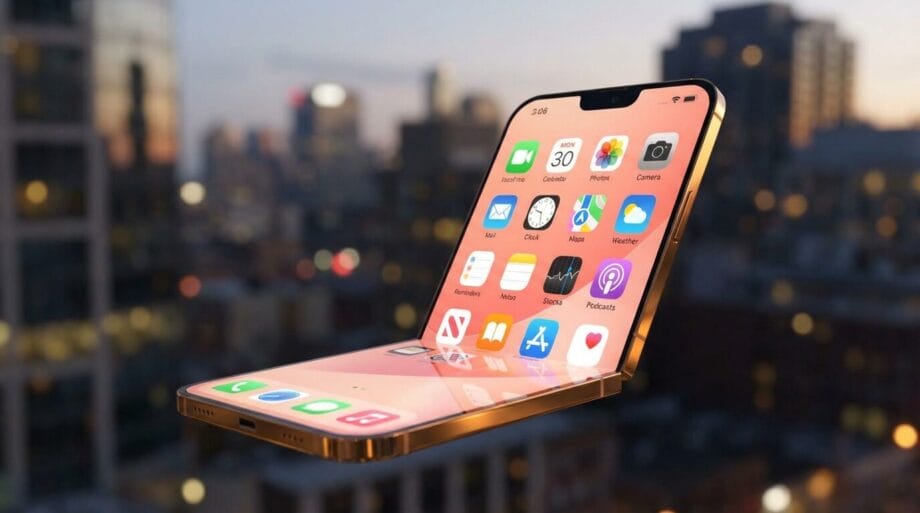
Industry analysts predict that Apple may unveil the foldable iPhone during its customary autumn event scheduled for September.
Nonetheless, the device may not be available to consumers until later in the year, potentially around December.
This interval between announcement and release could offer developers the opportunity to tailor applications suitable for a dual-screen or foldable format.
A similar strategy was observed with the iPhone X, which was announced ahead of time but shipped subsequently.
Apple might adopt this approach once again to ensure seamless integration of hardware and software prior to widespread availability.
Source link: Hindustantimes.com.