Quick Summary
WhatsApp is redefining customer lifecycle marketing with unmatched open rates (94–98%) and rapid engagement, making it far more effective than email or SMS. The right WhatsApp automation tool depends on your lifecycle complexity, scale, and budget.
WANotifier stands out for full-funnel automation, real-time analytics, seamless integrations, and zero markup pricing, making it ideal for scalable, cost-efficient lifecycle campaigns. Respond.io offers enterprise-grade flexibility with deep automation and integrations. AiSensy excels in high-volume broadcasts with smart segmentation. WATI and SleekFlow are better suited for smaller teams or sales-focused workflows. Whatso is a basic entry-level option for simple awareness campaigns.
Success in WhatsApp lifecycle marketing depends on mapping your full customer journey, ensuring compliance (opt-ins, templates, frequency), and choosing a platform that balances automation depth with cost efficiency.
Introduction
Traditional lifecycle marketing operates on channels with structural limitations. Email open rates sit at 18-22%; SMS deliverability is inconsistent; retargeting ads are increasingly ignored due to banner blindness and privacy-driven signal loss.
WhatsApp changes the performance baseline entirely: 94-98% open rates across the customer lifecycle, with 96% opens and 85% read within five minutes of delivery. For lifecycle marketers, consistent reach is essential for every stage of the customer journey. The platforms discussed here are evaluated based on their effectiveness in facilitating lifecycle progression and delivering high-scale broadcasts, starting from the initial contact and continuing through to long-term retention.
Understanding Lifecycle Stages and Message Requirements
Stage 1: Awareness to Interest
Build a qualified audience and establish credibility by educating prospects on specific problems or opportunities. Focus on broad announcements and value-first content, limiting frequency to one or two times a week. Key functionalities include high-volume broadcast capability and robust link tracking.
Stage 2: Interest to Consideration
Nurture leads by demonstrating solutions and overcoming objections with automated drip sequences and behavioral triggers. Track engagement over 14 days; adjust content based on interactions, like redirecting to technical solutions if a contact clicks a case study link.
Stage 3: Consideration to Purchase
Create urgency for final buying decisions with personalized offers or sales team handoffs. Integrate with CRM and route leads effectively, deploying three to five touchpoints in the last 48 hours before a decision deadline.
Stage 4: Post-Purchase Retention and Expansion
Enhance customer lifetime value with automated welcome sequences, product tips, and upgrade prompts. Use purchase event triggers and segment customers by spending history for tailored nurturing.
1. WANotifier
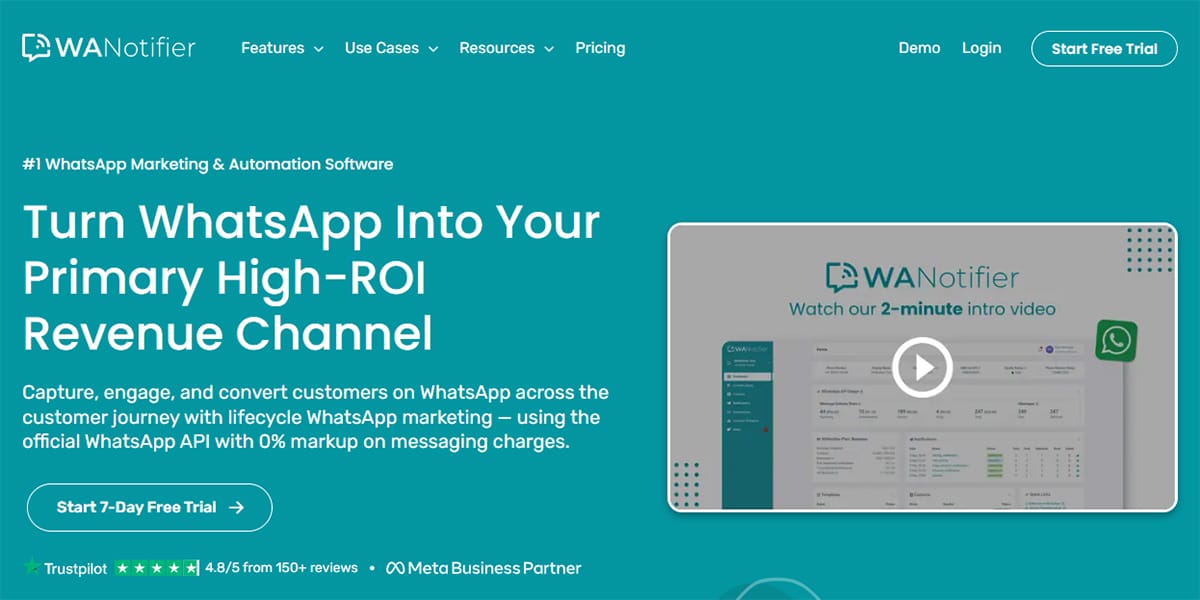
WANotifier is an official Meta Tech Partner and a comprehensive WhatsApp marketing and automation platform built for end-to-end customer lifecycle marketing. It provides everything you need to move prospects from awareness-stage campaigns to consideration-stage nurture sequences, and ultimately guide them toward conversion within WhatsApp.
WANotifier is well-known for its intuitive interface and prompt customer support that allows users to get started with WhatsApp marketing in no time.
Campaign Infrastructure:
WANotifier enables you to send highly targeted WhatsApp campaigns using its built-in CRM. It also provides advanced analytics to monitor and optimize campaign performance.
The platform also offers a shared team inbox that enables you to collaborate with your team on customer conversations (assign chats, invite team members, and view entire conversation history).
Sequence Automation Depth:
WANotifier supports automation at every stage of the customer lifecycle, from first-touch to post-purchase engagement.
It includes essential automations for greetings, out-of-office and delay-in-response messages, and keyword-based auto-replies for FAQs. It also features a no-code chatbot builder that lets you create multi-step sales and support journeys without writing any code.
For ongoing engagement, you get drip sequences that help nurture leads and re-engage inactive prospects over time. Finally, WANotifier also provides subscribe and unsubscribe automation that automatically adds or removes contacts based on their messaging preferences.
Integration Ecosystem:
WANotifier’s integration plugins and REST API enable you to connect your website, lead-gen forms, CRM, e-commerce stores, and third-party marketing tools without requiring custom development.
Lifecycle Cost Model:
One of the biggest advantages of WANotifier is its pricing model. Unlike other WhatsApp automation tools that charge 12% to 25% markup on WhatsApp’s API usage costs, it charges 0% markup and offers transparent pricing.
Note that in February 2026, WhatsApp’s marketing message rate in India is ₹0.86 per message. WANotifier charges this official rate with no added markup, while some competing platforms charge up to ₹1.08 per message after applying their markup. At 100,000 monthly messages, this transparent model saves $2,000 to $4,000 annually compared to platforms charging the industry-standard 12-25% markup.
WANotifier is the strongest choice for lifecycle marketers running multi-stage programs where cost efficiency and automation depth are both non-negotiable.
2. WATI
WATI is effective for small to mid-sized lifecycle programs, providing a user-friendly interface for managing incoming leads. WATI is particularly strong at the consideration stage, where human agents need to intervene in chatbot conversations to move contacts toward a purchase decision.
Broadcast Infrastructure:
WATI’s broadcast tool is reliable but subject to platform-imposed daily limits of 10,000 messages, which can constrain large awareness-stage campaigns. Analytics are available with approximately a 1-hour reporting delay compared to more advanced systems.
Sequence Automation Depth:
WATI offers a drag-and-drop bot builder suited for simple, linear sequences supporting up to 3 levels of branching. Creating complex behavioral trigger logic across multiple lifecycle stages is more challenging on WATI than on enterprise-focused platforms.
Integration Ecosystem:
WATI integrates with common tools, including Shopify and HubSpot, though the depth of data passing for post-purchase lifecycle triggers is limited for businesses requiring custom API work.
Lifecycle Cost Model:
WATI operates on a subscription basis with approximately 20% markup on Meta API fees, making it a predictable choice for steady volume, though total costs rise significantly during high-traffic campaign periods. WATI suits small to mid-sized teams managing steady-volume lifecycle programs where human agent handoff is a core part of the conversion stage.
3. AiSensy
AiSensy‘s Smart Segments feature is a powerful tool for the consideration stage, allowing lifecycle marketers to retarget contacts based on whether they clicked a link in a previous broadcast, creating a more responsive mid-lifecycle experience.
Broadcast Infrastructure:
AiSensy supports up to 25,000 messages a day with solid delivery rates across regions, making it well-suited for broadcast-heavy awareness strategies aimed at reaching a wide audience quickly. Analytics carry an approximate 30-minute reporting delay.
Sequence Automation Depth:
AiSensy’s sequence automation supports up to 5 levels of branching logic and is particularly well-suited for event-based lifecycle programs requiring high-volume, time-sensitive messaging.
Integration Ecosystem:
AiSensy primarily relies on API-based integrations, which offer flexibility but require a more technical setup to achieve a fully automated lifecycle program connected to a complete marketing stack.
Lifecycle Cost Model:
AiSensy’s cost model includes standard industry markups on messages. It is recommended that you calculate the impact of these markups if the lifecycle strategy involves frequent nurture messages, as a 20% markup adds $500 to $1,000 in additional costs for a 50,000-message campaign. AiSensy suits broadcast-heavy lifecycle strategies in price-sensitive markets where smart segmentation and high send volume are the primary requirements.
4. SleekFlow
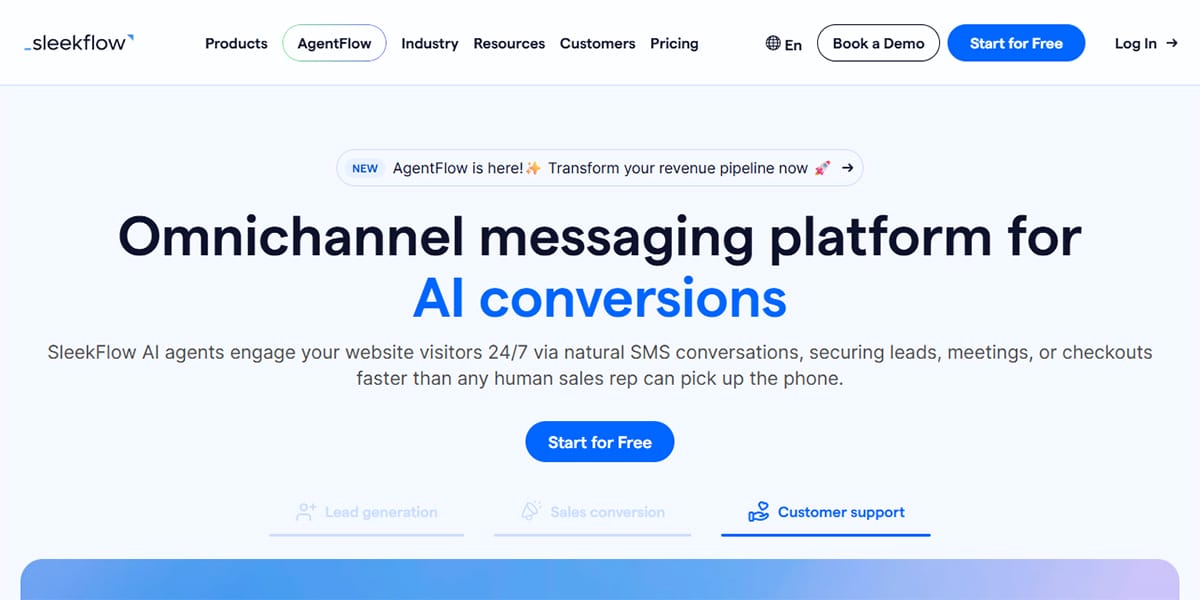
SleekFlow is an omnichannel platform that excels at the purchase conversion stage. SleekFlow’s interface is designed specifically to help sales teams collaborate on closing contacts that were advanced through earlier lifecycle stages via automated broadcasts.
Broadcast Infrastructure:
SleekFlow’s broadcast capabilities are present but secondary to its focus on one-to-one sales conversations, with a daily limit of 5,000 messages suited to targeted rather than mass awareness campaigns. Real-time basic analytics are available.
Sequence Automation Depth:
SleekFlow’s automation is geared toward routing and basic follow-ups, supporting up to 3 levels of branching. Long-term educational nurture sequences across extended lifecycle windows may require supplementation from external tools such as Zapier or Make.
Integration Ecosystem:
SleekFlow offers strong native CRM integrations, making it straightforward to sync WhatsApp lifecycle data with an existing sales stack in real-time, which is a differentiating strength at the conversion stage.
Lifecycle Cost Model:
SleekFlow’s pricing is tiered and based on user or contact count, with a markup on Meta API charges that is a key consideration for high-volume lifecycle programs. SleekFlow suits sales-led organizations where the conversion handoff from automated lifecycle sequences to human agents is the highest-value moment.
5. Respond.io
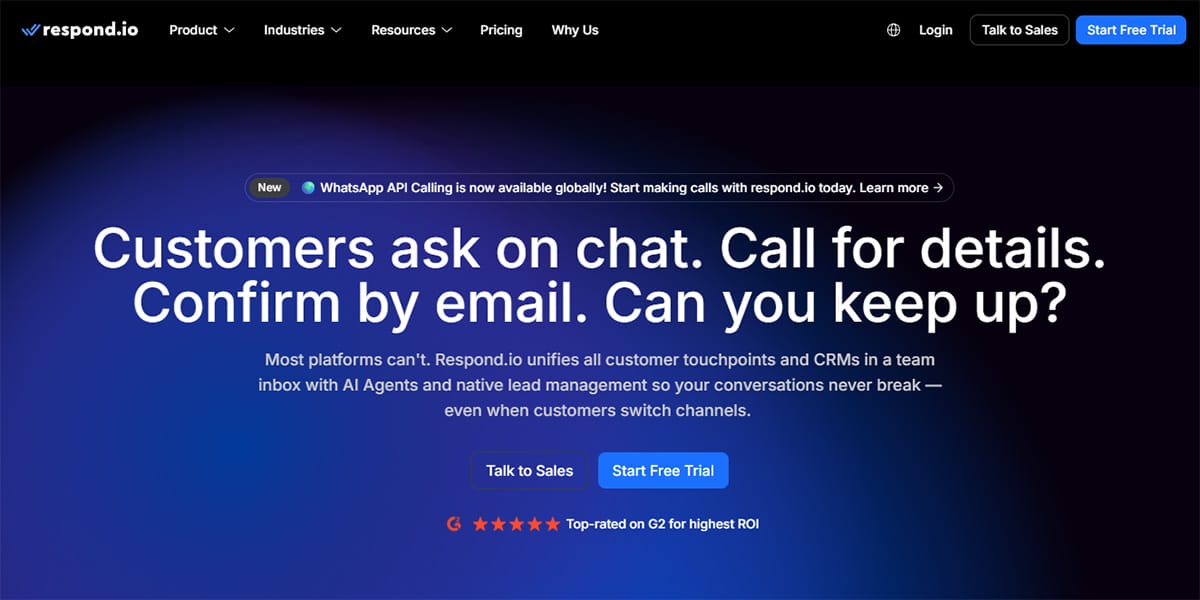
Respond.io is a highly flexible platform configurable for almost any lifecycle structure. Respond.io’s Workflows feature enables extreme customization at every stage, from initial awareness to long-term post-purchase expansion.
Broadcast Infrastructure:
Respond.io imposes no platform broadcast limits, deferring to Meta-defined limits for the registered phone number, and provides comprehensive real-time analytics across every lifecycle campaign.
Sequence Automation Depth:
Respond.io’s automation depth is one of its primary strengths, supporting unlimited branching and complex logic suitable for the most advanced multi-stage lifecycle programs with 15 or more touchpoints.
Integration Ecosystem:
Respond.io features an extensive library of native integrations and a powerful API, positioning it to anchor a complex enterprise marketing tech stack for agency-level lifecycle deployments.
Lifecycle Cost Model:
Respond.io’s pricing is based on active monthly contacts with no direct markup on Meta API charges, though monthly subscription fees are positioned at the higher end of the market. Respond.io suits enterprise-level teams managing highly complex lifecycle programs across multiple audiences or product lines.
6. Whatso
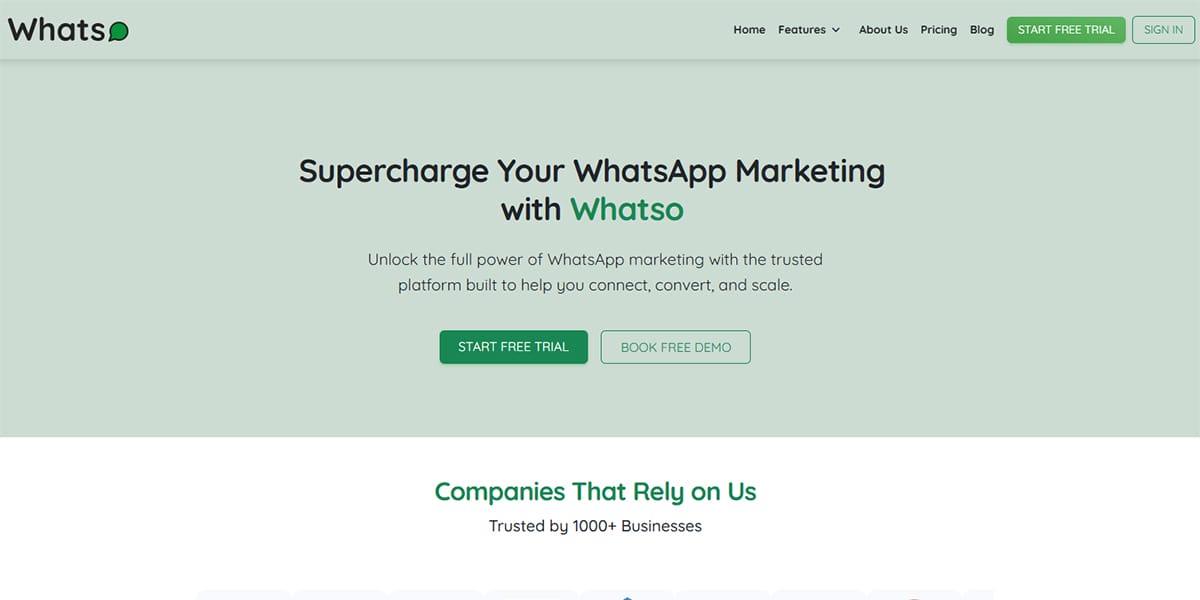
Whatso is a straightforward bulk messaging tool designed for businesses entering WhatsApp marketing for the first time. Its focus is awareness-stage broadcast delivery at a low entry cost, and it is best evaluated as a starting point rather than a scalable lifecycle marketing infrastructure.
Whatso is most effective at the awareness stage for mass announcements where multi-stage lifecycle nurturing is not a primary requirement.
Broadcast Infrastructure:
Whatso’s infrastructure is built for simple bulk messaging with a daily limit of 1,000 messages. Whatso lacks the advanced deliverability optimizations and real-time analytics of official Meta Tech Partner platforms, with delivery rates of 94%-95%.
Sequence Automation Depth:
Whatso’s automation is linear only, capable of a single welcome message or one follow-up, and is not suited for the multi-stage behavioral logic that lifecycle marketing programs require.
Integration Ecosystem:
Whatso’s native integrations are limited; most businesses use Whatso as a standalone communication tool rather than an integrated component of a lifecycle marketing stack.
Lifecycle Cost Model:
Whatso is recognized for its low entry price and is cost-effective for small businesses with simple outreach needs and low message volumes that do not justify a larger subscription. Whatso suits first-time WhatsApp marketers running basic awareness broadcasts where simplicity and low cost matter more than lifecycle automation depth or multi-stage performance at scale.
Lifecycle Automation Performance Metrics
| Platform | Broadcast Limit | Delivery Rate | Sequence Branches | CRM Integration | Analytics Depth |
| WANotifier | No platform limit | 98.5%+ | Unlimited | Native + API | Real-time, comprehensive |
| Respond.io | No platform limit | 97-98% | Unlimited | Extensive native | Real-time, comprehensive |
| AiSensy | 25,000 a day | 97-98% | 5 levels | API only | 30-min delay |
| WATI | 10,000 a day | 96-97% | 3 levels | Limited native | 1-hour delay |
| SleekFlow | 5,000 a day | 95-96% | 3 levels | Native limited | Real-time basic |
| Whatso | 1,000 a day | 94-95% | Linear only | None | Basic tracking |
The Compliant Lifecycle Broadcast Strategy
Maintaining a healthy WhatsApp Business account requires adherence to Meta’s compliance rules at every lifecycle stage.
- Opt-in is mandatory: every recipient must have explicitly consented to receiving messages; a pre-checked box during signup is insufficient, and a proactive opt-in action from the contact is required for full compliance.
- Template requirements: promotional lifecycle broadcasts must use a Meta pre-approved message template. It is recommended that you submit templates 24 to 48 hours before the campaign to allow for the approval process.
- Frequency limits: sending more than one broadcast a day significantly increases spam complaint risk and lowers the phone number’s quality rating across all lifecycle stages.
- Unsubscribe option: always provide a clear opt-out path, such as “Reply STOP to unsubscribe,” to protect long-term sender reputation and prevent account reports to Meta.
The ROI of Zero-Markup Lifecycle Marketing
The cost difference between a 0% markup platform and a markup-based provider compounds across a full lifecycle program. An agency managing a lifecycle campaign in India, sending 100,000 messages a month, incurs a direct Meta cost of approximately ₹86,000 (~$925 USD).
A platform charging a 25% markup adds ₹21,500 (~$230 USD) in pure platform fees on the same volume. Over a year, that equals ₹2,58,000 (~$2750 USD) in avoidable marketing spend that could have funded additional lead acquisition or retention sequences.
By choosing a zero-markup platform such as WANotifier, businesses ensure that cost-per-lifecycle-touchpoint remains as low as possible as program volume scales.
Conclusion

The strategic principle is consistent: map the most complex lifecycle journey first, then select the platform that executes it without expensive technical workarounds. Simple programs with three to five messages can be handled by almost any tool.
Full lifecycle programs spanning awareness through post-purchase expansion, with 15 or more touchpoints and behavioral branching at every stage, require unlimited automation logic, real-time analytics, and zero-markup pricing. WANotifier addresses all requirements, making it the platform most consistently aligned with customer lifecycle marketing performance at scale.


